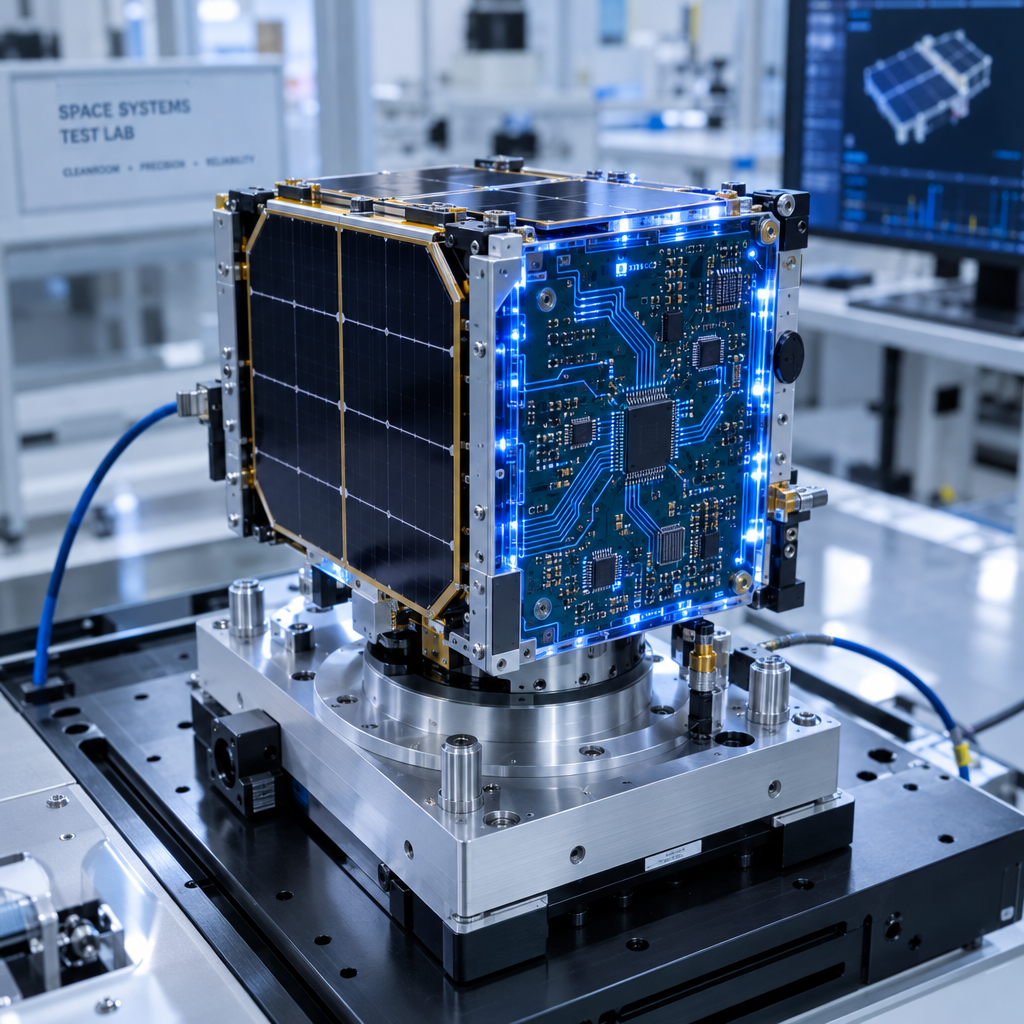
The mission comes as SpaceComputer officials say on-orbit security needs are rising, and not only from a defense standpoint. Satellites today increasingly carry payloads from multiple companies sharing a single platform, and SpaceComputer wants those payloads to share compute and communications resources without exposing themselves to one another.
Space Fabric sits on top of a satellite’s compute module and uses cryptographic methods to provide verifiable proof that compute processes run in orbit were, in fact, run in orbit. The module is intended to deliver stronger security guarantees for space-based data operations and to let multiple digital payloads operate safely on the same in-orbit compute module without being exposed to each other. On the D-Orbit mission, Space Fabric will connect directly to Aptos Orbital’s cEDGE box, communicating over the Iridium satcom network. The flight aims to confirm that data sent from satellites to ground networks was not tampered with in transit. SpaceComputer also hopes to secure intersatellite links in the future.
“With the internet, we arrived at the place where we have HTTPS securing pretty much every website,” SpaceComputer CEO Daniel Bar said. “Space Fabric essentially gives that HTTPS-for-space standard.” Bar added that the technology would eventually be needed broadly across spacecraft. “Every spacecraft that is being launched would actually need something like [it] inside,” he said. “Ultimately it’s like an invisible technology that just enables that degree of security for the entire space internet.”
The D-Orbit flight is one of three missions SpaceComputer has planned for 2027. The others include a mission to GEO on an undisclosed satellite and a mission with Spacemanic that will act as the minimum viable product for the company’s security architecture for compute payloads. Together, the missions aim to bring a new standard for digital security to compute and communications modules in space.
SpaceComputer frames the work around a future in which orbital data centers are commonplace. In that environment, Bar said, the shared-payload architecture will require a security layer to ensure every operator works in a protected silo. The company positions Space Fabric as the foundation for that protection as constellations scale and payload sharing grows.
The three 2027 missions, including the D-Orbit ION flight, the undisclosed GEO mission, and the Spacemanic flight, mark the next milestones for SpaceComputer as it works to establish its security standard in orbit.