
Tag: Astronomy
-
Antarctic IceCube observatory tracks a single neutrino to solve cosmic ray puzzle
In this artistic rendering, a blazar is accelerating protons that produce pions, which produce neutrinos and gamma rays. One neutrino’s path is represented by a blue line passing through Antarctica, while a gamma ray’s path is shown in pink. (IceCube / NASA Illustration) An array of detectors buried under a half-mile-wide stretch of Antarctic ice…
-
NASA delays Webb Space Telescope’s liftoff to 2020, says it may bust $8B budget
An artist’s conception shows the James Webb Space Telescope with its five-layered, foldable sunshield. Issues with the sunshield have contributed to launch delays. (NASA Illustration) NASA is delaying the scheduled launch of its next flagship observatory, the $8.8 billion James Webb Space Telescope, by a year — which may hike its cost so high that Congress…
-

Scientists say they’ve detected birth of the first stars – and perhaps dark matter, too
This artist’s rendering shows the universe’s first, massive, blue stars embedded in gaseous filaments, with the cosmic microwave background just visible at the edges. (NSF Illustration / N.R. Fuller) Astronomers have detected radio waves from a time within 180 million years of the Big Bang, and they say they see signs of what may be…
-
Super-wide-angle Zwicky Transient Facility celebrates ‘first light’ with help from UW
The Zwicky Transient Facility captured this “first light” image on Nov. 1. The Orion Nebula is at lower right. Computers searching these images for quick-changing events are trained to recognize and ignore non-astronomical artifacts such as the vertical lines seen here. (Caltech Optical Observatories) A sky survey that draws upon the data-crunching skills of researchers…
-
UW’s DIRAC Institute gears up for big data from wide-angle telescope surveys
Artwork shows the Large Synoptic Survey Telescope scanning the night sky in Chile. (LSST Illustration) A new data analysis center for what’s expected to be torrents of astronomical imagery is taking shape at the University of Washington. Thanks to contributions from software billionaire Charles Simonyi and other donors, researchers at the Astronomy Department’s DIRAC Institute are…
-
SkyMapper Sighting signs up citizen scientists to hunt for supernovae
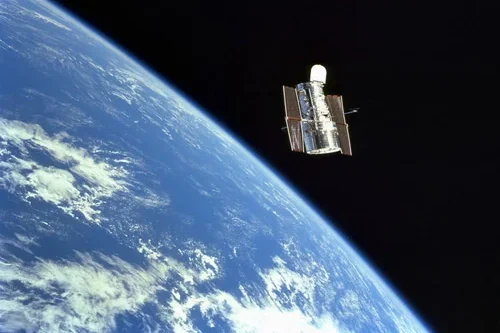
Supernova remnant N 63A shines in a photo captured by the Hubble Space Telescope. (NASA / ESA / HEIC / Hubble Heritage Team / STScI / AURA) Calling all citizen scientists: The Australian National University wants you to join the search for supernovae. Brad Tucker from the ANU Research School of Astronomy and Astrophysics says…
-
Astronomy Rewind sifts through old pictures to find new cosmic perspectives
A photo of the Orion Nebula from the June 1905 issue of Astronomical Journal, at left, can be matched up automatically with WorldWide Telescope’s sky atlas, at right. (AAS / NASA / SAO Astrophysics Data System / WorldWide Telescope) A new project called Astronomy Rewind is recruiting citizen scientists to bring decades-old cosmic images back…
-
Looking for Planet 9 and other far-out objects? Finally, NASA has an app for that
An artist’s conception shows Planet X, a.k.a. Planet Nine. (Carnegie Institution / Robin Dienel) Citizen scientists can join an online hunt for icy worlds, brown dwarfs and other yet-to-be-discovered objects beyond the orbit of Neptune, using a technique that’s not all that different from the method that led to Pluto’s discovery 87 years ago. “Backyard Worlds:…
-
Video: Watch a journey to Jupiter created by amateur astronomers around the globe
The Great Red Spot shows up in this frame from the “Journey to Jupiter” video. (Peter Rosén et al. via YouTube) While NASA’s Juno orbiter is giving Jupiter its close-up, a new video based on more than 1,000 images taken by 91 amateur astronomers provides the wide-angle view. “A Journey to Jupiter” shows how bands of…
-
Astronomers round up the unusual suspects for ‘alien megastructure’ star
This illustration shows a star behind a shattered comet. (Credit: NASA / JPL-Caltech) That mysterious “alien megastructure” star is still a mystery, but the most plausible explanations appear to be dense patches of interstellar gas or dust that just happened to pass in front of the star. That’s the upshot of analyses conducted by the…