
Tag: Black holes
-

Russia to launch science mission probing dark energy
EDITOR’S NOTE: The launch of the Spektr-RG mission has been rescheduled for no earlier than Saturday, June 22, at 1217 GMT (8:17 a.m. EDT). Artist’s illustration of the Spektr-RG observatory in space. Credit: Max Planck Institute for Extraterrestrial Physics A Russian-built satellite hosting an array of X-ray telescopes is awaiting launch Friday from the Baikonur Cosmodrome…
-
Proton rocket, Russian-German astronomy satellite arrive at launch pad
A rocket-transporting railroad car ferried a Proton booster to its launch pad Friday at the Baikonur Cosmodrome in Kazakhstan for final checkouts and testing before the vehicle’s scheduled June 21 liftoff with the Russian-German Spektr-RG X-ray telescope. The Proton rocket began the trip to the Complex 81 launch pad Friday at around 6:30 a.m.…
-
GeekWire Calendar Picks: Picturing black holes; Cloud City Tech Meetup; and classic arcade games
–One of the biggest scientific feats was accomplished this year when a team of astronomers captured an image of a black hole. The achievement reignited our wonder and enthusiasm toward learning about what lies outside our solar system. The techniques used to take that picture will be the subject of Astronomy on Tap’s free monthly…
-
LIGO and Virgo recap smashups, including hints of a black hole eating a neutron star
Scientists work in the LIGO Hanford control room. (Caltech / MIT / LIGO Lab Photo / C. Gray) The science teams for the Laser Interferometer Gravitational-Wave Observatory, or LIGO, and Europe’s Virgo detector today laid out the details of their recent detections, including a crash between neutron stars, three black hole mergers and what may…
-
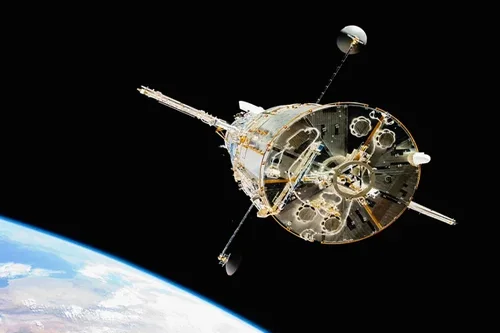
Russia ships X-ray astronomy satellite to launch site
The Spektr-RG astronomy satellite is prepared for shipment to the Baikonur Cosmodrome at an NPO Lavochkin facility in Khimki, Russia, near Moscow. Credit: Roscosmos A Russian X-ray astronomy satellite with major contributions from German and U.S. scientists and instrument developers arrived Thursday at the Baikonur Cosmodrome in Kazakhstan for a launch in June aboard a…
-
Scientists unveil Event Horizon Telescope’s first image of a galaxy’s monster black hole
This image from the Event Horizon Telescope shows the supermassive black hole in the elliptical galaxy M87, surrounded by superheated material. (EHT Collaboration) WASHINGTON, D.C. — Scientists today shared the first picture to show the immediate surroundings of a galaxy’s supermassive black hole, captured by a network of radio telescopes that adds up to what…
-
LIGO and Virgo detectors get in sync for gravitational-wave hunt that’ll last a year
Detector engineers Hugh Radkins (foreground) and Betsy Weaver (background) take up positions inside the vacuum system of the detector at LIGO Hanford Observatory to perform the hardware upgrades required for Advanced LIGO’s third observing run. (LIGO / Caltech / MIT Photo / Jeff Kissel) Physicists won’t be fooling around on April 1 at the Laser…
-
Scientists add four black hole collisions to LIGO’s list, including the biggest so far
An artist’s conception shows two black holes in the process of merging. (LIGO / Caltech / MIT Illustration) Four more mergers of black holes, including the biggest one recorded to date, have been added to a catalog generated by gravitational-wave detectors. The additions were announced today by the teams in charge of the Laser Interferometer…
-

Einstein’s right again: Star obeys relativity as it whirls around Milky Way’s black hole
News Brief: A 26-year-long observational campaign provides clear evidence of the effect that general relativity has on the motion of a star known as S2 as it boomerangs around the supermassive black hole at the center of our Milky Way galaxy. The redshift observations, made in infrared wavelengths using instruments on the European Southern Observatory’s…
-
Antarctic IceCube observatory tracks a single neutrino to solve cosmic ray puzzle
In this artistic rendering, a blazar is accelerating protons that produce pions, which produce neutrinos and gamma rays. One neutrino’s path is represented by a blue line passing through Antarctica, while a gamma ray’s path is shown in pink. (IceCube / NASA Illustration) An array of detectors buried under a half-mile-wide stretch of Antarctic ice…