
Tag: Black holes
-
The way we think of black holes just might be in for a radical change … again
Columbia theoretical physicist Brian Greene delves into Albert Einstein’s theory of relativity in “Light Falls,” a theater piece that made its debut at the World Science Festival. (Greg Kessler Photo / World Science Festival) After decades’ worth of mystery, it feels as if physicists are finally closing in on the nature of black holes, thanks…
-

NASA’s Rossi X-ray probe makes a quiet exit after spending 22 years in orbit
News Brief: A month after the breakup of China’s Tiangong-1 space lab, another spacecraft went to its fiery doom today with far less fanfare. Orbital assessments from the U.S. military’s Joint Space Operations Center indicate that NASA’s Rossi X-Ray Timing Explorer made its atmospheric re-entry at roughly 7:45 a.m. PT (14:45 GMT), more than 22…
-
Gravitational waves get to play a starring role in ‘Black Hole Apocalypse’ on TV
A disk of superheated debris blazes around a black hole. The bright circular pattern is caused by the gravitational lensing of light from the part of the disk that’s behind the black hole. (NOVA via YouTube) Black holes are the collapsed stars of the show on “Black Hole Apocalypse,” a two-hour “NOVA” presentation that’s premiering…
-
Jupiter’s moons, black holes, exoplanets among JWST’s first scientific targets
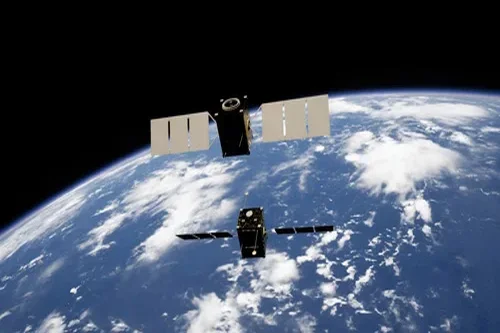
Artist’s concept of the James Webb Space Telescope. Credit: NASA/Northrop Grumman The James Webb Space Telescope should start returning its first scientific results by the end of 2019, and scientists recently announced a slate of observations selected to whet the appetites of astronomers who will use the multibillion-dollar facility well into the 2020s. The observatory’s…
-

Andromeda Galaxy gets photobombed by a couple of monster black holes farther out
A combination of X-ray and optical imagery shows the black hole pair known as J0045+41 glowing amid the much closer stars of the Andromeda Galaxy. (X-ray: NASA / CXC / UW / Dorn-Wallenstein et al. Optical: NASA / ESA / J. Dalcanton et al. and R. Gendler) It turns out that even galaxies can be…
-

LIGO gravitational-wave hunters get lucky and find smallest black hole merger
An artist’s conception shows two black holes in the process of merging. (LIGO / Caltech / MIT Illustration) It took months to figure it out, but the scientists in charge of the Laser Interferometer Gravitational-wave Observatory, or LIGO, have confirmed their observations of the most lightweight black hole merger yet. The latest detection provides further…
-
Europe’s Virgo detector picks up its first gravitational wave and nails down locale
This graphic shows the ripples in spacetime created by gravitational waves emanating from the merger of two black holes. (Max Planck Institute / NCSA Illustration) Astronomers have detected their fourth gravitational wave from the merger of two black holes, but this one marks a new milestone. It’s the first wave picked up by the Virgo…
-
Chinese astronomy satellite placed into orbit by Long March rocket
China’s Long March 4B rocket lifts off Thursday with the Hard X-ray Modulation Telescope. Credit: Xinhua China’s first X-ray astronomy satellite launched Thursday on a mission to survey the Milky Way galaxy for black holes and pulsars, the remnants left behind after a star burns up its nuclear fuel. The Hard X-ray Modulation Telescope will…
-
Black holes crash together and make waves
STORY WRITTEN FOR CBS NEWS & USED WITH PERMISSION Artist’s conception shows two merging black holes similar to those detected by LIGO. The black holes are spinning in a non-aligned fashion, which means they have different orientations relative to the overall orbital motion of the pair. LIGO found hints that at least one black hole in the…
-
This black hole crash expands the frontier for gravitational wave hunters at LIGO
An artist’s conception shows two merging black holes similar to those detected by LIGO. (LIGO / Caltech / MIT / Sonoma State Illustration / Aurore Simonnet) The Laser Interferometer Gravitational-wave Observatory has detected its third confirmed black hole merger, and this one’s a doozy: LIGO’s latest discovery is about 3 billion light-years away, which is more…