
Tag: Cosmology
-
NASA selects mission to probe the history of galaxies
Artist’s concept of the SPHEREx spacecraft in orbit. Credit: Caltech NASA has selected a space telescope named SPHEREx for launch in 2023 on a mission to survey the sky in near-infrared wavelengths, collecting spectral data to study the origins of the universe and ices in our own galaxy that could help seed life on planets.…
-
NASA selects mission to probe the history of galaxies
Artist’s concept of the SPHEREx spacecraft in orbit. Credit: Caltech NASA has selected a space telescope named SPHEREx for launch in 2023 on a mission to survey the sky in near-infrared wavelengths, collecting spectral data to study the origins of the universe and ices in our own galaxy that could help seed life on planets.…
-
The way we think of black holes just might be in for a radical change … again
Columbia theoretical physicist Brian Greene delves into Albert Einstein’s theory of relativity in “Light Falls,” a theater piece that made its debut at the World Science Festival. (Greg Kessler Photo / World Science Festival) After decades’ worth of mystery, it feels as if physicists are finally closing in on the nature of black holes, thanks…
-
How number crunchers could help crack the cosmological mystery of dark energy
Berkeley astrophysicist Saul Perlmutter discusses the implications of the universe’s accelerating expansion at the University of Washington. (GeekWire Photo / Alan Boyle) Big data just might give astronomers a better grip on the answer to one of the biggest questions in physics: Exactly what’s behind the mysterious acceleration in the expansion rate of the universe,…
-
Stephen Hawking’s ‘Final Theory’ goes into publication – but it’s not the final word
Belgian physicist Thomas Hertog meets with Stephen Hawking in 2015. (KU Leuven / Facebook) Weeks after the death of British physicist Stephen Hawking, his final research paper on the nature of our universe and its place in the wider multiverse was published today in the Journal of High-Energy Physics. Now it’s up to his co-author,…
-
Gaia probe maps the comings and goings of galaxy’s stars – and scientists go gaga
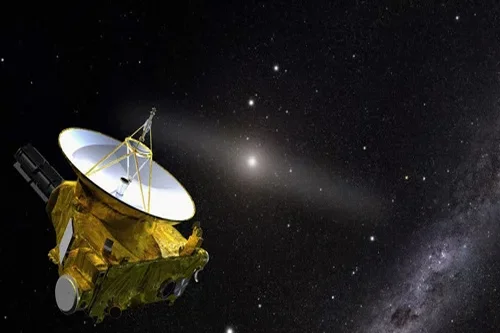
A newly released image from the European Space Agency’s Gaia star-mapping mission shows a full-sky view of our Milky Way galaxy and neighboring galaxies in color. (ESA / Gaia / DPAC) The European Space Agency has released the world’s most exhaustive star catalog, pinpointing the positions of nearly 1.7 billion stars. Today’s release, based on…
-
Even after death, Stephen Hawking stirs up fresh cosmological tiffs and tributes
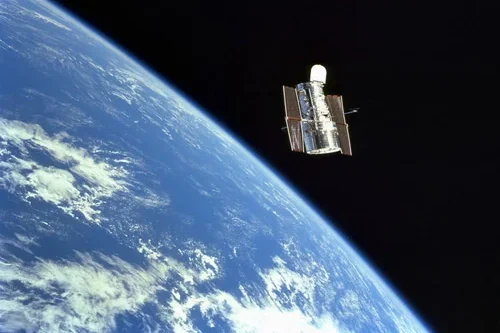
Physicist Stephen Hawking visited the Large Hadron Collider’s underground tunnel in 2013. (CERN Photo / Laurent Egli) The ashes of the late British physicist Stephen Hawking will get a fitting resting place in Westminster Abbey, near the graves of Isaac Newton and Charles Darwin. But you could argue that the true monuments to Hawking’s memory…
-
Scientists say they’ve detected birth of the first stars – and perhaps dark matter, too
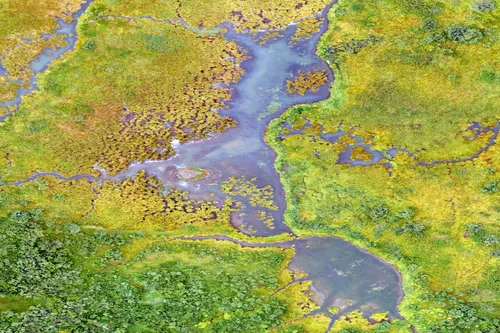
This artist’s rendering shows the universe’s first, massive, blue stars embedded in gaseous filaments, with the cosmic microwave background just visible at the edges. (NSF Illustration / N.R. Fuller) Astronomers have detected radio waves from a time within 180 million years of the Big Bang, and they say they see signs of what may be…
-
Jupiter’s moons, black holes, exoplanets among JWST’s first scientific targets
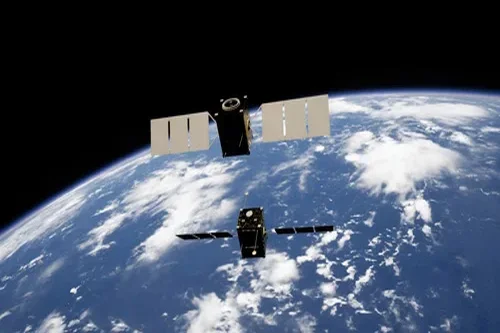
Artist’s concept of the James Webb Space Telescope. Credit: NASA/Northrop Grumman The James Webb Space Telescope should start returning its first scientific results by the end of 2019, and scientists recently announced a slate of observations selected to whet the appetites of astronomers who will use the multibillion-dollar facility well into the 2020s. The observatory’s…
-
Breakthrough Prize ceremony shines glitzy scientific spotlight on cosmic mappers
A color-coded projection map of the full sky shows temperature variations as measured by NASA’s Wilkinson Microwave Anisotropy Probe. (NASA Photo) This year’s Breakthrough Prizes, cast as the “Oscars of Science,” are going to genetic engineers, disease fighters, math whizzes — and the scientists on the cosmos-mapping team behind the Wilkinson Microwave Anisotropy Probe, or WMAP.…