
Tag: CSA
-
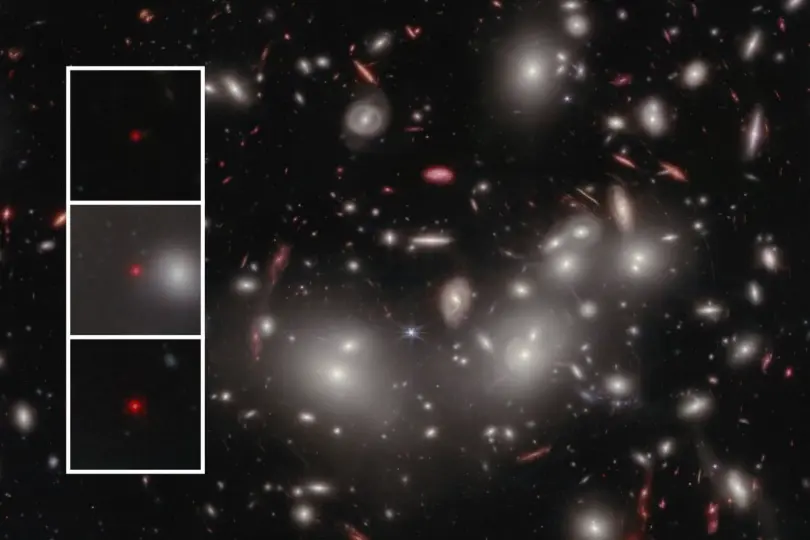
Ancient black hole sheds new light on Webb’s Little Red Dots
Using the joint NASA/European Space Agency/Canadian Space Agency James Webb Space Telescope, an international team of astronomers has performed the first direct measurement of a supermassive black hole in the early universe. A pair of recently published studies investigating this black hole provide new insight into the nature of the elusive little red dots (LRD),…
-

MDA Space advances Gateway robotic arm despite funding uncertainty
Will MDA Space complete the Gateway robotic arm amid funding uncertainty? MDA Space is pressing forward with development of the Canadarm3 robotic system for NASA’s lunar Gateway station while navigating ongoing discussions with the Canadian Space Agency about program continuity and funding levels. The Toronto-based contractor confirmed work continues on the 8.5-meter manipulator system despite…
-
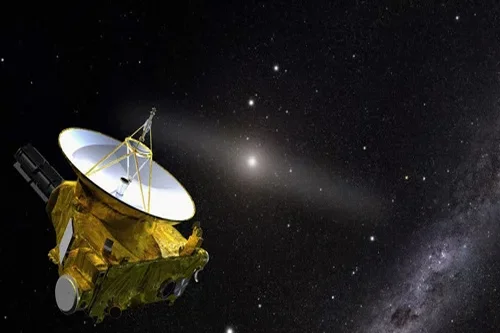
Artemis II returns humanity to the Moon with launch on Wednesday evening
At 23:35 UTC on Dec. 16, 1972, the Apollo 17 command module, America, successfully completed its trans-Earth injection burn, sending it and its crew of NASA astronauts Gene Cernan, Harrison Schmitt, and Ronald Evans on a return trajectory back to Earth. The moment marked the final time a crewed Apollo spacecraft was in orbit around…
-
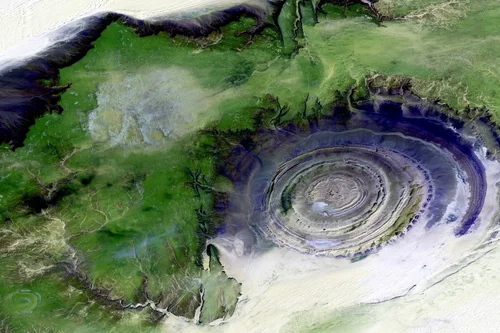
NASA readies unique science experiments and tech demonstrations for Artemis II crew
Artemis II, the next mission in NASA’s Artemis program to explore the Moon, is scheduled to launch from Florida within the coming weeks. The mission will be the first crewed mission to the vicinity of the Moon since 1972, with the four-person crew expected to travel farther than any other human mission in spaceflight history.…
-
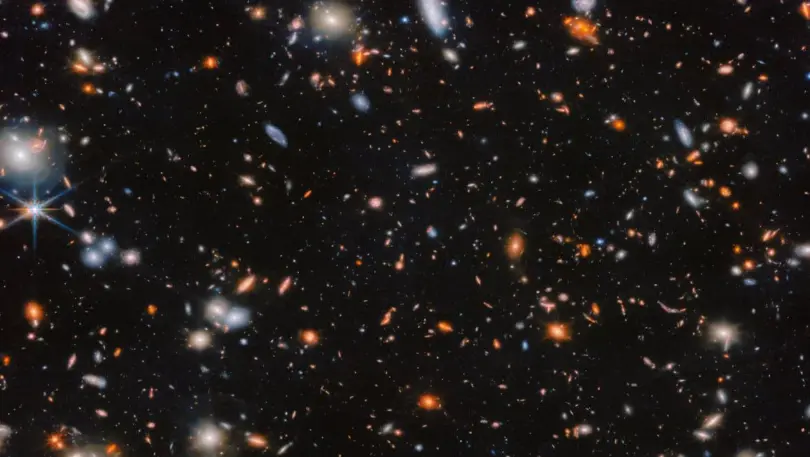
Webb discovers rapidly growing black hole in the very early universe
Using the joint NASA/European Space Agency/Canadian Space Agency James Webb Space Telescope, a group of astronomers has discovered a supermassive black hole within the distant galaxy CANUCS-LRD-z8.6. The galaxy is among the farthest ever observed, with Webb imaging it as it was just 570 million years after the Big Bang. CANUCS-LRD-z8.6 is a part of…
-

Webb investigates protoplanetary disk in extreme detail, observes glowing interstellar material
The joint NASA, European Space Agency (ESA), and Canadian Space Agency (CSA) James Webb Space Telescope, located at the Sun-Earth Lagrange Point 2, recently utilized its extraordinary suite of infrared instruments to investigate and image a protoplanetary disk around a newborn star. Webb’s observations provided scientists with unprecedented views of the disk, material jets, and…
-
Webb identifies surprising carbon-rich ingredients around young star
Using the joint NASA, European Space Agency (ESA), and Canadian Space Agency (CSA) James Webb Space Telescope, a team of international scientists studied a disk of cosmic material surrounding an extremely low-mass star. The results from the investigation show the richest hydrocarbon chemistry ever observed within a protoplanetary disk, which is a disk of gas,…
-
Using Hubble and Webb, scientists investigate galaxies responsible for the reionization of the universe
Utilizing the infrared-sensitive instruments of the joint NASA, European Space Agency, and Canadian Space Agency James Webb Space Telescope, as well as observations from the Hubble Space Telescope, scientists recently collected the first spectroscopic observations of some of the oldest galaxies in the universe, some being born during the first one billion years of the…
-
Webb discovers neutron star within supernova remnant
Using the joint NASA, European Space Agency, and Canadian Space Agency James Webb Space Telescope (JWST), an international team of astronomers has found evidence of a neutron star in the remnants of a recent supernova. The supernova, called SN 1987A, was first observed on Feb. 24, 1987, and occurred 160,000 light-years from Earth in the…
-
Webb discovers potential aurorae on brown dwarf
Silently floating through the universe are cosmic objects that are both too large to be planets and too small to be stars. Called brown dwarfs, these substellar objects are among the most captivating objects in the universe, and their low surface temperatures mean that most of the light they emit is infrared and thus can…