
Tag: Heliophysics
-
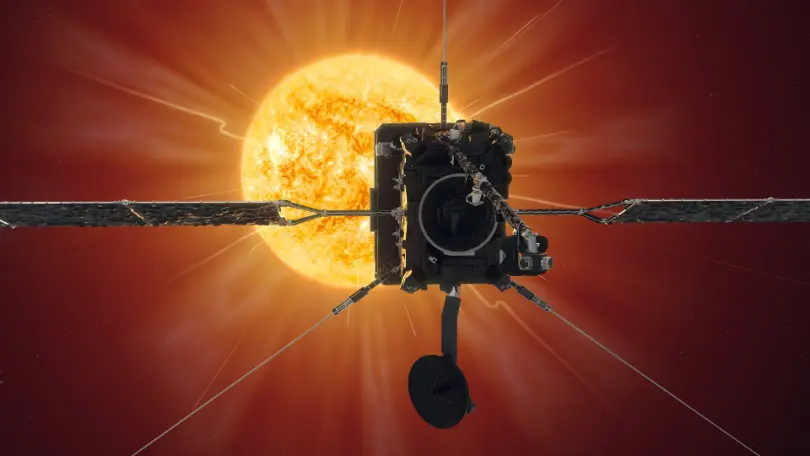
Solar Orbiter discovers plasma jets that could fuel the production of solar wind
Recently, the joint European Space Agency (ESA)/NASA Solar Orbiter spacecraft discovered an array of tiny jets of material being ejected from the Sun’s outer atmosphere. Ejecting plasma at 100 kilometers per second, the jets last for just 20 to 100 seconds, and could be the source of solar wind. Solar wind is made up of…
-
Data from ESA’s Gaia mission reveals our Sun’s future and past
On June 13, the third major data release from the European Space Agency’s (ESA) Gaia mission revealed details about the past and future of our solar system’s star, the Sun, by using data collected by Gaia on stars of similar mass and composition to our Sun. Gaia is a star mapping mission and collects massive…
-
Solar Orbiter successfully completes historic close pass of the Sun
On March 26, 2022, the joint European Space Agency (ESA) and NASA Solar Orbiter spacecraft successfully completed its first close pass through the Sun’s corona, bringing the spacecraft’s specially-designed collection of instruments closer to the Sun than ever before. During the close pass, called perihelion, all ten of Solar Orbiter’s instruments operated simultaneously, working together…
-

Starlink loss highlights current space weather prediction capabilities, coming advancements
On February 8, 2022, SpaceX announced the loss of around 40 of the 49 Starlink satellites launched on the Starlink Group 4-7 mission from LC-39A on February 3. For spacecraft initially orbiting at low altitudes, as the Starlinks did at the time upon deployment, many factors can lead to a craft not reaching its final…
-
Starlink loss highlights current space weather prediction capabilities, coming advancements
On February 8, 2022, SpaceX announced the loss of around 40 of the 49 Starlink satellites launched on the Starlink Group 4-7 mission from LC-39A on February 3. For spacecraft initially orbiting at low altitudes, as the Starlinks did at the time upon deployment, many factors can lead to a craft not reaching its final…
-
Parker Solar Probe pulls back the veil on Venus’s night side
When flying past Venus in July 2020, Parker Solar Probe’s WISPR instrument, short for Wide-field Imager for Parker Solar Probe, detected a bright rim around the edge of the planet that may be nightglow — light emitted by oxygen atoms high in the atmosphere that recombine into molecules in the nightside. The prominent dark feature…
-

NASA selects SpaceX to launch mission studying interstellar space
This illustration shows the Interstellar Mapping and Acceleration Probe observing signals from the interaction of the solar wind with the winds of other stars. Credit: NASA NASA has awarded SpaceX a $109 million contract to launch the Interstellar Mapping and Acceleration Probe, a NOAA space weather observatory, a robotic scout to map water on the moon,…
-
Carrington Event still provides warning of Sun’s potential 161 years later
On 28 August 1859, a series of sunspots began to form on the surface of our stellar parent. The sunspots quickly tangled the Sun’s magnetic field lines in their area and produced bright, observed solar flares and one — likely two — Coronal Mass Ejections, one major. The massive solar storm impacted our planet on…
-
Carrington Event still provides warning of Sun’s potential 161 years later
On 28 August 1859, a series of sunspots began to form on the surface of our stellar parent. The sunspots quickly tangled the Sun’s magnetic field lines in their area and produced bright, observed solar flares and one — likely two — Coronal Mass Ejections, one major. The massive solar storm impacted our planet on…
-
Solar Orbiter reveals closest pictures, new science of the Sun
The European Space Agency (ESA) and NASA have released the first pictures and preliminary findings captured by the Solar Orbiter, including intriguing glimpses of “campfires” near the solar surface that could shed new light on one of the biggest solar mysteries scientists are eager to learn more about. Numerous other scientific areas of intrigue were…