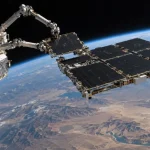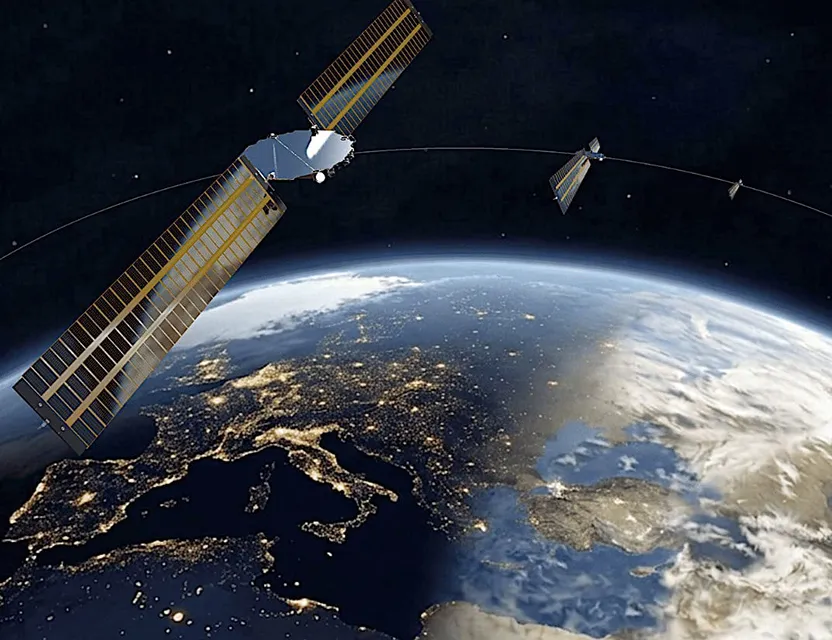
Belgian satellite manufacturer Aerospacelab said September 21 that it had reached profitability in early 2026, before winning a €2.4 billion ($2.75 billion) contract to design, manufacture and deliver 264 low Earth orbit satellites for the European Union’s IRIS² secure communications constellation.
The contract, announced September 10, gives Aerospacelab responsibility for approximately 76% of the 348 spacecraft planned for IRIS². It is the largest disclosed satellite manufacturing allocation under the program and represents a major industrial step for a company founded in 2018.
Aerospacelab will supply the fully integrated satellites through Eutelsat, which leads the low Earth orbit segment of the SpaceRISE consortium. SpaceRISE—comprising Eutelsat, SES and Hispasat—was selected to develop and operate IRIS² under a concession agreement with the European Union.
IRIS², short for Infrastructure for Resilience, Interconnectivity and Security by Satellite, is intended to provide secure and resilient connectivity for European governments, defense and security organizations, institutions, businesses and commercial users. The system is expected to begin providing services around 2030.
At the announced contract value, Aerospacelab’s award is equivalent to approximately €9.1 million per satellite, although the total covers integrated spacecraft delivery rather than only the underlying satellite platforms.
Profitability Precedes Large-Scale Production Ramp
Aerospacelab’s move into profitability follows a loss-making period in which the company invested in products, production infrastructure and manufacturing capacity.
The company reported a net loss of €17.75 million on €14.6 million in revenue for fiscal 2025. Chief Executive Benoît Deper attributed the turnaround in early 2026 to growth in subsystem contracts and deliveries of complete spacecraft in relatively small volumes to government and commercial customers.
Reaching profitability before recognizing revenue from the IRIS² award is important because the new contract will require substantial working capital, advance procurement and manufacturing investment. Satellite constellation contracts typically demand spending on components, tooling, personnel, test equipment and supplier capacity well before all contractual payments are received.
The company’s existing business spans satellite subsystems, standardized small-satellite buses, customized spacecraft and associated operational services. That mix provides revenue from both component-level sales and complete missions while Aerospacelab prepares for the much larger IRIS² production campaign.
Belgian Megafactory Targets 500 Satellites a Year
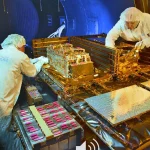
Aerospacelab is building its IRIS² production capability around a 20,000-square-meter manufacturing facility in Belgium. The plant began pilot production in early 2026 and is scheduled to be fully completed in 2027.
The company says the facility will be capable of producing up to 500 satellites annually across spacecraft ranging from approximately 15 kilograms to 1,000 kilograms. Its production system is designed to support small satellites and larger platforms on parallel integration lines.
Aerospacelab is applying serialized manufacturing methods associated with the automotive industry, including standardized processes and greater use of automated assembly. For IRIS², the effectiveness of that approach will depend not only on nominal factory capacity but also on component availability, configuration control, repeatable environmental testing and the speed at which completed spacecraft can pass acceptance reviews.
Producing 264 integrated satellites will therefore test the company’s ability to convert planned factory throughput into flight-ready hardware. Maintaining common platform designs can reduce recurring engineering work, but secure government communications missions still require rigorous verification, supply-chain traceability and coordination with payload, ground-system and launch providers.
Tooling, production-line commissioning and supplier expansion are expected to continue through the factory’s scheduled completion in 2027. Those preparations must support IRIS² delivery milestones ahead of the constellation’s planned entry into service around 2030.
The award also reflects a broader change in Europe’s satellite manufacturing sector. IRIS² work is being distributed among established aerospace groups and newer industrial suppliers, with Airbus, Thales Alenia Space, OHB and Aerospacelab taking roles across different spacecraft, platform and payload elements.
For Aerospacelab, profitability reduces—but does not eliminate—the financial and operational risks of moving from low-volume spacecraft production to a sovereign constellation program measured in hundreds of satellites. The next major test will be the completion and qualification of its expanded factory, followed by a sustained production ramp capable of meeting the IRIS² delivery schedule.