SpaceX moved the Super Heavy booster assigned to Starship Flight 14 to the launch pad at Starbase, Texas, on September 21, advancing preparations for the vehicle’s first orbital mission. Targeted for September 28 pending regulatory approval, the flight is expected to complete six Earth orbits and deploy 26 operational Starlink V3 satellites.
The booster, identified as Booster 21, will soon be paired with the Ship 41 upper stage on the launch mount. The fully stacked Starship stands about 124 meters tall, combining a 33-engine Super Heavy first stage with a 52-meter upper stage powered by six Raptor 3 engines.
SpaceX has already completed major propulsion tests for both stages. Ship 41 performed a single-engine static fire on August 19 to demonstrate the type of burn required to leave orbit, followed by a roughly 60-second test involving all six engines on August 20. Booster 21 completed a full-duration static fire of all 33 engines on August 28.
Flight 14 is scheduled to launch during a 75-minute window opening at 7:15 a.m. local time in Texas on September 28. SpaceX originally targeted September 22 but delayed the mission by six days without publicly identifying a reason.

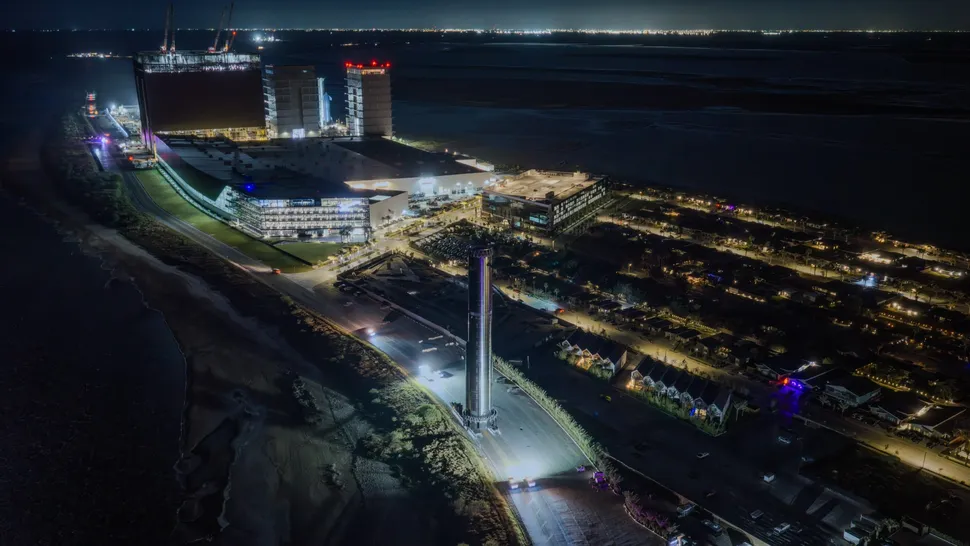
Super Heavy on its way to its launch mount at Starbase. (Image credit: SpaceX)
Six Orbits and the First Operational Starlink V3 Deployment
Although Starship has flown 13 integrated test missions since its April 2023 debut, each followed a suborbital trajectory. Flight 14 is designed to place Ship 41 into low Earth orbit at an altitude of about 275 km, beginning a nearly 10-hour mission that will take the spacecraft around Earth approximately six times.
Ship 41 will deploy 26 Starlink V3 satellites during the orbital phase. The mission will mark the first time SpaceX has placed operational V3 spacecraft into the Starlink constellation and represents an important transition for Starship from an experimental flight vehicle toward a payload-carrying launch system.
Flight 13 deployed 20 Starlink V3 satellites, but the spacecraft were released on a suborbital trajectory and subsequently reentered. That mission allowed SpaceX to test the satellite deployment mechanism without leaving operational payloads in orbit.
Starlink V3 satellites are larger and more capable than the spacecraft currently forming the broadband network, making Starship’s payload volume and lift capacity central to their planned deployment. SpaceX has said the new generation is intended to increase network capacity, connection speeds and reliability.
Three of the Flight 14 satellites will also carry cameras positioned to photograph Ship 41’s heat shield after deployment. The images are expected to provide engineering data on tile condition before atmospheric reentry, supplementing onboard telemetry and postflight observations.

Super Heavy on the launch mount. (Image credit: SpaceX)
Ocean Landings Prioritize Orbital Objectives
Super Heavy will not attempt a return to the Starbase launch site on Flight 14. Instead, Booster 21 is expected to perform a controlled descent and splash down in the Gulf of Mexico about seven minutes after liftoff.
Ship 41 will conduct a deorbit maneuver after completing its planned orbits and target a Pacific Ocean splashdown west of Chile around 10 hours after launch. The location is new for Starship; previous suborbital missions descended over the Indian Ocean west of Australia after flights lasting approximately 65 minutes.
SpaceX will therefore make no attempt to catch either stage with the launch tower’s mechanical arms. The company has caught Super Heavy three times and reflown two recovered boosters, but it has not yet attempted to catch a Starship upper stage or recover a Version 3 Super Heavy at the tower.
Deferring those recovery objectives allows Flight 14 to concentrate on orbital insertion, sustained operations in low Earth orbit, payload deployment, the deorbit burn and controlled atmospheric return. These are prerequisites for routine satellite missions and for the more complex in-space operations planned for Starship.
Orbital propellant transfer remains another major milestone. Refueling multiple Starships in orbit is fundamental to SpaceX’s planned lunar and Mars missions because a lunar lander or deep-space vehicle cannot carry all the propellant required for those missions in a single launch. NASA has selected a Starship-derived lunar lander for its Artemis program, making progress in orbital operations, cryogenic propellant management and upper-stage recovery important beyond SpaceX’s commercial Starlink deployment plans.
If Flight 14 reaches orbit and completes its deployment sequence, the mission will move Starship into a new development phase focused increasingly on operational payload delivery, orbital refueling and recovery of both stages.