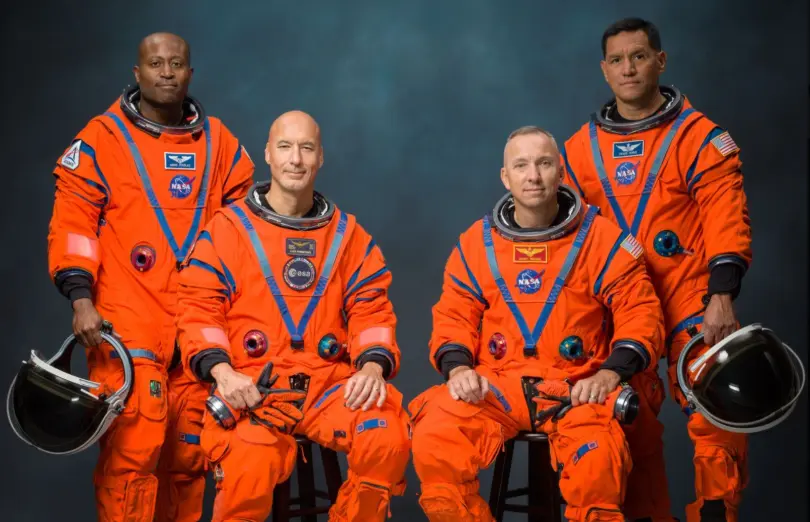
NASA has assigned the four astronauts who will fly the agency’s next crewed Space Launch System mission, an Earth-orbit test flight designed to evaluate one or both human-rated lunar landers before Artemis III.
Commanding the mission will be NASA astronaut Randy Bresnik, with ESA astronaut Luca Parmitano serving as pilot. NASA astronauts Frank Rubio and Andre Douglas round out the crew as Mission Specialists 1 and 2, respectively.
The flight, known internally as Artemis III-Prime or a similar designation in current planning, will launch aboard the SLS rocket and Orion spacecraft into low-Earth orbit.
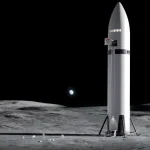
There, the crew will conduct rendezvous, docking, and operations with one or both lander vehicles—likely including a stock Version 3 Starship with a docking adapter, and Blue Origin’s Blue Moon MK2 demonstrator—gathering critical data to de-risk the subsequent lunar landing mission.
Commander: Randy Bresnik
Randy Bresnik, a U.S. Marine Corps Colonel, has flown twice before—once on the Space Shuttle and once on Soyuz.
spaceflight
(adsbygoogle = window.adsbygoogle || []).push({});
He launched aboard STS-129 in November 2009 on Atlantis, performing two spacewalks in support of ISS construction.

Randy Bresnik, far right in the STS-129 crew portrait.
In 2017 he returned to the station on Soyuz MS-05 for a long-duration increment, conducting three more EVAs focused on Canadarm2 maintenance and other station upkeep, for a career total of 32 hours outside.
Bresnik logged over 7,000 flight hours in 95 different aircraft types, including combat missions in the F/A-18 Hornet, and served as an instructor on the F/A-18, T-38, and T-2.
His deep piloting background and station assembly experience make him well-suited for the piloting-intensive objectives of the Artemis III test flight.
Pilot: Luca Parmitano
Pilot Luca Parmitano, an Italian Air Force Colonel and European Space Agency astronaut, has flown two long-duration missions to the ISS.
Selected in 2009, he first flew aboard Soyuz TMA-09M in 2013. That mission is remembered for a harrowing spacesuit anomaly during his second EVA when his helmet began filling with water due to a clogged filter in the cooling system.
Parmitano and crewmate Chris Cassidy safely terminated the spacewalk and returned to the airlock despite water reaching his eyes, nose, and mouth, cutting off communications.
 Undeterred, Parmitano returned to the station in 2019 aboard Soyuz MS-13 and completed four additional EVAs, bringing his career total to six.
A highly experienced test pilot with over 2,000 hours in more than 20 types of fixed- and rotary-wing aircraft (and flight experience in over 40), Parmitano’s piloting expertise will be particularly relevant for evaluating Orion’s handling qualities during rendezvous and proximity operations with the lander vehicles.
Mission Specialist 1: Frank Rubio
Frank Rubio brings extensive spaceflight and operational experience to the commander’s seat. A U.S. Army Colonel and former helicopter pilot with more than 1,100 flight hours—including 600 combat hours in Bosnia, Iraq, and Afghanistan—Rubio was selected by NASA in 2017.
He previously flew a record-setting mission to the International Space Station aboard Soyuz MS-22, launching in September 2022.
After a coolant leak forced the abandonment of the original Soyuz, Rubio and his crewmates spent 371 days in orbit, the longest single spaceflight by an American astronaut. During that mission, he also accumulated more than 21 hours of extravehicular activity (EVA) time.
That long-duration endurance and EVA experience will be valuable for the extended Orion flight and complex operations planned for this test mission.
Mission Specialist 2: Andre Douglas
Andre Douglas, a U.S. Coast Guard Commander, is the only member of the crew without a prior spaceflight, but he is intimately familiar with the Artemis program.
Selected as a NASA astronaut in December 2021, Douglas served as backup crew for Artemis II and was part of the closeout crew that strapped the prime crew into Orion for that mission’s launch.
A Miami native, Douglas’s operational experience and recent intensive training with the Artemis II prime crew position him strongly for the demanding test objectives of this precursor flight.
Mission Status and Timeline
NASA provided a status update on the primary Artemis III lunar landing mission during the crew announcement event.
The agency continues to work toward a 2028 target for the first crewed lunar landing of the Artemis program, though exact dates remain under review as lander development and SLS/Orion flight schedules mature.
The upcoming crewed Earth-orbit test flight will provide essential operational data on lander performance in the actual environment the Artemis III crew will encounter, helping ensure a safe and successful return to the lunar surface.
(Lead Image via Ryan Caton graphic of the Artemis III crew).