China and Europe released the first images and scientific data from their joint SMILE satellite on September 30, 2026, marking its transition into science operations. The observations include panoramic ultraviolet views of the northern auroral oval, X-ray calibration images, and magnetic-field and ion measurements, advancing a mission designed to show how the solar wind interacts with Earth’s magnetic shield.
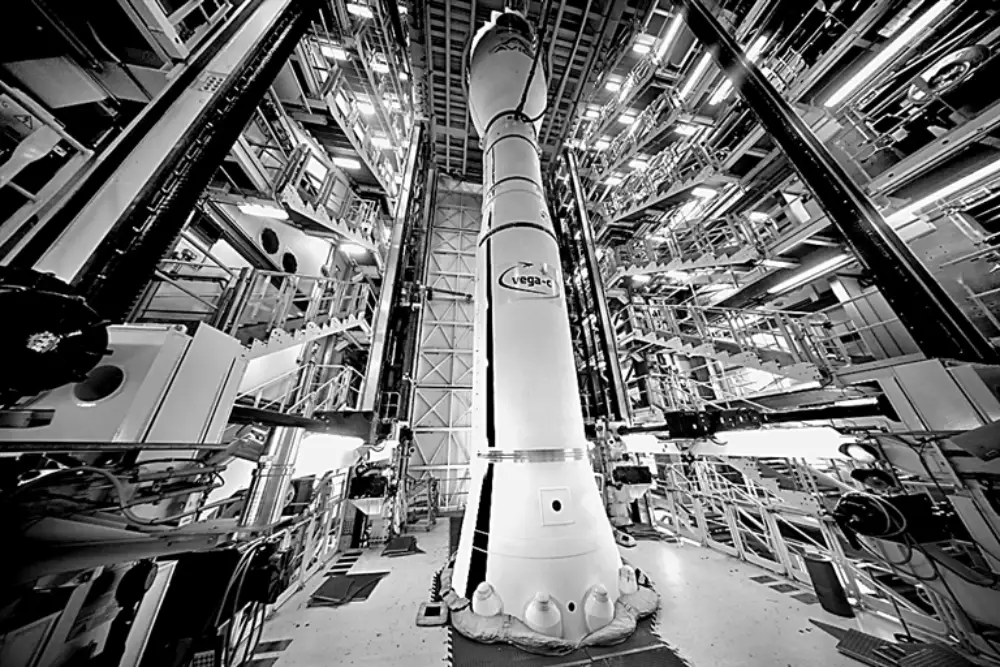
The Solar wind Magnetosphere Ionosphere Link Explorer, developed jointly by the Chinese Academy of Sciences (CAS) and the European Space Agency (ESA), launched aboard a Vega-C rocket from Kourou, French Guiana, on May 19. It reached its science orbit on June 20, following approximately a month of orbital maneuvers.
SMILE’s central objective is to connect changes at the outer boundary of Earth’s magnetosphere with the response of the polar ionosphere. Combining remote imaging with measurements taken along the spacecraft’s flight path could help scientists distinguish local disturbances from changes affecting the wider system.
First observations establish instrument performance
ESA declared SMILE ready for science operations on September 23, following commissioning activities that included deploying mechanisms, activating instruments and checking spacecraft-to-ground communications.
The ultraviolet aurora imager, UVI, has returned footage showing an auroral substorm on July 24. ESA described it as the first camera since 2008 to capture the full northern auroral oval in ultraviolet light, with continuous observing periods reaching approximately 45 hours.

Auroral oval captured by UVI on August 4, 2026 (raw, unprocessed image). Credit: Chinese Academy of Sciences / European Space Agency.
The Soft X-ray Imager, SXI, returned test images of supernova remnants to verify its performance. Those images should be distinguished from the mission’s intended observations of Earth’s magnetospheric boundary. In its September update, ESA reported that unwanted light affected Earth-directed observations and that teams were adjusting instrument settings and implementing software changes.

SMILE’s first X-ray image: a supernova remnant in the Large Magellanic Cloud. Credit: European Space Agency / Chinese Academy of Sciences.
The magnetometer and Light Ion Analyser provide complementary measurements of magnetic fields and the surrounding plasma. Together, the four instruments are intended to link large-scale images with the physical conditions encountered by the spacecraft.
Making a largely invisible boundary observable
The solar wind is a continuous flow of charged particles carrying the Sun’s magnetic field through interplanetary space. At Earth, it compresses the sunward magnetosphere and stretches the opposite side into a long magnetic tail.
Upstream of the magnetosphere, the solar wind crosses a bow shock, where the flow slows and heats. It then passes through the magnetosheath before encountering the magnetopause, the boundary separating the solar wind plasma from the region dominated by Earth’s magnetic field.
Traditional space physics missions measure particles and fields directly at their locations. These observations are essential, but a spacecraft crossing a moving boundary cannot independently establish whether the measured change represents a local fluctuation or a broader reconfiguration.
SMILE adds a remote perspective through solar wind charge exchange. Highly charged heavy ions in the solar wind capture electrons from neutral atoms in Earth’s extended outer atmosphere. As those electrons settle into lower energy states, they emit soft X-rays.

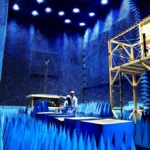
The SMILE satellite undergoing pre-shipment testing at ESA’s facility in the Netherlands. Image courtesy of the SMILE science team.
By measuring this faint emission, SXI is designed to trace structures in the magnetosheath and polar cusps and help determine the location and movement of the magnetopause. The instrument observes radiation associated with the interaction region rather than photographing magnetic field lines directly.
UVI observes the northern auroral oval, where particles depositing energy in the upper atmosphere produce ultraviolet emissions. Comparing these images with X-ray observations and local plasma measurements should help researchers investigate how energy entering the magnetosphere reaches the polar atmosphere.
Connecting global observations with spacecraft operations
The mission addresses a central difficulty in space weather research: similar solar wind disturbances can produce different responses at Earth. The orientation of the interplanetary magnetic field, existing magnetospheric conditions and magnetic reconnection all influence how efficiently energy enters the system.
Simultaneous observations could help scientists test models of those processes, including the development of geomagnetic storms and auroral substorms. SMILE is a research mission; improvements in operational forecasting will depend on translating its findings into validated models.
That work has practical relevance for satellite operators. Disturbed space weather can affect spacecraft electronics and charging, disrupt radio propagation and navigation, and heat the upper atmosphere, increasing drag on low Earth orbit satellites.
With commissioning complete, SMILE’s next scientific task is to build coordinated records of solar wind conditions, magnetospheric boundary changes and auroral activity. Those observations will allow researchers to examine the sequence of events linking disturbances outside Earth’s magnetic shield to their effects closer to the planet.
SMILE’s combination of specialized instruments and coordinated observations highlights the importance of matching space systems to specific mission objectives. For organizations planning satellite missions, STARPATH GLOBAL helps identify cost-competitive satellite, payload and assembly, integration and testing (AIT) options through its global supply network. Organizations can share their mission requirements with STARPATH GLOBAL to explore options suited to their intended observations, technical requirements and budget.