The findings emerge from months of work by Kevin Hoy, an ESO student based in Chile and lead author of the study published in Nature. Hoy examined the CD-35 2722 system and described its arrangement as “super weird” compared with our own Solar System. At the center is a star with about half the Sun’s mass. Orbiting it is a brown dwarf, an object too small to sustain hydrogen fusion yet more massive than a planet. The newly identified object orbits that brown dwarf, creating a hierarchy in which a massive satellite circles an object that itself revolves around a star.
The researchers call the newly detected object an exosatellite. It has at least the mass of Jupiter, while the brown dwarf it orbits is more than 30 times as massive as Jupiter, making the possible moon far more massive than any natural satellite in our Solar System. “The exosatellite is clearly massive enough to be a planet, but it does not orbit a star, though it orbits an object that orbits a star,” Hoy said. “Being the third wheel in this system makes us want to call it a moon, even if it is nothing like the small, rocky moons we have in our system.”
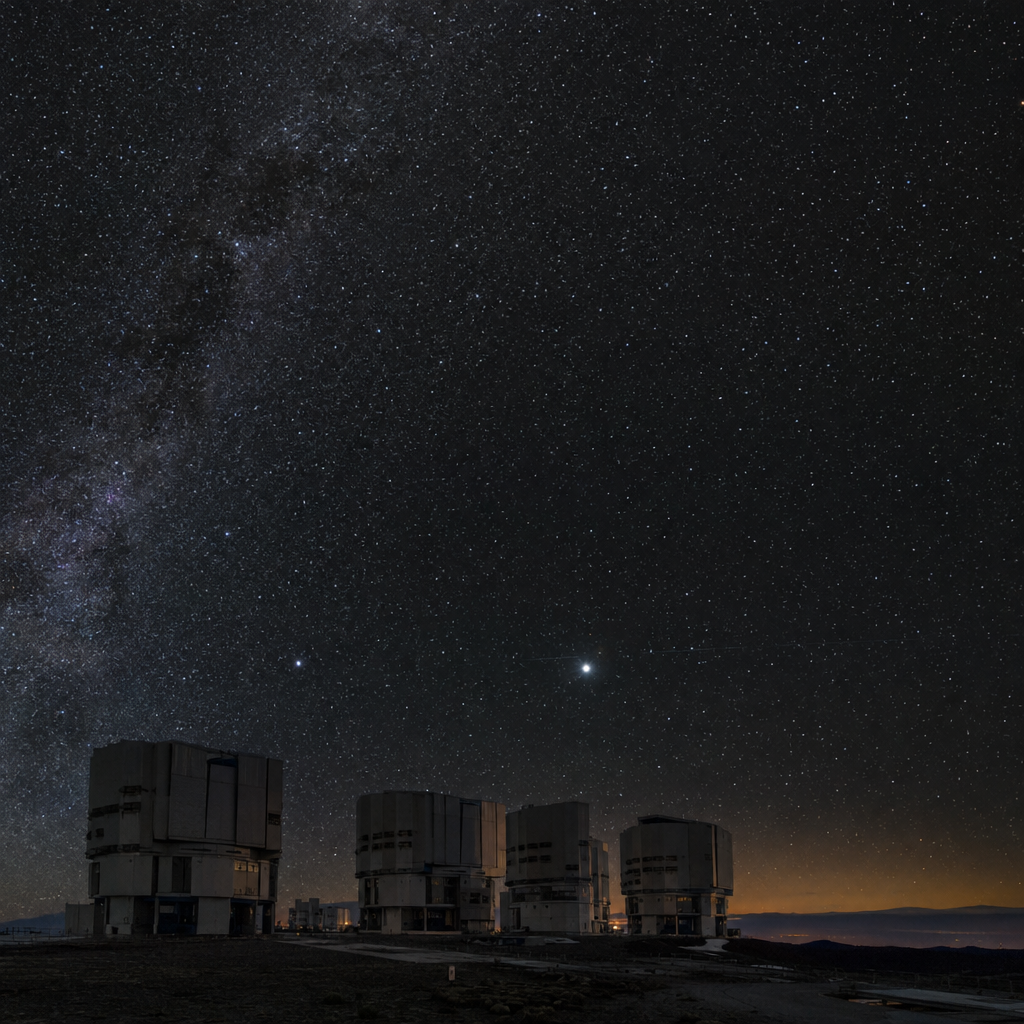
To investigate the system, Hoy, Alice Zurlo, and colleagues used the CRIRES+ instrument on the Very Large Telescope. The team applied the radial velocity method, which measures small changes in an object’s motion caused by the gravitational pull of a companion. By examining subtle changes in the brown dwarf’s motion, the researchers identified what they consider strong evidence that another massive body is orbiting it. Zurlo, director of the Millennium Nucleus of Young Exoplanets and their Moons and an astrophysicist at Universidad Diego Portales, described the satellite as “a giant gaseous body orbiting a highly massive companion, itself several times the mass of Jupiter.”
The discovery highlights a fundamental problem with applying familiar labels to distant systems. Astronomers have identified more than 6,000 exoplanets, but only a handful of possible exomoons have emerged, and the supporting evidence has remained limited. No candidate has yet been detected with enough certainty to count as a confirmed discovery. “This system is somewhat hard to define using Solar-System-based words like ‘planet’ and ‘moon’,” Hoy said. Zurlo added that in the CD-35 2722 system, “where we are blurring the lines between stars, planets, and moons, the whole thing becomes more complicated to describe.” She called the result “a breakthrough: the first plausible detection of an exosatellite.”
ESO’s upcoming Extremely Large Telescope, equipped with a 39-meter mirror, is expected to play a major role in the continued search, giving astronomers the ability to detect smaller exomoons beyond the reach of existing observatories. Future observations could reveal whether massive satellites like the one proposed in CD-35 2722 are rare exceptions or part of a broader population of unusual objects.