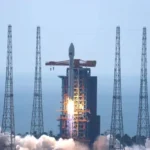
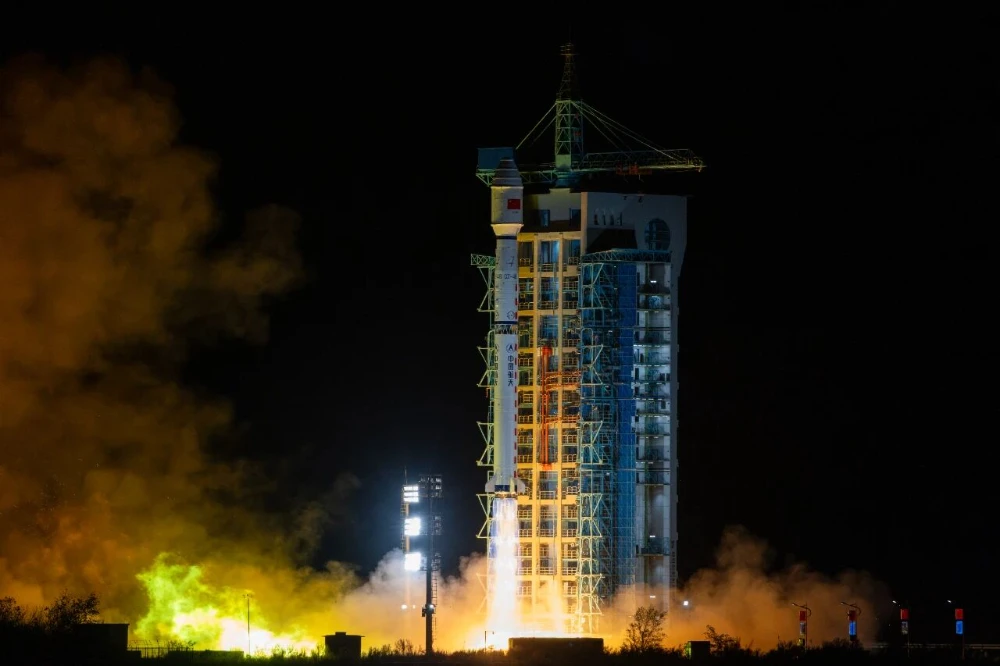
China launched six remote-sensing satellites aboard a Long March 4B rocket from the Jiuquan Satellite Launch Center at 3:25 a.m. Beijing Time on October 24, 2026. The rocket placed Yaogan-53 satellites 07, 08 and 09 and Yaogan-56 satellites 19, 20 and 21 into their planned orbits.
The payload comprised two separately designated groups of three spacecraft. China Aerospace Science and Technology Corporation said the satellites will primarily support scientific experiments, land and natural-resource surveys, agricultural yield estimation, and disaster prevention and mitigation.
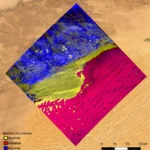
These applications typically depend on repeated Earth-observation coverage. Land surveys use satellite data to map resources and identify surface changes, while agricultural yield estimation relies on observations collected during different stages of crop development. Satellite imagery can also provide wide-area assessments following floods, landslides and other disasters, particularly where field access is limited.
Launching six spacecraft on a single vehicle requires the rocket and payload adapter to accommodate multiple satellites and execute a controlled separation sequence. CASC did not release details of the adapter configuration, deployment order or time intervals between separations.
The Long March 4B is a three-stage launch vehicle using storable liquid propellants. It is designed to carry different satellite types to a range of orbits and can conduct both single-satellite and multi-satellite missions. CASC said the rocket can place up to 3.3 metric tons into a circular sun-synchronous orbit, although the announcement did not provide a reference altitude or confirm that the six satellites entered such an orbit. Sun-synchronous orbits are frequently used for Earth observation because they allow a satellite to pass over a location at approximately the same local solar time, supporting more consistent lighting conditions for image comparison and long-term monitoring.

Long March 4B Rocket on the Launch Pad
A commercial launch vehicle subsidiary of CASC served as the overall contractor for the rocket, while the Shanghai Academy of Spaceflight Technology, also known as CASC’s Eighth Academy, was responsible for its development.
The launch marked the 673rd flight of the Long March launch vehicle family.
The six-satellite mission also reflects the continued expansion of China’s satellite manufacturing and deployment capabilities. STARPATH GLOBAL connects international customers with this growing supply base, whether you need cost-effective Earth-observation data or a dedicated satellite capability. Customers can use our satellite imagery catalog to identify the resolution and revisit frequency their applications actually require, while organizations planning their own missions can contact our team to discuss satellite, payload and AIT options aligned with their technical requirements and budget.