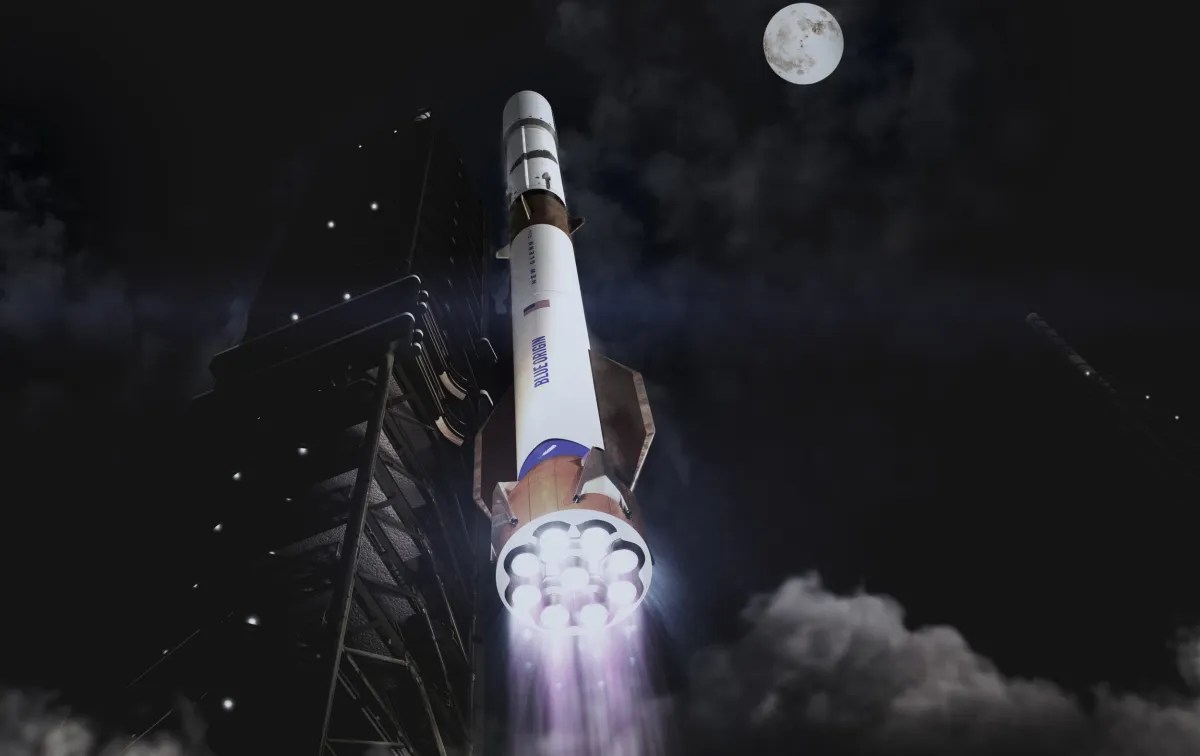
Blue Origin has announced plans for a significantly enlarged version of its New Glenn launcher, signalling a push into the super-heavy lift segment as global competition intensifies. The new configuration, known as New Glenn 9×4, adds engines to both stages and marks the most substantial design shift since development of the rocket began more than a decade ago.
The upgrade introduces nine BE-4 engines on the first stage—up from seven—and four BE-3U engines on the upper stage, doubling the thrust capability of the existing version. CEO Dave Limp shared digital renderings depicting the enlarged booster, which appears taller than NASA’s Saturn V.
Blue Origin said the 9×4 variant will fly alongside, rather than replace, the current 7×2 configuration. The new design is expected to lift more than 70 metric tons to low Earth orbit and more than 20 metric tons to trans-lunar injection. The vehicle will feature an expanded 8.7-metre fairing to accommodate larger spacecraft, including elements of mega-constellations and deep-space missions.
“We aren’t disclosing a specific timeframe today. The iterative design from our current 7×2 vehicle means we can build this rocket quickly,” a company spokesperson said.
The announcement comes as launch providers worldwide move to scale up their heavy-lift capabilities. SpaceX, United Launch Alliance and Rocket Lab are among those advancing new large-rocket concepts to meet rising demand for high-volume satellite deployments and long-range exploration.
New Glenn has taken about a decade and billions of dollars to develop, with a reusable first stage aimed at competing with SpaceX’s Falcon family and, eventually, the still-developing Starship system. Alongside the 9×4 reveal, Blue Origin confirmed upcoming performance upgrades to the baseline vehicle, including higher-thrust BE-4 engines, improved BE-3U engines, super-cooled propellants, a reusable payload fairing and a more durable heat shield.
The company said both New Glenn versions “will serve the market concurrently, giving customers more launch options for their missions, including mega-constellations, lunar and deep space exploration, and national security imperatives such as Golden Dome.”
Cultural shift under Dave Limp
The redesign reflects broader organisational changes under CEO Dave Limp, who joined nearly two years ago with a mandate to accelerate execution and expand production. Blue Origin has increased the pace of announcements in recent months, including the unveiling of a full-scale deployable aerobrake concept for Mars and lunar missions.
“The key cultural shift that we’re trying to achieve is to move from an R&D company to a manufacturing and operational space company,” Limp said.
The successful launch and landing of New Glenn earlier this month suggest the company is gaining momentum as it prepares to develop an even larger rocket.