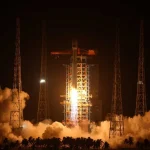
The failed ChinaSat-4B launch has once again drawn attention to one of the most important yet least understood pillars of China’s space program: the ChinaSat communications satellite fleet. Over three decades, the program has evolved from reliance on foreign-built spacecraft into one of the world’s largest geostationary communications satellite systems, supporting everything from television broadcasting and military communications to broadband connectivity and Belt and Road infrastructure projects.
The ChinaSat-4B Failure and Why It Matters
On August 10, 2026, a Long March 7A rocket carrying the ChinaSat-4B communications satellite lifted off from the Wenchang Space Launch Site on Hainan Island. Shortly after launch, the rocket experienced an in-flight anomaly, resulting in mission failure. Chinese authorities later confirmed that an investigation was underway to determine the cause.
The loss of ChinaSat-4B is significant, but it does not threaten the overall operation of China’s communications satellite network. Instead, the incident highlights the importance of a satellite fleet that has quietly become one of the country’s most critical pieces of national infrastructure.
For many outside observers, ChinaSat satellites are simply television or telecommunications spacecraft. In reality, they represent a strategic system that underpins national information security, long-distance communications, emergency response, maritime connectivity, military communications, and China’s growing international digital presence.
To understand why the ChinaSat-4B failure attracted so much attention, it is necessary to examine the history and evolution of the ChinaSat program itself.
From Imported Satellites to Strategic Infrastructure
The ChinaSat series consists primarily of geostationary communications satellites operated by China Satellite Communications Co., Ltd. (China Satcom).
Positioned approximately 36,000 kilometers above the equator, these satellites remain fixed relative to the Earth’s surface and occupy orbital slots ranging from roughly 51.5°E to 163°E. Their coverage extends across China, the Asia-Pacific region, the Middle East, Africa, Europe, Australia, and large portions of the Pacific Ocean.
Today, the constellation supports:
- Television broadcasting
- Broadband internet access
- Maritime communications
- Aviation connectivity
- Enterprise networking
- Emergency communications
- Government communications
- Military communications
- International telecommunications services
The strategic value of these satellites goes far beyond their technical capabilities.
Why Geostationary Orbit Matters
One of the least appreciated aspects of communications satellites is the importance of orbital slots.
Geostationary orbital positions and associated radio-frequency resources are limited assets regulated internationally through the International Telecommunication Union (ITU). Once an operator establishes and maintains use of a slot, it effectively secures long-term access to that orbital resource.
When China entered the satellite communications industry, many prime orbital positions had already been occupied by established space powers.
Through continuous deployment of ChinaSat spacecraft, China gradually secured and maintained critical orbital positions such as:
- 92.2°E
- 98°E
- 101.4°E
- 110.5°E
- 115.5°E
- 125°E
- 163°E
These orbital positions now form the backbone of China’s communications architecture and represent strategic national assets that may remain valuable for decades.
The Era of Foreign Dependence
The early development of China’s communications satellite industry relied heavily on international cooperation.
ChinaSat-7
Launched in 1996, ChinaSat-7 was manufactured by Hughes Space and Communications of the United States.
At the time, China lacked extensive experience in large commercial communications satellites. Imported spacecraft provided immediate communications capacity while also giving Chinese engineers valuable operational experience.
ChinaSat-6B and ChinaSat-9
The most important imported satellites arrived in the mid-2000s.
ChinaSat-6B and ChinaSat-9 were both ordered from French satellite manufacturer Thales Alenia Space.
These satellites became critical components of China’s television broadcasting system.
ChinaSat-9 in particular played a central role in China’s direct-to-home broadcasting program, allowing rural households to receive television services through small satellite dishes.
For millions of viewers in remote regions, the satellite became their primary gateway to national broadcasting.
The 2009 ChinaSat-6B Incident
One event fundamentally shaped China’s determination to achieve technological independence.
On February 9, 2009, ChinaSat-6B suffered a major anomaly that interrupted approximately 150 television channels across China for nearly an hour.
The outage affected China Central Television (CCTV) channels and provincial broadcasters simultaneously.
Although the satellite remained operational afterward, the incident exposed the vulnerability of relying on externally supplied critical infrastructure.
Within China’s aerospace community, the lesson was clear: communications satellites were not merely commercial products—they were strategic assets that required indigenous control.
That realization accelerated investment in domestic satellite platforms and payload technologies.
The Rise of the DFH-4 Platform
China’s breakthrough came with the development of the DFH-4 (Dongfanghong-4) satellite platform by the China Academy of Space Technology (CAST).
The DFH-4 would become the most successful communications satellite platform in Chinese history, with more than 30 satellites delivered and operated in orbit.
The platform enabled spacecraft weighing between approximately 3.8 and 7 metric tons with power generation ranging from 8 to 22 kilowatts. It became the foundation for most modern ChinaSat missions.
Several important satellites emerged from this generation.
ChinaSat-6A
Launched in 2010, ChinaSat-6A became China’s first domestically developed broadcasting satellite based on the DFH-4 platform.
Although a helium-system leak reduced its operational life, the satellite successfully demonstrated China’s ability to build large broadcasting satellites independently.
ChinaSat-10
Launched in 2011, ChinaSat-10 represented another major milestone.
The mission introduced a hybrid development model combining a Chinese-built satellite bus with foreign payload technology, helping China bridge the gap between imported systems and fully domestic solutions.
ChinaSat-11
ChinaSat-11 further validated the DFH-4 platform as a reliable commercial communications spacecraft serving customers across the Asia-Pacific region.
Even today, the satellite remains operational, demonstrating the maturity of Chinese satellite engineering.
Building a Military Communications Backbone
Not all ChinaSat satellites are purely commercial.
Several satellites publicly designated as ChinaSat spacecraft are widely believed to support military communications missions.
Examples include:
- ChinaSat-22 (Fenghuo-1A)
- ChinaSat-22A
- ChinaSat-1A
- ChinaSat-1C
- ChinaSat-1D
- ChinaSat-1E
These satellites helped establish dedicated military communications networks capable of supporting command, control, communications, and intelligence operations.
Although publicly available information remains limited, they played a major role in modernizing China’s military communications infrastructure during the past two decades.
ChinaSat-16 and the High-Throughput Revolution
The next major turning point arrived in 2017.
Originally launched as Shijian-13 before entering operational service as ChinaSat-16, the satellite represented China’s first true high-throughput communications satellite.
Its achievements included:
- High-throughput Ka-band communications
- Electric propulsion
- Laser communications experimentation
- Extensive domestic component usage
Positioned at 110.5°E, ChinaSat-16 provides broadband services across China and surrounding waters through 26 Ka-band spot beams. It supports applications ranging from internet access and telemedicine to maritime and aviation communications.
ChinaSat-16 marked China’s entry into an elite group of nations capable of deploying advanced broadband communications satellites.
It also validated the commercial viability of satellite broadband services within China.
Failures That Shaped the Program
Like every major space program, the ChinaSat series has experienced significant setbacks.
ChinaSat-9A
Launched in June 2017, ChinaSat-9A failed to reach its intended orbit due to a launch vehicle malfunction.
Rather than abandoning the spacecraft, Chinese engineers conducted a series of orbital rescue maneuvers over sixteen days.
The satellite eventually reached operational orbit, becoming one of the most notable recovery efforts in China’s space history.
ChinaSat-18
Perhaps the most damaging setback occurred in 2019.
ChinaSat-18 was designed to work alongside ChinaSat-16 to create a nationwide broadband satellite network.
Although the launch vehicle successfully placed the spacecraft into orbit, the satellite suffered a complete power-system failure after separation.
Its solar arrays never deployed.
Despite months of recovery efforts, the spacecraft was declared a total loss.
The failure delayed China’s broadband satellite deployment plans and disrupted utilization of the important 115.5°E orbital position.
ChinaSat-4B
The latest setback arrived in August 2026 when the Long March 7A carrying ChinaSat-4B failed shortly after launch. Unlike ChinaSat-18, the satellite never reached orbit. Investigators are still working to determine the root cause.
The Shift Toward Full Localization
During the 2020s, China accelerated efforts to reduce reliance on foreign technologies.
Several recent satellites illustrate this trend.
ChinaSat-6D
Launched in 2022, ChinaSat-6D succeeded ChinaSat-6A and significantly expanded broadcasting coverage across Asia-Pacific regions.
It also became the first Chinese civilian communications satellite to utilize relay tracking and control technologies.
ChinaSat-6E
Launched in 2023, ChinaSat-6E completely replaced the foreign-built ChinaSat-6B in broadcasting service.
The transition represented the culmination of nearly two decades of technological progress.
ChinaSat-10R
Launched in 2025, ChinaSat-10R introduced multiple domestically developed communications components, including high-power traveling-wave tube amplifiers and advanced signal distribution systems.
ChinaSat-9C
ChinaSat-9C may be the clearest example of China’s communications satellite maturation.
Launched in 2025, it replaced the veteran ChinaSat-9 and delivered approximately 50% more capacity while introducing new maritime and western-region coverage beams.
The satellite’s power generation and payload performance reached record levels for the DFH-4 family, demonstrating how far the platform had evolved since its introduction.
Beyond China: Supporting the Belt and Road
The ChinaSat constellation increasingly serves users outside China.
Modern satellites such as ChinaSat-15, ChinaSat-19, ChinaSat-10R, and ChinaSat-16 provide communications services across:
- Southeast Asia
- South Asia
- Central Asia
- The Middle East
- Africa
- The Pacific Ocean
These capabilities align closely with China’s broader Belt and Road Initiative, enabling telecommunications services in regions where terrestrial infrastructure remains limited.
ChinaSat-19 is particularly notable because it extends coverage deep into the Pacific Ocean, supporting trans-Pacific aviation and maritime routes. This represents a significant expansion beyond the constellation’s original domestic focus.
More Than Satellites
The ChinaSat program is often viewed through the lens of space technology, but its broader significance lies elsewhere.
Over three decades, it has helped China:
- Secure strategic geostationary orbital resources
- Build an indigenous communications satellite industry
- Develop high-throughput broadband capabilities
- Modernize military communications networks
- Expand international telecommunications services
- Train generations of aerospace engineers
- Strengthen the country’s industrial supply chain
Each generation of ChinaSat satellites reflects a different stage of China’s technological development—from imported spacecraft and foreign dependence to increasingly sophisticated domestic systems.
Conclusion
The failure of ChinaSat-4B represents a setback for the specific mission, but it does not fundamentally change the broader development trajectory of China’s communications satellite sector. The ChinaSat program has evolved over more than three decades from reliance on imported spacecraft to a large and increasingly domestically developed geostationary communications satellite fleet serving broadcasting, telecommunications, broadband, maritime, aviation, and other applications.
The outcome of the ChinaSat-4B mission will ultimately depend on the findings of the ongoing investigation and any subsequent decisions regarding the satellite and its launch vehicle. Regardless of the outcome of this individual mission, the longer-term development of the ChinaSat series reflects China’s gradual expansion of its capabilities in satellite communications, including satellite manufacturing, payload technology, orbital operations, and communications services.