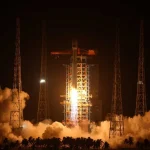
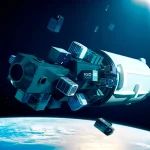
At 16:07 on March 17, 2025, the Ceres-1 (Yao-10) carrier rocket developed by Beijing Galaxy Aerospace Technology Co., Ltd. carried a total of 8 satellites, Yunyao-1 55-60, Zhongke Satellite 06, and 07, at the Jiuquan Satellite Launch Center. The satellite was then successfully put into the predetermined orbit, and the launch mission was a complete success.
The following is the relevant research and analysis content of the Ceres-1 launch vehicle:
1. Basic information
The Ceres-1 launch vehicle is a four-stage rocket. The first, second and third stages of the rocket use solid engines, and the fourth stage uses an advanced liquid upper stage. The rocket’s SSO (500 km) transport capacity is 0.3 t, and its SSO (700 km) transport capacity is 0.27 t.
2. Rocket composition
(1) Fairing
Before the Yaosan rocket, the Ceres-1 launch vehicle had two types of fairings. Type I fairing has an inner diameter of 1.2 m and a load space height of 2.2 m; Type I fairing has an inner diameter of 1.4 m and a load space height of 2.5 m. Starting from Yaosan, the Ceres-1 launch vehicle has a new upgraded fairing with a diameter of 1.6 m and a height of 5.2 m.
(2) First level
The first stage of Ceres 1 has a diameter of 1.4 m and is equipped with a “Lightyear” GS-1 solid engine with a thrust of 60 t at sea level and a specific impulse of 249.5 s. GS-1 adopts a new HTPB propellant formula with low burning rate, high mechanical properties and high specific impulse, and optimizes the propellant structure of low pressure-to-strength ratio and high loading fraction.
(3) Second level
The second stage of Ceres 1 has a diameter of 1.4 m and is equipped with a “Lightyear” GS-2 solid engine with a vacuum thrust of 30 t and a vacuum specific impulse of 285.8 s.
(4) Third sub-level
The third stage of Ceres 1 has a diameter of 1.4 m and is equipped with a “Lightyear” GS-3 solid engine with a vacuum thrust of 15 t and a vacuum specific impulse of 287 s.
(5) Fourth sub-level
The fourth stage of Ceres 1 is an advanced liquid upper stage, which uses a “boundary” orbit and attitude control power system (liquid power integrated with orbit control and attitude control), which can achieve multiple satellites in one rocket, space ferrying, and active deorbiting. The “boundary” orbit attitude control power system not only provides attitude control for the first, second and third stages, but is also responsible for the acceleration and deorbiting passivation of the upper stage.
3. Rocket spectrum
Ceres 1 is available in standard and sea-launched versions.
4. Launch platform
The launch platform of Ceres 1 was developed by Aerospace Tianma of the Tenth Academy of Aerospace Science and Industry. Starting from Yaos4, Ceres 1 will be launched using a transfer launch vehicle. The rocket transfer launch vehicle has functions such as better environmental temperature control, motorized transfer transportation, and rapid erect launch. It effectively solves the problems of long rocket launch preparation time and low launch frequency. After entering the launch pad, it has the ability to launch quickly within one hour. The Ceres-1 sea-launched launch vehicle also uses a land-based transfer launch vehicle for thermal launch. The launch vehicle is fixed behind the ship, and only a magnesium belt locking mechanism is added at the rear end of the rocket. The magnesium belt locking mechanism can ensure the safety of the rocket’s erection under shaking conditions before ignition, and can be ablated and unlocked after ignition to ensure reliable takeoff of the rocket.
5. Development costs
The research and development cost of Ceres-1 is about 100 million yuan, and the cost of producing a single rocket is less than 30 million.
6. Launch record
Currently, Ceres-1 has launched a total of 18 rounds, of which 17 were successful and 1 failed. At 12:59 on September 21, 2023, the Ceres-1 (Yao-11) rocket was launched from the Jiuquan Satellite Launch Center. The rocket attitude became unstable when it was flying for about 67.5 seconds, and the launch mission failed. The cause of the failure was abnormal ablation in the expansion section of the first-stage engine nozzle.