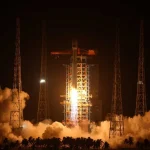
At 18:00 on November 17, 2019, the Global Multimedia Satellite System α-phase A and B satellites were successfully launched aboard the Kuaizhou-1A carrier rocket at the Jiuquan Satellite Launch Center. The satellites successfully entered the predetermined orbit and carried out Ka-band communication technology tests. The Kuaizhou-1A launch vehicle was developed by China Aerospace Science and Industry Rocket Technology Co., Ltd. It is a general-purpose four-stage small solid launch vehicle developed on the basis of the original Kuaizhou-1 star-rocket integrated launch vehicle by extending the length and diameter of the fairing. The total length of the rocket is about 20 m, with a maximum diameter of 1.4 m. It adopts a vehicle-mounted mobile launch method. The SSO (700 km) carrying capacity is 300 kg. The launched satellite was developed by the Microsatellite Innovation Institute of the Chinese Academy of Sciences. The mass of the α-A star is about 70 kg, and the mass of the α-B star is about 90 kg.
At 19:01 on August 4, 2021, the Global Multimedia Satellite System β-phase A and B satellites (“Songjiang” and “G60”) successfully lifted off aboard the Long March-6 carrier rocket at the Taiyuan Satellite Launch Center, and the satellites successfully entered the predetermined orbit. The Long March 6 launch vehicle is a new generation of non-toxic and non-polluting small liquid launch vehicle developed by the Eighth Academy of Aerospace Science and Technology. The rocket has a three-stage configuration, with a core diameter of 3.35m, a second and third core diameter of 2.25m, and an SSO (700 km) capacity of 500 kg. The two satellites launched were developed by the Microsatellite Innovation Institute of the Chinese Academy of Sciences.
At 14:42 on August 6, 2024, the Qianfan Polar Orbit Group 01 satellite was successfully launched into space on the Long March 6A carrier rocket at the Taiyuan Satellite Launch Center in the “18-star-with-a-shot” manner, and the satellite successfully entered its intended orbit. The Long March 6A launch vehicle was developed by the Eighth Academy of Aerospace Science and Technology. It is a launch vehicle designed in a modular, combined and serialized manner based on the successful first flight of the Long March 6 rocket. Chang Liujia is a two-stage semi-configuration rocket. The liquid core stage is bundled with four solid boosters. It is my country’s first rocket to use solid boosters. The core stage diameter is 3.35m, the boost diameter is 2m, and the SSO (700 km) capacity is 5t. The launched satellite was developed by the Shanghai Microsatellite Engineering Center of the Chinese Academy of Sciences. The mass of a single satellite is approximately 240 kg.
At 19:06 on October 15, 2024, the Qianfan Polar Orbit 02 satellites were successfully launched into space on the Long March 6A carrier rocket at the Taiyuan Satellite Launch Center in the “18-star-with-a-shot” manner, and the satellites successfully entered the predetermined orbit. The satellites launched this time were developed, designed and mass-manufactured by Shanghai Gesi Aerospace Technology Co., Ltd.
At 12:41 on December 5, 2024, Qianfan Polar Orbit 03 satellites were successfully launched into space on the Long March 6A carrier rocket at the Taiyuan Satellite Launch Center in the “18 satellites with one rocket” method, and the satellites successfully entered the predetermined orbit. The satellite launched this time was developed by the Microsatellite Innovation Institute of the Chinese Academy of Sciences.