1. Basic information
The Long March 2F was developed by the First Academy of Aerospace Science and Technology. It has a two-stage and a half configuration and adopts the “three vertical (vertical assembly, vertical testing, vertical transfer)” test and launch mode. It is a rocket specially developed for manned space missions after the launch of my country’s manned space project in 1992. Based on the Long March 2E, the Long March 2F has improved reliability and safety in accordance with the requirements for launching manned spacecraft. The Long March 2F is the first launch vehicle in my country’s aerospace history that has clear requirements for reliability indicators of 0.97 and safety indicators of 0.997. At present, the latest indicators of Long March 2F have been improved to reliability 0.9905 and safety 0.99996.
2. Rocket structure
(1) One sub-level
The Long March 2 F first stage has a diameter of 3.35 meters and is equipped with four YF-20K engines. The propellant is dinitrogen tetroxide/uniform dimethyl hydrazine. The sea level thrust of a single engine is 740.4 kN, and the sea level specific impulse is 2550.0 m/s.
(2) Second level
The Long March 2F second stage has a diameter of 3.35 meters and is equipped with a YF-24K engine assembly. The main engine is YF-22K, the propellant is dinitrogen tetroxide/uniform dimethylhydrazine, the vacuum thrust is 742.04 kN, and the vacuum specific impulse is 2941.8 m/s; the traveling engine is YF-23B, the propellant is dinitrogen tetroxide/uniform dimethyl hydrazine, the vacuum thrust is 47.04 kN, and the vacuum specific impulse is 2761.6 m/s.
(3) Booster
The basic version of the Long March 2F has four boosters. Each booster has a diameter of 2.25 meters and a length of 16.094 meters. It is equipped with a YF-25K engine. The propellant is dinitrogen tetroxide/uniform dimethylhydrazine, with a sea level thrust of 740.4 kN and a sea level specific impulse of 2550.0 m/s.
(4) Fairing
The Long March 2F is a dedicated launch vehicle for my country’s manned spaceflight project, and its fairing design is directly related to the safety of astronauts and the success or failure of the mission. In the manned state, the fairing length is more than 13 meters, with a maximum diameter of 3.8 meters. It is composed of 5 sections, and 4 grid wings (key escape flight mechanisms) are integrated on the outside of the middle section. In order to adapt to the requirements of large payloads such as “Tiangong-1”, the diameter of the Long March 2F fairing was expanded to 4.2 meters. In addition, the Long March 2F fairing subverts the traditional pyrotechnics model, using 32 mechanical locks linked through pull rods, and 16 locks on one side are unlocked simultaneously to realize the “aircraft door-style” opening of the separation mechanism.
(5) Escape Tower
The Long March 2F escape tower consists of a nose cone, a counterweight section, four FG-58 yaw and pitch engines, one FG-57 engine, one FG-56 engine and a tail skirt. The length is 8.35 meters and the structural mass is 2870 kg.
3. Model change
(1) Basic type
The basic version of the Long March 2F has a total length of 58.34 meters, an escape tower installed, a fairing diameter of 3.8 meters, a take-off mass of 479.8 tons, and a LEO carrying capacity of 8.08 tons. It has performed a total of 7 missions and successfully achieved my country’s first manned space launch, my country’s first multi-person multi-day flight, my country’s first space walk and other missions. It is no longer in use.
(2) Improved type
There are two types of improved Long March 2F, one for launching transport spacecraft (Y series) and one for launching target aircraft (T series).
1.Y series
The Y series is equipped with an escape tower for launching manned spacecraft. The diameter of the fairing is 3.8 meters, the length of the fairing is more than 13 meters, the total length of the rocket is 58.34 meters, the take-off mass is about 497 tons, and the LEO carrying capacity is 8.8 tons.
2.T series
The T series has no escape tower and is used to launch target aircraft and reusable test spacecraft. The fairing diameter is 4.2 meters, the fairing length is 12.7 meters, the total length of the rocket is 52.03 meters, the take-off mass is 493.1 tons, and the LEO carrying capacity is 8.6 tons.
4. Launch records
The Long March 2F carrier rocket has been launched a total of 25 times, all of which were successful, with a success rate of 100%. Specifically, it includes 10 unmanned missions and 15 manned missions. my country’s first full-scale unmanned spacecraft, first manned space flight, first multi-person multi-day flight, first space walk, first space laboratory, first manned rendezvous and docking, first manned space science experiment space laboratory with additional functions, first realization of astronauts’ mid-term on-orbit residency, my country’s first manned mission during the construction phase of the space station, etc. were all achieved through the Long March 2F carrier rocket.
5. Launch station
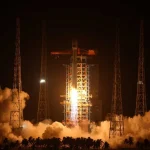
All launches of the Long March 2F carrier rocket are launched from station 921 of the Jiuquan Satellite Launch Center. Construction of the 921 site started in 1994, was completed in 1998, and was first launched on November 20, 1999. Station 921 mainly includes the launch tower, diversion trough, aiming room and underground instrument room. The launch tower is an 11-story fixed steel structure with a main body height of 75 meters. There is a large crane and lightning rod above, with a total height of 105.52 meters and a total mass of approximately 2,300 tons. There is a double-sided asymmetric diversion trough underground at the launch station, with a total length of 113.373 meters, a long side of 62.729 meters, and a return angle of 45 degrees; a short side of 50.644 meters, a return angle of 30 degrees; the cone top elevation is -5.5 meters, and the half cone top angle is 32 degrees. Directly behind where the rocket is fired, there is a movable aiming room with a size of 4.5 meters × 5.6 meters. There are two CCD laser self-collimating theodolite in the room, which are 156.5 meters and 158.5 meters away from the launch point respectively. They can emit lasers. The lasers are reflected along the original path through the aiming prism of the rocket inertial platform, and it can be judged whether the rocket is aimed at the direction.