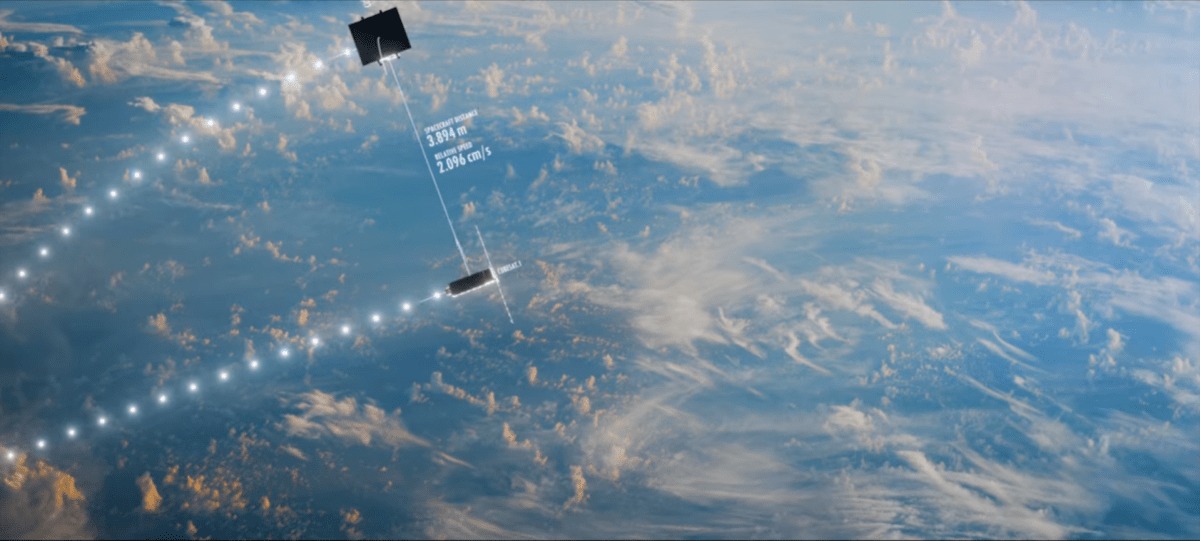
The European Space Agency (ESA) and Switzerland-based startup ClearSpace have begun the Prelude technology demonstration mission, a step aimed at validating close-proximity spacecraft maneuvers needed for future satellite inspection, life-extension and debris-removal operations.
Planned for launch next year, Prelude will test navigation and control technologies that allow two small spacecraft to maneuver together at close range. The mission is designed to demonstrate precise tracking and autonomous movement using a combination of sensors and cameras, enabling spacecraft to operate freely in all directions while maintaining safety margins.
ClearSpace is working with ESA on several initiatives focused on orbital sustainability, including the ClearSpace-1 mission to demonstrate active debris removal and the Phoenix program, which is developing technologies to maintain satellites in orbit and extend their operational lifetimes. While the missions differ in scope, the companies say experience gained through Prelude is expected to inform later, more complex operations.
“Prelude is a critical de-risking mission whose primary objective is to validate the extensive groundwork done to enable the large Phoenix GEO life extension mission,” said Luc Piguet, chief executive of ClearSpace. He added that the mission’s focus is on validating proximity operations at meter-level distances and does not include robotic capture technologies.
Space debris is an increasing concern for satellite operators and space agencies. Ground-based tracking systems currently monitor about 40,000 debris objects larger than a smartphone, while ESA estimates roughly 1.1 million objects larger than one centimetre are in orbit. Such debris can threaten satellites and crewed missions, prompting growing interest in in-orbit servicing and removal capabilities.
Prelude will seek to validate reusable operational building blocks for close-proximity maneuvers under real mission conditions, collect autonomous navigation and safety data, and refine repeatable concepts for future servicing missions. ClearSpace said that within a year of Prelude’s completion it expects to be able to offer recurring in-orbit inspection services.
“Our technologies are moving from development to delivery,” Piguet said. “This marks a tangible step toward making safe and sustainable operations part of everyday space activity.”