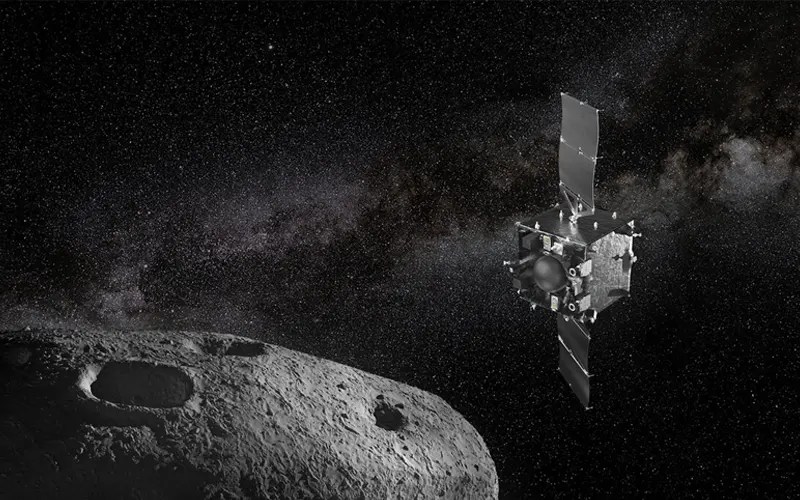
The European Space Agency (ESA) has awarded OHB Italia an €81.2 million contract to build, assemble and test the spacecraft for its Ramses mission, which will study the asteroid Apophis during a rare close flyby of Earth in 2029.
The contract signals that the mission has entered full development following approval of funding at ESA’s Ministerial Council meeting in late 2025. ESA also said its review board completed the mission’s Critical Design Review in “record time,” confirming the spacecraft meets technical and scientific requirements.
Apophis is expected to pass within about 32,000 kilometers of Earth’s surface in early 2029 — closer than geostationary satellites — offering scientists an unusual opportunity to observe how a near-Earth asteroid responds to the planet’s gravitational forces. ESA plans to launch the Rapid Apophis Mission for Space Safety (Ramses) in spring 2028 so the probe can rendezvous with the asteroid before the flyby.
“With Ramses, ESA is seizing a once-in-a-lifetime opportunity to study asteroid Apophis as it swings past Earth, deepening our understanding of near-Earth objects and advancing our capabilities to protect our planet,” said Orson Sutherland, head of ESA’s Mars & Beyond Projects Group.
ESA previously awarded OHB Italia €63 million in October 2025 for early implementation work, using existing budget allocations while awaiting final approval of the mission’s full funding. The latest contract confirms that decision.
Mission manager Paolo Martino said the rapid completion of the design review demonstrates the program’s readiness. “Passing the Critical Design Review in record time gives us full confidence that Ramses’ design is mature, robust, and ready to be built,” he said, adding that maintaining the accelerated schedule reflects the team’s engineering commitment.
The mission includes international cooperation, with Japan’s space agency JAXA contributing components such as a solar array and a thermal infrared imager. ESA has also indicated the spacecraft could launch alongside Japan’s Destiny+ mission on an H3 rocket.
In addition to the primary probe, Ramses will deploy two CubeSats to conduct supplementary observations. ESA has already awarded Tyvak International €4.7 million and Spain’s Emxys €1.5 million for preparatory work. Tyvak received a further €8.2 million contract on Feb. 10 to complete construction and testing of its CubeSat, though ESA did not disclose whether a similar follow-on contract had been issued to Emxys.
Scientists hope the mission will improve understanding of near-Earth asteroids and refine planetary defense strategies as global interest grows in monitoring objects that could pose future risks.