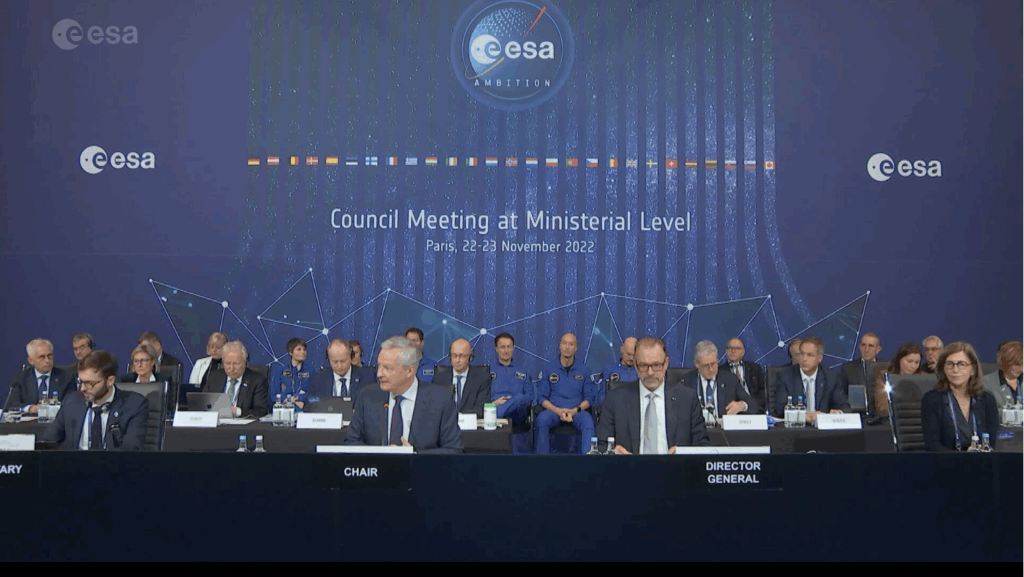
The European Space Agency (ESA) is poised for a pivotal decision later this month, as its Council of Ministers prepares to vote on a package of projects that could mark the agency’s first formal step toward supporting European defense activities.
The two-day meeting, scheduled for Nov. 26–27, will bring together senior officials from ESA’s 23 member states to consider a proposal by Director General Josef Aschbacher to allocate €1 billion ($1.1 billion) toward developing a European Earth observation capability with defense applications. If approved, the move would represent a major shift for ESA, which has maintained a strictly civilian focus since its founding in 1975.
The initiative, known as European Resilience from Space (ERS), would fund early activities to support the European Union’s Earth Observation Governmental Service (EOGS) — a proposed constellation of electro-optical and radar satellites intended for intelligence, surveillance, and reconnaissance (ISR) purposes. ESA said the program is aimed at strengthening Europe’s autonomy in response to growing geopolitical tensions, particularly following Russia’s invasion of Ukraine.
ESA operates independently of the 27-member European Union, though the two institutions frequently collaborate on space initiatives. The EOGS proposal is set to be reviewed by the EU Council of Ministers on Dec. 18–19 as part of the union’s next three-year financial framework. The plan aligns with the EU’s recently approved Defence Readiness Roadmap 2030, which includes developing a “European Space Shield” as part of efforts to boost collective defense.
Aschbacher has described the ERS plan as a step toward better coordination of Europe’s fragmented space programs, emphasizing the need to synchronize civil and defense initiatives without compromising national sovereignty. Under the proposal, ESA would not operate military satellites directly but would play a coordinating role through a “pooling and sharing” model in which member states retain control of their own systems while contributing to a broader European capability.
ESA has already taken part in several dual-use projects, including IRIS2, the EU’s planned secure satellite communications network, and NAVISP, a program supporting independent European positioning, navigation, and timing technologies. According to ESA, NAVISP has generated over 350 contracts with a combined value of €330 million, involving more than 300 industrial and academic partners.
While the ERS proposal is viewed as a key step toward European space resilience, ESA officials have noted that participation will remain voluntary for member states. The program’s future will depend on approval and funding at the ministerial meeting, followed by agreement on its governance framework.
The decision later this month could define ESA’s role in Europe’s evolving security landscape — and potentially end a decades-long separation between the continent’s civil and defense space efforts.