The European Space Agency (ESA) recently released a new picture of the center of the Milky Way galaxy, an area known as the galactic bulge. Containing over 60 million stars, the picture, taken by ESA’s Euclid space telescope, represents the largest and most detailed photo of this region to date.
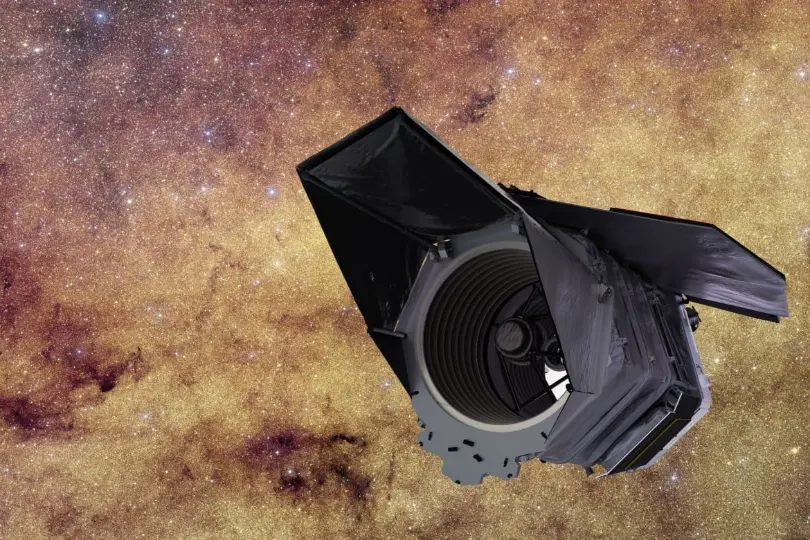
Euclid observed the area outside of its regular survey in support of NASA’s upcoming Nancy Grace Roman Space Telescope’s exoplanet study. This week, Roman arrived at NASA’s Kennedy Space Center (KSC) in Florida, where technicians will prepare it for its launch atop a SpaceX Falcon Heavy no earlier than Aug. 30.
The new image — which consists of nine individual pictures, or pointings, stitched together in a mosaic — covers a five-square-degree area of sky, roughly equivalent to 25 full Moons. Euclid captured the photo on March 23, 2025, training its camera on the area for 26 hours. The telescope used only its visible light sensor (VIS) for this study, so the image lacks color. ESA used ground-based observations from the Canada-France-Hawai’i Telescope (CFHT) to add color to the image ahead of its release.
Euclid’s study of the galactic bulge marks a break from its regular mission, measuring the shapes of billions of galaxies in this area to map the distribution of dark matter throughout the universe. This wide survey takes about two-thirds of Euclid’s total mission time, during which it observes approximately a third of the sky away from the galactic plane as well as the Solar System’s Ecliptic plane.
See Also
- Euclid Updates
- Roman Updates
- Space Science coverage
- NSF Store
- Click here to Join L2
“This is the only time Euclid has paused its normal sky survey, which is mainly geared toward cosmology,” said U.S. Euclid science lead Jason Rhodes of NASA’s Jet Propulsion Laboratory (JPL), who also serves as NASA JPL Roman project scientist. “This takes a lot of work and planning, so it really has to be something with a high impact for science. Adding Euclid’s snapshot to Roman’s future survey will help us map our galaxy better and identify hard-to-find cosmic treasures like isolated black holes and rogue planets more easily.”
Roman will point its instruments at parts of the area studied by Euclid to detect exoplanets by observing an effect called microlensing, which occurs when a star lines up behind another from the telescope’s point of view.
Astronomy
(adsbygoogle = window.adsbygoogle || []).push({});
Microlensing is a small-scale effect of gravitational lensing, which effectively bends light as it travels through the curved spacetime around massive objects. In the case of Roman’s study, the foreground star’s gravity distorts the background star’s image like a lens. If the foreground star hosts a planet, this causes a subtle additional distortion.
Video Player
(Video: Animation of Roman observing microlensing. Credit: NASA Goddard’s Scientific Visualization Studio)
“During the last twenty years, almost 300 exoplanets have been discovered using this technique, all with ground-based telescopes and all towards the center of our galaxy. This image from Euclid includes 51 known planetary systems — and it will assist in studying many more that will be found,” said Euclid’s galactic bulge survey original instigator Jean-Philippe Beaulieu of the Institut d’Astrophysique de Paris in France, and the University of Tasmania in Australia.
The microlensing technique works best on stars in high-density regions, like the Milky Way’s center. Detecting microlensing events requires observing how the star’s light changes for a period of more than 20 days, much longer than Euclid’s galactic bulge survey.
Despite not containing new microlensing events, Euclid’s observations help extend Roman’s study by adding data upfront. Euclid’s survey will help astronomers discern lens stars and measure their masses. Moreover, it will also determine whether planets far away from stars are in distant orbits or rogue planets that don’t orbit any stars at all.
“Euclid has already captured the stars involved in all the future microlensing events that the Roman space telescope will detect, but before the stars and planets involved have aligned,” said Natalia Rektsini of the Institut d’Astrophysique de Paris, who led the release of Euclid’s galactic bulge survey data for the scientific community.

“This means that anyone who detects a microlensing event in the same region, for example, with Roman, will be able from now on to use Euclid data as a time reference in the past and see how the stars looked before they overlapped,” said Rektsini. “Since Euclid can clearly separate individual stars, one can then measure how fast they move over time and use that information to confirm the existence of a planet and determine its mass. This would not be possible with data from one point in time.”
Two years after Euclid studied the galactic bulge, Roman will start observing parts of the same area in spring 2027, to detect microlensing events. While both telescopes have a similar resolution, Roman will be able to peer deeper into the Milky Way’s core and also collect more color detail compared to Euclid’s observations.
Beyond Roman’s exoplanet mission, Euclid’s observations also support the forthcoming telescope’s Galactic Plane Survey to map the galaxy in unprecedented detail. Roman’s other science goals include the study of dark matter, dark energy, and infrared astrophysics.
NASA completed construction of the Nancy Grace Roman Space Telescope in late November, 2025. Since then, the agency has subjected the telescope to a series of tests to ensure its readiness for launch. Throughout its development and testing, the program has run ahead of schedule and under budget.

Roman arrives at NASA’s Kennedy Space Center. (Credit: Jerry Pike for NSF)
After completing integration and testing at NASA’s Goddard Space Flight Center in Maryland, the agency shipped Roman to the KSC, where it arrived on June 21 aboard NASA’s Pegasus barge. A truck then carried the telescope to the Payload Hazardous Servicing Facility.
Next, technicians will perform final tests of Roman’s solar panels and perform several inspections and other tasks to ensure the telescope is ready for flight. Additionally, teams will load the spacecraft’s tanks with hydrazine fuel.
NASA and SpaceX target Aug. 30 for Roman’s launch atop a Falcon Heavy from KSC’s Launch Complex 39A (LC-39A). Once in space, the telescope will travel to the Sun-Earth Lagrange point 2 (L2), where Euclid and the James Webb Space Telescope also reside.
With Euclid’s galactic bulge survey now released to the scientific community, Roman’s discoveries get a head start before the telescope can point its cameras at the stars.
“We’ve shown that these two telescopes can work together to do science that surpasses what either was originally designed for,” Rhodes said. “In doing so, we’ve established a model for future coordinated observations that can unlock far more discoveries than either mission could make alone.”
(Lead image: Euclid’s Galactic Bulge survey kick-starts Roman’s exoplanet mission. Credit: Euclid Galactic Bulge survey: ESA/Euclid/Euclid Consortium/NASA, CFHT, image processing by J.-C. Cuillandre and E. Bertin (CEA Paris-Saclay), Roman rendering: NASA Goddard Space Flight Center Scientific Visualization Studio. )