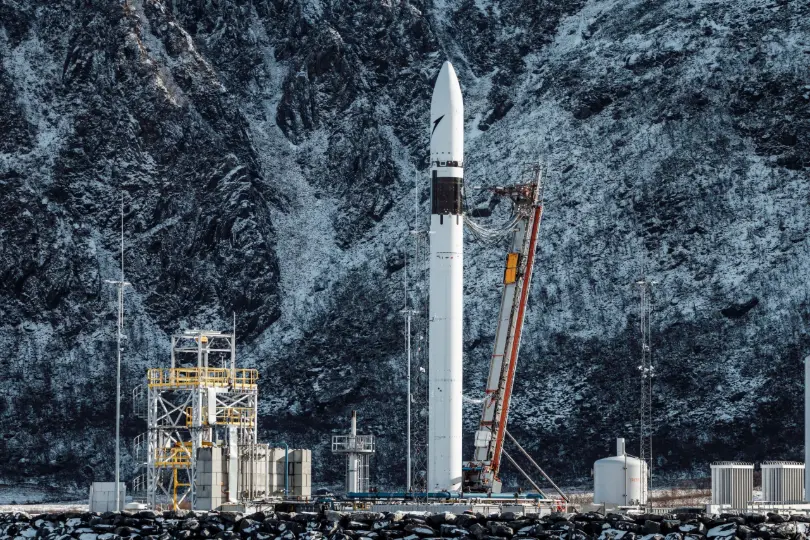
The European private space launch provider Isar Aerospace, headquartered in Ottobrunn, Germany, is set to fly its Spectrum small-satellite launcher on its second mission after weeks of delays and aborted launch attempts. Over a year after Spectrum’s first flight failed, the company is to fly the “Onward and Upward” mission from the Orbital Launch Pad at the Andoya Spaceport in Norway. Liftoff is scheduled for 20:00 UTC on Monday, June 15. However, Monday’s attempt was scrubbed.
Spectrum was originally scheduled to fly as early as Jan. 21, but that attempt was scrubbed due to a faulty pressurization valve. The launch was rescheduled for mid-March; however, due to a combination of weather, range safety issues, and an unexpected increase in engine fuel temperatures, the mission was ultimately scrubbed. A new April launch date would also be scrubbed due to a suspected leak in a composite overwrapped pressure vessel.
For “Onward and Upward,” Isar Aerospace will attempt to enter orbit. This flight, taking a trajectory to a Sun-synchronous orbit, will also carry Spectrum’s first customer payloads, including five cubesats and one experiment; its objective, as per Isar Aerospace, is to qualify the launch vehicle under operational conditions.
Spectrum’s first flight, “Going Full Spectrum,” launched on March 30, 2025, but failed after just 30 seconds into flight when the rocket lost attitude control after starting a pitch-over maneuver. An investigation found that a vent valve unexpectedly opened at the start of the pitch-over maneuver at T+25 seconds. The flight termination command, which cut off Spectrum’s nine engines, was issued at T+30 seconds, and the rocket plunged into the sea near the launch site, missing the launch pad.
The company upgraded Spectrum’s software and increased the vehicle’s margins as part of corrective actions after the failure. The Spectrum vehicle for “Onward and Upward” successfully passed integrated static fire tests, lasting 30 seconds, for both of its stages late last year, and is now on the launch pad.
Spectrum’s first stage uses nine Aquila engines with propane and liquid oxygen as propellants, while its second stage uses one vacuum-optimized Aquila engine using the same propellants. Propane is clean-burning and offers a higher specific impulse — a measure of fuel efficiency for rockets — than other carbon-based fuels.

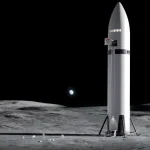
Artist’s impression of the Spectrum’s second stage launching a payload into orbit. (Credit: Isar Aerospace)
The second stage is designed for multiple in-flight restarts, eliminating the need for a kick stage to place payloads into their desired orbits. The rocket, 28 m tall and two meters in diameter, can carry 700 kg to a Sun-synchronous orbit (SSO) from Andøya or 1,000 kg to a low-Earth orbit (LEO) from Kourou, French Guiana, which Isar also plans to use as a launch site for Spectrum.
Company News
(adsbygoogle = window.adsbygoogle || []).push({});
By comparison, Rocket Lab’s 18 m tall Electron carries up to 200 kg to SSO and 320 kg to LEO. Firefly’s Alpha carries up to 630 kg to SSO and 1,030 kg to LEO. Spectrum, like Alpha, can serve the higher end of the small satellite market.
For this flight, Spectrum is carrying an experiment payload from the German space hardware manufacturer Dcubed, as well as cubesats from Technische Universitat Berlin (TU Berlin), the Norwegian University of Science and Technology (NTNU), the University of Maribor, the Technische Universitat Wien Space Team (TU Wien), and EnduroSat. These five cubesats are the first satellites to fly aboard Spectrum.

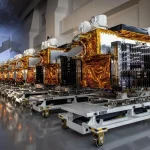
Five payloads flying on “Onward and Upward” are shown here during launch processing. (Credit: Isar Aerospace)
TU Berlin’s CybeeSat will demonstrate a miniaturized transceiver for the Short Duration Mission frequency band, cybersecurity applications, and hardware, including radiation-tolerant perovskite solar cells. NTNU’s FramSat-1, built in Norway, is a demonstrator for Norwegian-built space technology.
See Also
- Onward and Upward Updates
- European spaceflight articles
- NSF Shop
- Click here to join L2
The University of Maribor’s TriSat-S will test battery performance after extended hibernation in space, along with a new optical navigation system, while the TU Wien SpaceTeamSat-1 will allow Austrian students to run software that they developed on the satellite.
Finally, EnduroSat’s Platform 6 will fly technology demonstrations and customer payloads. Exolaunch, the German small-satellite integrator and flight provider, is participating in this flight with deployer equipment.
These payloads will, of course, only be able to fulfill their missions if they reach orbit, and that is far from guaranteed with this test flight. One major test for “Onward and Upward” will be successfully completing the pitch-over maneuver, where “Going Full Spectrum” failed.
Another major test for Spectrum is stage separation and the performance of the second stage, along with fairing separation. Every second of data beyond what “Going Full Spectrum” delivered is important for the vehicle’s development.
Our launch manifest is filling up rapidly! We have signed a launch agreement with U.S.-based integration and mission services provider @SEOPSLLC for a dedicated mission in 2028, expanding flexible and independent access to orbit for our global customers. More:… pic.twitter.com/BEfM4ixQoM
— Isar Aerospace (@isaraerospace) November 18, 2025
Isar Aerospace now has two launch service agreements with the European Space Agency (ESA) to launch CASSINI from the Dutch company ISISpace and the “Tom and Jerry” mission from the French company Infinite Orbits. These agreements are part of the Flight Ticket Initiative launched by ESA and the European Commission.
In addition to the Flight Ticket Initiative payloads, Isar also recently agreed to launch a dedicated mission for the U.S. company SEOPS in 2028. The Norwegian Space Agency is launching two Arctic Ocean surveillance satellites on the same flight, and Redwire is also flying the Sigma YNDEO-3 with 10 European-built demonstration payloads on a future flight.
According to Isar’s Chief Commercial Officer Stella Guillen in a November 2025 press release, “The global demand for launch capacity from Europe continues to accelerate as nations and industries recognize the strategic importance of independent access to space.” Spectrum’s second flight is critical to show the company’s progress and readiness to service the European and global space launch markets.
NSF is partnering with Isar Aerospace to provide livestream production services for the “Onward and Upward” mission.
(Lead image: Spectrum on the Orbital Launch Pad at Andøya Spaceport before the “Onward and Upward” mission. Credit: Isar Aerospace)