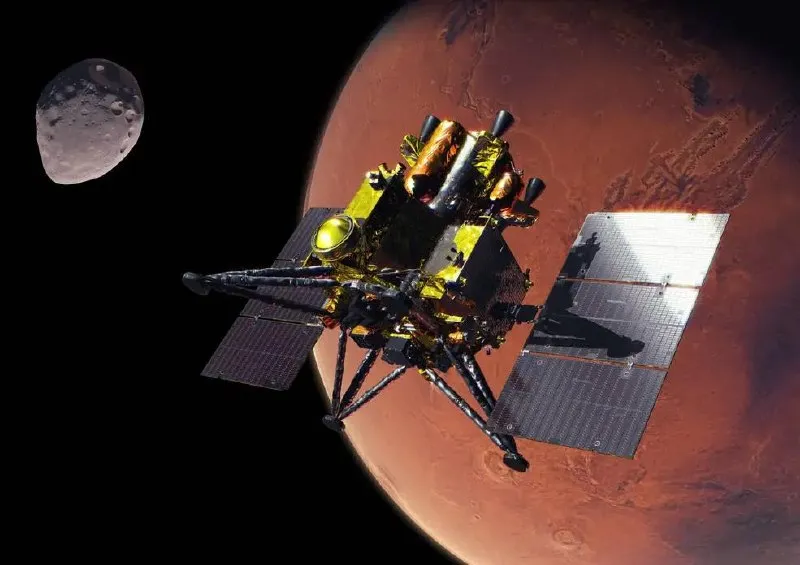
Japan is preparing to take a major step in planetary exploration with the launch of its Martian Moons eXploration (MMX) spacecraft on Oct. 20, 2026. The Japan Aerospace Exploration Agency (JAXA) said the mission will lift off aboard the No. 10 H3 rocket from the Tanegashima Space Center in Kagoshima Prefecture at 4:41:03 a.m. local time.
MMX will travel to the Martian system, study both of Mars’ small moons, Phobos and Deimos, and attempt to collect samples from Phobos before returning them to Earth. The spacecraft is expected to reach the vicinity of Mars about a year after launch and return to Earth in fiscal 2031, making the mission one of Japan’s most ambitious deep-space sample-return efforts.
MMX Will Investigate Both Martian Moons, But Phobos Is the Mission’s Core Target
The scientific problem behind MMX is deceptively simple: scientists still do not know how Phobos and Deimos formed.
The two moons are small, irregular bodies, and their origin remains disputed. One major possibility is that they are captured asteroids. Another is that they formed from material ejected into orbit after a major impact on Mars. Their surface properties and orbital characteristics have provided evidence for both types of explanation, leaving the question unresolved.
MMX is designed to address that problem by combining remote observations with direct sampling. Phobos will receive the most detailed investigation because the spacecraft is intended to enter a quasi-satellite orbit around the moon, survey its surface and environment, land, and collect material for return to Earth. Deimos will also be observed during the spacecraft’s operations around Mars.
The samples could be especially valuable because laboratory instruments on Earth can perform analyses that are difficult or impossible to conduct with spacecraft instruments alone. Researchers will be able to investigate the mineralogical and chemical composition of Phobos material and look for evidence of water-bearing minerals and organic material relevant to the early evolution of the Martian system and the inner Solar System.
A Five-Year Mission With Several High-Risk Phases
The Oct. 20 launch is only the beginning of a mission expected to last roughly five years.
After departing Earth aboard the H3, MMX is scheduled to spend approximately one year traveling to the Martian system. JAXA’s current mission plan calls for arrival in 2027, followed by an extended period of operations around Mars and its moons. The spacecraft is expected to remain in the Martian sphere for about three years before beginning its return journey to Earth around 2030.
The sample-return sequence is particularly demanding. MMX must navigate around Mars, characterize Phobos, approach a tiny body with extremely weak gravity, descend to its surface, acquire material, depart safely and then execute the trajectory required to return to Earth.
The mission’s small French-German rover, IDEFIX, will add another layer of capability. Developed with contributions from France’s CNES and Germany’s DLR, the rover is intended to operate on Phobos and provide close-up information about the surface while helping the mission understand the terrain and support landing and sampling operations.
JAXA’s published schedule calls for observations and surface operations from 2027 through 2030, followed by departure from the Martian system. The spacecraft is expected to spend another year traveling back toward Earth, with the return capsule scheduled to separate and enter Earth’s atmosphere in fiscal 2031.
Why Phobos Is a Difficult Place to Land
Phobos presents a very different engineering problem from landing on a large planetary body.
Its gravity is extremely weak, meaning a spacecraft cannot rely on conventional planetary landing techniques in the same way it would on Mars or Earth. A small navigation error can have major consequences because the spacecraft operates close to an irregular body whose surface, gravity field and terrain must be characterized with high precision.
MMX therefore combines orbital observation, autonomous navigation and landing technologies designed specifically for small-body exploration. JAXA says the spacecraft will use image-based navigation technology derived from experience with the agency’s SLIM lunar lander.
The spacecraft itself is divided into three major modules: propulsion, exploration and return. This architecture allows one vehicle to perform several fundamentally different tasks — travel between Earth and Mars, conduct scientific observations, reach the surface of Phobos and collect samples, and finally deliver those samples back toward Earth.
JAXA lists a launch mass of roughly 4,200 kilograms and identifies the H3-24L as the launch configuration in its mission documentation. The spacecraft carries a broad scientific payload for studying Phobos, Deimos, Mars and the surrounding environment.
Japan Is Building on Its Asteroid Sample-Return Experience
MMX is not Japan’s first attempt to retrieve material from a small Solar System body.
The mission builds on the country’s Hayabusa and Hayabusa2 programs, which demonstrated increasingly sophisticated techniques for rendezvous, surface operations, sample acquisition and high-speed return to Earth.
Hayabusa2’s successful return of asteroid Ryugu material in 2020 established Japan as one of the few nations capable of completing an end-to-end asteroid sample-return mission. MMX extends that heritage into a substantially more complicated environment: the spacecraft must operate in the gravitational environment of Mars while moving between two moons and eventually returning from the Martian system.
That distinction is important. MMX is not simply another asteroid sample-return mission with a different destination. It combines deep-space transportation, Mars-system navigation, small-body landing, surface sampling and Earth re-entry into one integrated architecture.
JAXA describes MMX as the first mission intended to return material from the Martian sphere to Earth. The agency also views the technology development as relevant to future planetary exploration, including advanced sampling, deep-space communications and round-trip missions between Earth and the Mars system.
An International Mission Around a Japanese Core
Although JAXA leads MMX, the mission is international in scope.
NASA is participating in the project, while France’s CNES and Germany’s DLR contribute hardware and scientific expertise. The IDEFIX rover is a prominent example of this cooperation, carrying instruments supplied through the European partnership.
NASA’s participation also gives MMX significance beyond Japan’s planetary program. NASA describes the mission as an orbiter, lander and sample-return project focused on Phobos and Deimos, with the broader objective of understanding the origin of the Martian moons and the evolution of the Mars system.
The international structure reflects the growing complexity of deep-space exploration. Sample-return missions require specialized capabilities across propulsion, navigation, remote sensing, surface operations, planetary protection and re-entry systems. Combining national programs can distribute both technical risk and scientific investment.
MMX Could Reshape Understanding of the Mars System
The scientific payoff extends beyond determining whether Phobos is an asteroid-like object or material generated by Mars.
Because Phobos and Deimos orbit Mars, their composition potentially preserves information about the history of the planet and the region of the early Solar System in which the Martian system formed. MMX will also study Mars itself and its surrounding environment, giving researchers another perspective on how the planet and its moons evolved together.
JAXA has also identified possible implications for future human exploration. Detailed measurements of Phobos’ surface, composition and environment could improve understanding of whether the moon could eventually serve as a useful staging location or operational base for missions deeper into the Martian system.
That does not mean MMX is a precursor to an immediate crewed mission to Phobos. Its more immediate role is technological and scientific: demonstrate how spacecraft can operate around and on a small Martian moon while returning physical material to Earth.
The H3’s Role Adds Another Dimension to the Mission
MMX will also be an important mission for Japan’s H3 launch vehicle.
The H3 is Japan’s next-generation flagship rocket, developed to provide a more flexible and cost-effective launch platform for government and commercial payloads. Putting a roughly four-ton planetary spacecraft on a trajectory toward Mars represents a substantially different challenge from launching satellites into low Earth orbit.
For JAXA, the mission therefore links two strategic elements of Japan’s space program: the maturation of the H3 launch system and the expansion of Japanese deep-space exploration.
The spacecraft’s successful arrival at Tanegashima earlier in 2026 marked an important milestone. JAXA said MMX left Mitsubishi Electric’s Kamakura Works on March 28, arrived at Shimama Port on Tanegashima on March 31, and was transferred to the Tanegashima Space Center, where system-level protoflight testing continued ahead of launch.
What Comes After the October Launch
The Oct. 20 departure should therefore be viewed as the opening phase of a long sequence rather than the mission’s defining event.
If MMX launches on schedule, the next major milestone will be its arrival at the Martian system in 2027. The spacecraft will then begin the detailed reconnaissance required to select and safely approach Phobos, deploy IDEFIX, conduct surface operations and attempt sample collection.
The mission’s final objective will come much later. After completing its Mars-system operations, MMX is expected to depart around 2030 and travel back toward Earth. The sample-return capsule is planned to separate in fiscal 2031 and re-enter Earth’s atmosphere, with JAXA’s mission plan calling for recovery in Australia.
That timeline highlights the central risk of planetary sample return: launch success is only the first gate. MMX must survive years of deep-space operations and complete multiple autonomous and precision-critical maneuvers before scientists can examine a single grain of Phobos material in an Earth laboratory.
For Japan, however, that is precisely the point. MMX is intended not only to answer one of planetary science’s longstanding questions, but also to demonstrate a set of capabilities needed for increasingly ambitious missions to the Mars system and beyond.
The Oct. 20 launch will begin that test. If MMX completes its planned journey and returns its samples in 2031, Japan will have demonstrated a new level of deep-space exploration capability — and scientists will finally have Martian moon material on Earth with which to investigate how the Mars system came to be.