The push follows a satellite communications blackout that struck Ukraine on Oct. 14, when SpaceX restricted part of its military satellite service and cut connections for terminals moving faster than 160 km/h, disrupting drone operations and military communications. The restriction was lifted 10 days later, but it exposed how heavily national security can depend on a low-Earth-orbit network. At an Oct. 20 Cabinet meeting, President Lee Jae-myung cited the Ukraine war and said securing transport capacity for space security and communications satellites was urgent.
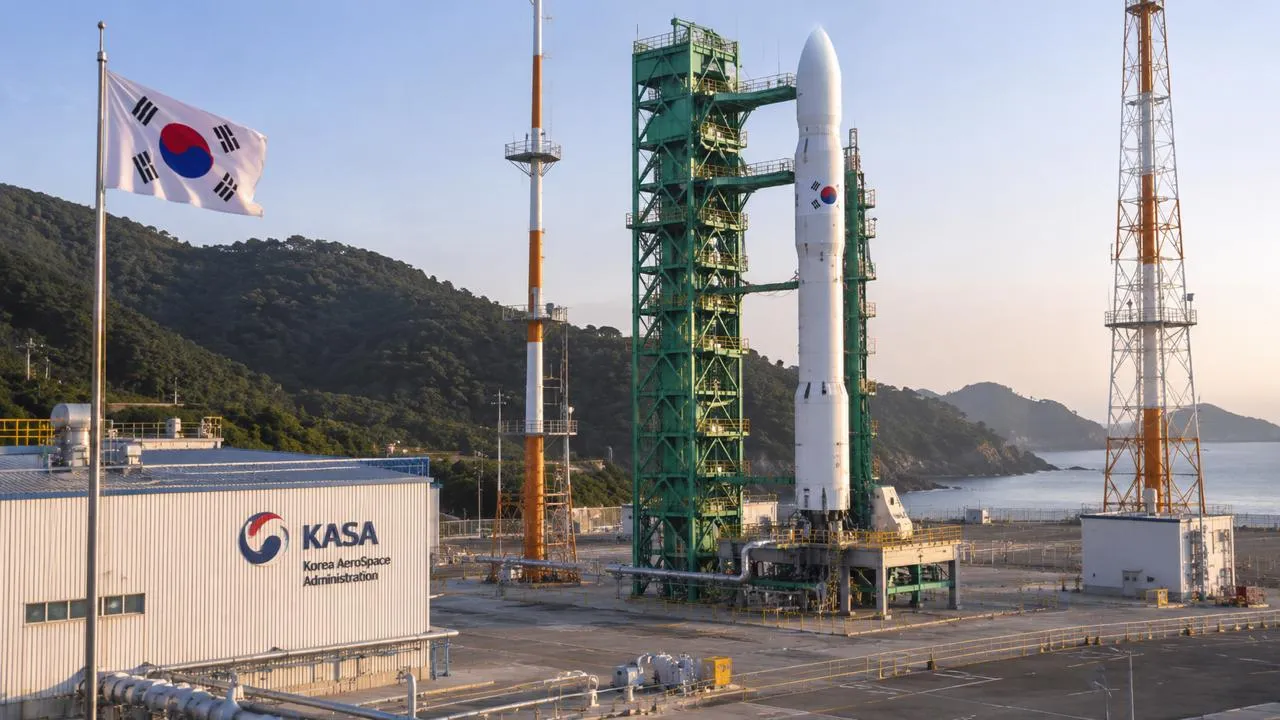
Korea reached a milestone on Oct. 7, when the fifth launch of the Nuri launch vehicle succeeded, placing five ultra-small cluster satellites into orbit at once for the first time. But Nuri and the planned next-generation launcher cannot alone lift the hundreds of satellites the constellation requires. Speaking at the Korea AeroSpace Administration office in Sacheon on Oct. 29, Oh said the agency will have private launch vehicles developed and put into operation from 2033.
Unlike the conventional approach in which the government develops a launcher and transfers it to industry, companies will sign contracts from the outset to launch satellites on behalf of the government and develop the vehicles themselves. Oh said the government will offer matching funds and incentives that share early risks, paying milestones for meeting staged goals and guaranteeing a certain level of launch demand so the business is viable. He said nothing is set on funding, but expects a program under 1 trillion won, below the roughly 2 trillion won spent on Nuri or the next-generation launcher, with private firms bearing part of the cost and using existing national test facilities and launch sites to cut expenses.
Oh said Korea should not compete head-on with SpaceX, comparing foreign rockets to large airliners on fixed routes and Korea’s launcher to a charter that goes directly where wanted. He argued Korea should focus on high-value-added components rather than finished satellites, citing semiconductors, solar cells, and thermal management as areas of strength. He said domestic companies can build from several dozen up to about 100 satellites a year, and that a next-generation reusable launcher with about three times Nuri’s payload would allow more satellites to reach orbit.
Oh framed the satellite network as the catalyst for space-industry growth, saying space has become a strategically vital domain and that, within national capacity, Korea should pursue launch vehicles, satellites, and deep-space exploration to the Moon. He said companies, unlike research institutes, can assume risk and move faster, which is why the space industry needs to be company-led. He added that commercial launchers should cut unnecessary redundant systems and simplify production, using commercial off-the-shelf parts designed so the system still works if some satellites fail.
The next-generation launcher is slated to be operational from 2033, and the government plans to provide demonstration opportunities to verify whether ground-proven components can be used in space. Funding levels for private launcher development remain undecided.