Following a six-month battle to regain communication with its Mars Atmosphere and Volatile Evolution (MAVEN) spacecraft around Mars, NASA announced the conclusion of the MAVEN mission on June 3rd. The mission, which launched to the red planet in 2013, studied the Martian atmosphere and its evolution for 11 years — over a decade longer than initially expected.
Though MAVEN is no longer making new measurements at Mars, the data it collected remains highly valuable for planetary scientists and continues to be analyzed. One team of scientists recently used MAVEN data to discover an atmospheric effect in Mars’ atmosphere that deflects incoming solar wind in the absence of a magnetosphere.
NASA concludes MAVEN’s 11-year mission at Mars
MAVEN launched to Mars in November 2013 atop an Atlas V rocket, entered orbit in September 2014, and officially began scientific observations in November 2014. Selected in 2008 as the second mission under NASA’s Mars Scout Program, MAVEN featured a suite of eight scientific instruments designed to probe the Martian atmosphere and study the loss of its gases over time. MAVEN was the first NASA mission to conduct in-depth studies into the history and evolution of the red planet’s atmosphere.

MAVEN launches to Mars atop an Atlas V. (Credit: NASA)
At the time of its launch, MAVEN’s primary mission was expected to last two years, with one year dedicated to scientific operations in orbit around Mars. Due to the good health of the spacecraft and the quality of the data it was returning, MAVEN’s science phase was extended several times, first from June 2015 through September 2016, and then again from October 2016 through September 2018.
Ultimately, by the end of its mission, MAVEN had operated at Mars for 10 years longer than initially planned. During this time, it continued to collect atmospheric measurements and support communications between Earth and other Martian spacecraft — most notably NASA’s Curiosity and Perseverance rovers.
NASA’s Deep Space Network (DSN) lost contact with MAVEN on Dec. 6, 2025. The DSN is a worldwide network of large radio antennas that send and receive signals from NASA’s fleet of spacecraft throughout the solar system. When contact was lost, the satellite had been operating in a 4,500 km by 130 km orbit around Mars since 2019, completing approximately 6.6 orbits per day. Normally, when MAVEN’s orbit takes it behind Mars, teams briefly lose contact with the spacecraft until it emerges and reestablishes contact with the DSN. However, on Dec. 6, the DSN received no signals from the craft after it orbited behind Mars.
(adsbygoogle = window.adsbygoogle || []).push({});
Small amounts of data from the spacecraft were recovered after the loss of signal, indicating that MAVEN had entered safe mode due to an unexpectedly high spin rate, leading teams to believe its orbit had been disrupted. Interestingly, before passing behind Mars, MAVEN telemetry showed that all spacecraft systems were functioning nominally. NASA convened an anomaly review board in February to assess potential recovery efforts and the probable state of the Mars orbiter.
The review board concluded that the spacecraft’s batteries had likely been drained by the rotation, leaving MAVEN without power and unable to communicate with Earth, meaning the spacecraft cannot be recovered — ending its mission. However, the cause of the anomaly remains unknown, and the review board is expected to continue its investigations and provide results in a final report later this year. In the meantime, NASA will start the official decommissioning procedures for MAVEN and its team of scientists, and begin archiving the mission’s entire dataset for use in future studies of Mars’ atmosphere.
LIVE: Leaders with NASA’s Mars Atmosphere and Volatile Evolution (MAVEN) mission are providing an update on spacecraft operations and discussing the mission’s accomplishments. https://t.co/dEw7GWe3JS pic.twitter.com/QDrhHUQu5P
— NASA (@NASA) June 3, 2026
“The science MAVEN has given us is key to informing what kind of radiation protection and safety measures we must take before sending humans to Mars. The data collected from MAVEN will continue to provide valuable insight into Mars for decades to come,” said Louise Prockter, director of NASA’s Planetary Science Division.
See Also
- MAVEN Updates
- Mars Missions Section
- NSF Shop
- Click here to Join L2
“The MAVEN mission has truly advanced our understanding of the Martian atmosphere and evolution. This dataset has had a tremendous impact on the field. Our science team is exceptionally proud of all of these amazing discoveries,” said MAVEN principal investigator Shannon Curry of the Laboratory for Atmospheric and Space Physics at the University of Colorado Boulder.
MAVEN discovers a solar wind deflection phenomenon at Mars
Although the spacecraft is no longer active around Mars, its data continues to be used by teams of scientists around the world. One such team, led by Christopher Fowler of West Virginia University, used MAVEN data to discover a solar wind deflection process within Mars’ atmosphere. The phenomenon operates similarly to processes in Earth’s magnetosphere that deflect the solar wind away from Earth.
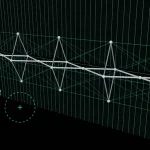
During this phenomenon, known as the Zwan-Wolf effect, charged particles ejected by the Sun are confined within magnetic structures in Mars’ atmosphere called flux tubes. The effect was first discovered in 1976 and — until Fowler et al.’s discovery — was believed to occur only in planetary magnetospheres, not in atmospheres. Mars lacks a strong magnetosphere like Earth, so the Zwan-Wolf effect instead occurs within the planet’s ionosphere, which lies below 200 km above the Martian surface. This atmospheric region contains significant numbers of charged particles, now known to be distributed via the Zwan-Wolf effect.

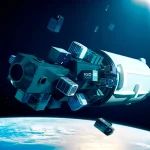
Artist’s impression of the Zwan-Wolf effect occurring within Mars’ atmosphere. (Credit: LASP/CU Boulder)
“When investigating the data, I all of a sudden noticed some very interesting wiggles. I would never have guessed it would be this effect, since it’s never been seen in a planetary atmosphere before,” Fowler explained.
Unlike Earth, Mars’ magnetosphere is induced by interactions between the solar wind and the planet’s ionosphere. Thus, due to fluctuating amounts of solar wind being ejected by the Sun, Mars’ magnetosphere can vary greatly in size and shape. MAVEN’s orbit brought the spacecraft into the outer regions of Mars’ atmosphere, so when a large solar storm impacted Mars, Fowler’s team studied the magnetosphere and observed unexpected fluctuations in the planet’s magnetic field. Several of MAVEN’s instruments are designed to study the Martian ionosphere, and after reviewing their data, the scientists determined that the Zwan-Wolf effect was the only explanation for the magnetic field fluctuations they observed.
The solar storm likely amplified the effect within the ionosphere, allowing Fowler’s team to discover it. Interestingly, the team noted that the effect may be occurring continuously in the ionosphere without the aid of solar storms, but MAVEN’s instrumentation would not have been able to detect it.

MAVEN fully deployed during testing before launch in 2013. (Credit: NASA/Kim Shiflett)
“No one expected that this effect could even occur in the atmosphere. That’s what makes this even more exciting. It introduces interesting physics that we haven’t yet explored and a new way the Sun and space weather can change the dynamics in the Martian atmosphere,” Fowler said.
The discovery of the Zwan-Wolf effect on Mars will further planetary scientists’ understanding of how space weather affects different types of planetary bodies, particularly those with little to no magnetosphere, such as Titan and Venus. Furthermore, as humanity pushes further into the solar system, understanding how space weather affects Mars’ climate is essential for preparing future astronauts and spacecraft that visit the red planet.
“Knowing how space weather interacts with Mars is essential. The MAVEN team continues making new discoveries with our datasets and finding these links between our host star and the red planet,” said Curry.
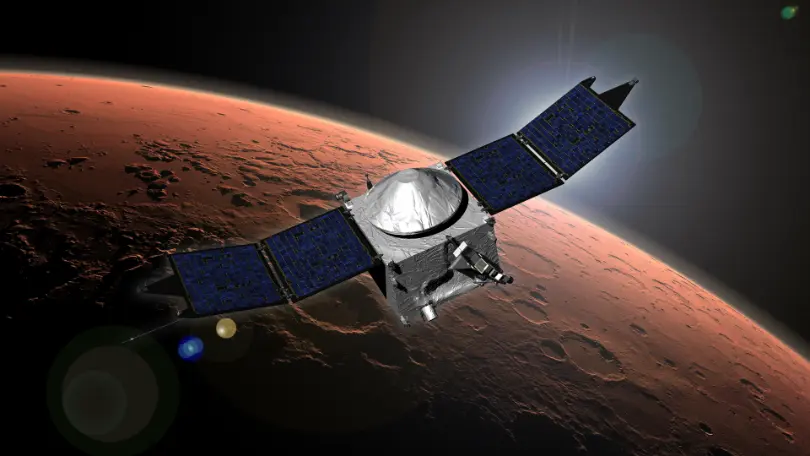
(Lead image: Artist’s impression of MAVEN at Mars. Credit: NASA)