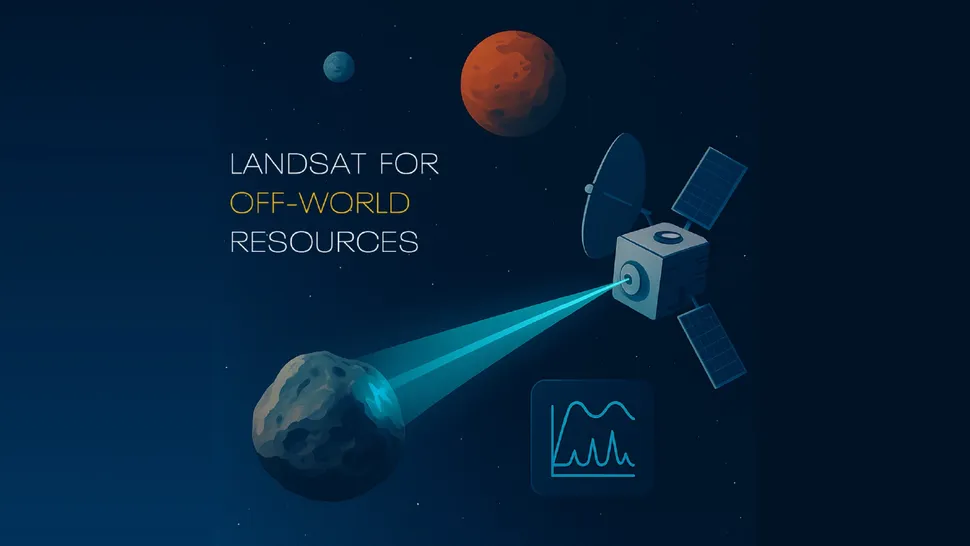
NASA has awarded Phase I funding to Interworld Slingshot Resource Surveys, a SETI Institute-led concept that would use a single 300-kilogram spacecraft to identify minerals on the Moon, a near-Earth asteroid and a Martian moon. The study will assess whether Raman spectroscopy can measure surface composition from 30–50 kilometers away, potentially helping future missions select exploration sites before committing to landing.
The project was among 18 NASA Innovative Advanced Concepts awards announced July 29, 2026. Each provides up to $175,000 for a nine-month investigation. Led by SETI Institute research scientist Pablo Sobron in Mountain View, California, the study remains an early feasibility effort; it is not an approved NASA flight mission.

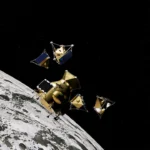
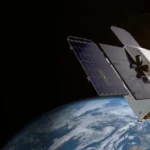
The NASA-funded Interworld Slingshot Resource Surveys study is exploring whether a small spacecraft could survey the moon, a near-Earth asteroid and Phobos during a single mission using a single remote-sensing instrument. (Image credit: Pablo Sobron)
Its central objective is to reduce the uncertainty surrounding resources beyond Earth. Identifying promising deposits remotely could help avoid expensive landings at unsuitable locations and guide subsequent sampling or drilling.
“The thing most likely to stop space mining may be that we cannot afford to prove there is anything worth mining,” Sobron said.
The ambition resembles the reconnaissance role that Landsat has served on Earth for more than five decades: providing observations that help users understand surface materials and decide where to investigate further.
The reference architecture uses solar electric propulsion for three reconnaissance stages. A 50-kilometer lunar polar orbit would support surveys of ice and ilmenite. A near-Earth asteroid encounter at approximately 30 kilometers would seek to characterize silicates, metals and organics. The spacecraft would then investigate volatile-bearing minerals from a proposed 30–50-kilometer orbit around Phobos or Deimos.
The trajectory remains under study. In an August 19 update, the SETI Institute described an alternative involving lunar orbital measurements followed by flybys of an asteroid and Phobos, with an estimated mission duration of five to eight years.
Raman spectroscopy identifies materials through small wavelength changes in laser light scattered by a target. These shifts reveal molecular structure, providing information about mineral composition. NASA’s Perseverance rover already uses Raman instruments in SHERLOC and SuperCam, but extending the technique to a moving spacecraft tens of kilometers above a surface presents a substantially different challenge.
Sobron’s earlier long-distance Raman work reached about 120 meters. The proposed observing range would be roughly 250–417 times greater. The team describes the signal as extremely weak, estimating that only about one photon in 10 trillion is Raman-scattered.
The instrument concept combines a pulsed laser, a time-gated photon-counting detector and precise beam steering. Researchers must determine whether sufficient light can illuminate a target and return to the detector, while spacecraft motion and pointing jitter remain controlled enough to recover useful spectra.
That makes instrument performance and mission design closely linked. Lower observing altitudes and alternative propulsion arrangements are among the options being evaluated if the initial architecture cannot meet its measurement requirements.
The team includes specialists from the SETI Institute, NASA Goddard Space Flight Center, NASA Ames Research Center and OffWorld. Its immediate goal is to identify promising targets for closer examination. The measurements would not by themselves establish economically recoverable reserves.
The longer-term vision is a Discovery-class mission architecture that could support additional reconnaissance spacecraft across the inner solar system. Potential applications include lunar landing-site selection, asteroid resource assessment and planning for local resource use around Mars.
Phase I will determine whether the concept is physically feasible and what advances in lasers, detectors or spacecraft systems it requires. A subsequent step would be competing for two-year NIAC Phase II support to develop the concept further.