Astronomers using South Africa’s MeerKAT radio telescope have detected faint hydrogen emissions that travelled roughly four to five billion years to Earth, demonstrating a way to study cosmic structure without relying on optical galaxy surveys. Announced on September 1, 2026, the result draws on approximately 96 hours of observations and measures hydrogen at two redshifts, about 0.32 and 0.44.
The international team, involving the University of the Western Cape and the University of Manchester, used hydrogen intensity mapping to measure the combined radio emission from galaxies too faint to identify individually. The findings, published in The Astrophysical Journal Letters, strengthen the case for using this technique to survey large cosmic volumes.
Neutral hydrogen emits radiation at a characteristic wavelength of approximately 21 centimeters. Cosmic expansion stretches that wavelength during its journey to Earth. Measuring the resulting redshift lets astronomers place the emitting gas at different stages of cosmic history, providing the depth information needed for three-dimensional mapping.
The method’s operational advantage is that researchers can measure the collective emission of many unresolved galaxies instead of detecting each galaxy separately. Co-author Zhaoting Chen said this offers a way to investigate both galaxy evolution and the distribution of matter. Previous robust detections at comparable distances have typically depended on combining radio measurements with optical galaxy surveys; this study extracted the signal from MeerKAT observations alone.
Early telescope data yield a new measurement
MeerKAT comprises 64 antennas in South Africa’s Northern Cape. The observations used in the analysis were collected in 2018, during the telescope’s early operational period. Lead author Sourabh Paul identified brighter foreground emission, human-generated radio interference and instrumental effects as major obstacles to isolating the much weaker hydrogen signal. The measurements probe structures spanning millions of light-years.
SARAO chief scientist Fernando Camilo said the dataset was originally collected to demonstrate MeerKAT’s technical readiness before science operations, rather than for a specific scientific investigation. It has since supported research into the universe’s star formation history as well as the hydrogen measurement.
The intensity-mapping project began in 2021, when Paul was a postdoctoral researcher in Mario Santos’s group at the University of the Western Cape. Two independent analysis methods produced consistent results, strengthening confidence in the detection.
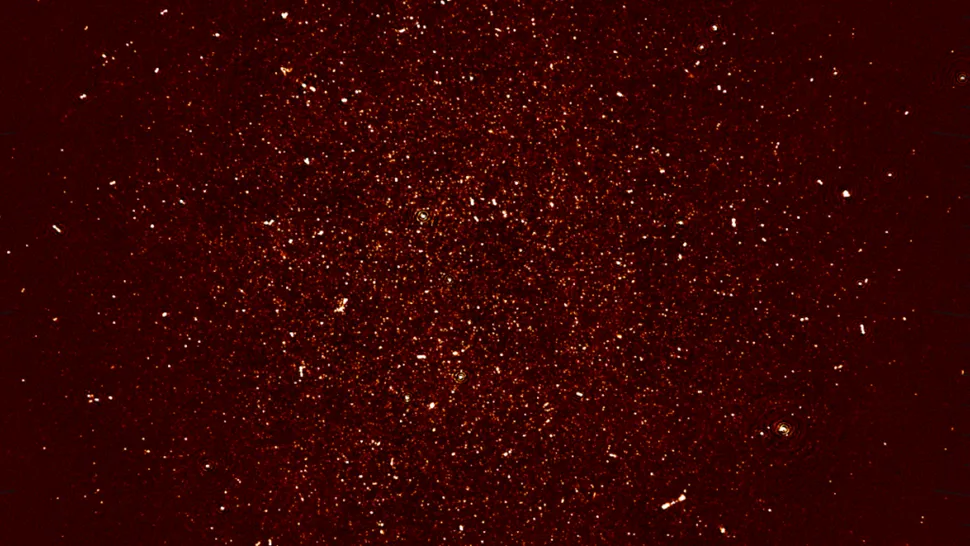
The result is a statistical measurement of hydrogen structure: the faint signal is not visible by eye in the radio image. It establishes a basis for broader mapping rather than delivering a comprehensive map of the distant universe.
A foundation for larger surveys
Co-author Laura Wolz of the University of Manchester said extracting the signal from observations not designed for intensity mapping demonstrates the scientific value of existing MeerKAT data. It also supports preparations for future surveys with the Square Kilometre Array Observatory.
Researchers now plan observations covering larger areas of sky with longer observing times. These measurements are intended to improve the detail of hydrogen maps and help establish how galaxies and cosmic structures evolved over billions of years.
Cover image: The MeerKAT in which astronomers made a detection of hydrogen in the distant universe (Image credit: Paul, et al (2026))