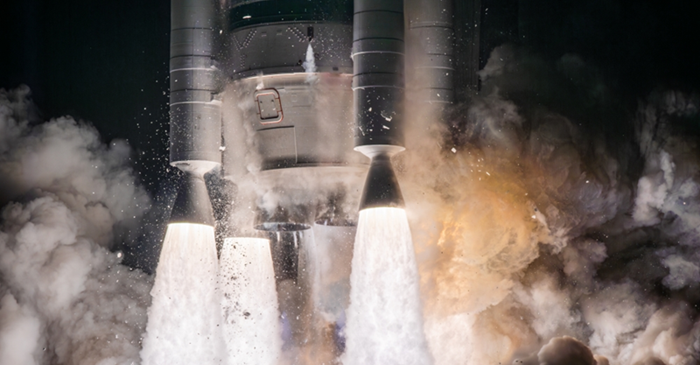
Four Northrop Grumman Corporation 63-inch-diameter extended length Graphite Epoxy Motors (GEM 63XL) delivered nearly two million pounds of thrust to help power the first certified launch of United Launch Alliance’s Vulcan rocket and the U.S. Space Force-106 mission. This launch marks the first time four GEM 63XL boosters have flown together, making it the most powerful Vulcan configuration to date.
Northrop Grumman’s commercial solid rocket motor products build upon flight-proven heritage and leverage commonalities to continuously improve and expand motor families at a low-cost and with high reliability and repeatable performance.
Northrop Grumman also provided an ESPAStar spacecraft bus for the mission’s Navigation Technology Satellite 3 payload. Northrop Grumman’s ESPAStar platform provides a modular, cost-effective and highly capable infrastructure resource for hosting technology development and operational payloads. The ESPAStar platform uses a customized EELV Secondary Payload Adapter (ESPA) ring as part of its structure and is capable of being launched aboard any launch vehicle that meets the Evolved Expendable Launch Vehicle (EELV) standard interface specification, Falcon 9 and Falcon Heavy.
Northrop Grumman began developing the Graphite Epoxy Motor (GEM) with the GEM 40 to increase launch capability for the Delta II launch vehicle, used on the Delta III and Delta II Heavy, and GEM 60 for the Delta IV Medium-Plus vehicle. The fourth-generation GEM 63 booster flew its inaugural flight on the Atlas V and the company began testing the extended-length GEM 63XL variant, the longest monolithic rocket motor produced to date to serve the Vulcan Centaur vehicle.