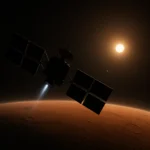
Rocket Lab released its IMM Apex space solar cell for production on September 8, offering a Beginning of Life conversion efficiency of 31.5% while eliminating the germanium substrate used in conventional multi-junction cells. The company said the product is 40% lighter than comparable cells and is intended to reduce satellite manufacturers’ exposure to rising germanium costs and supply constraints.
IMM Apex is the latest product based on Rocket Lab’s Inverted Metamorphic solar-cell architecture. Unlike conventional multi-junction cells, which retain a germanium growth substrate as part of the finished device, the IMM manufacturing process allows the semiconductor layers to be separated from the original substrate. Removing that material reduces cell mass while preserving the stacked junctions used to convert different parts of the solar spectrum into electricity.
The 31.5% figure describes Beginning of Life efficiency, or performance before extended exposure to the orbital radiation and thermal environment. Rocket Lab said the cell retains radiation hardness and performance across operating temperatures, although it did not publish detailed end-of-life power figures or qualification parameters for IMM Apex.
Lower cell mass increases specific power, measured in watts generated per kilogram. That can reduce the mass of a spacecraft’s solar array for a given power requirement or allow designers to generate more power within the same mass allocation. The benefit is particularly relevant for power-intensive communications, Earth-observation and national-security satellites, as well as spacecraft operating under tight launch-mass constraints.
Designed as a Drop-In Replacement
Rocket Lab said IMM Apex is mechanically and electrically compatible with heritage germanium-based solar cells. The drop-in design is intended to let satellite and solar-array manufacturers adopt the new cell without substantially redesigning panel hardware, electrical interfaces or production tooling.
That compatibility could be as important commercially as the efficiency increase. Spacecraft power systems typically require lengthy qualification and integration programs, making manufacturers reluctant to introduce components that require major changes to established panel designs. A cell that fits existing architectures may shorten adoption timelines and reduce non-recurring engineering costs.
Rocket Lab said optimized manufacturing processes and targeted capital investment have enabled production at multi-hundred-kilowatt volumes. IMM Apex is available to customers immediately, although the company did not identify initial buyers, order volumes or delivery schedules.
The product’s removal of germanium also addresses an industrial-base vulnerability extending beyond the space sector. Germanium is used in satellite solar cells as well as infrared optics and other defense systems, and the United States has been investing in additional domestic refining capacity. Rocket Lab’s approach does not remove every specialized semiconductor material from the cell, but it eliminates the bulk germanium substrate from the finished product.
Solar Technology Acquired Through SolAero
Rocket Lab entered large-scale space solar manufacturing through its acquisition of SolAero Technologies in January 2022. The business now forms part of Rocket Lab’s broader space-systems portfolio, which includes spacecraft, separation systems, reaction wheels, flight software and solar arrays alongside the company’s launch operations.
IMM Apex builds on a technology line with more than a decade of testing, qualification and orbital use. An earlier IMM cell powered NASA’s Ingenuity Mars Helicopter, whose lightweight solar array recharged its batteries during operations on Mars. Rocket Lab’s solar hardware has also supported the James Webb Space Telescope, NASA’s Artemis lunar program and other interplanetary missions.
The company says its solar products currently power more than 1,100 satellites in orbit and that it has manufactured cells representing more than 4 megawatts of power. Its catalog includes triple-junction, four-junction and IMM products designed for low Earth orbit, geostationary orbit and interplanetary missions.
IMM Apex’s 31.5% Beginning of Life efficiency is not the highest figure across Rocket Lab’s entire catalog; the company lists other IMM variants with higher nominal efficiencies. Its principal differentiators are the combination of germanium-free construction, lower mass, production scalability and compatibility with established germanium-based cell designs.
Rocket Lab said further development of the IMM platform is continuing, but it did not specify the next efficiency target or product introduction. The immediate milestone will be the transition of IMM Apex from production release into customer orders and qualified spacecraft programs.