The return of Starship launches may be just weeks away, with notices for the upcoming Flight 12 launch attempt publishing notification for windows opening as early as May 12.
The move signals accelerating preparations for the first orbital test flight of the upgraded Version 3 Starship and Super Heavy vehicles, although engineers will have several milestones to complete with the new vehicle and pad.
According to the notices, launch windows run from May 12 through May 18, with daily opportunities in the afternoon. Each window opens at approximately 5:30 p.m. Central Time (22:30 UTC) and extends for about two hours, including margin.
The target vehicle stack—Booster 19 and Ship 39—will lift off from Orbital Launch Pad 2 at Starbase in Boca Chica, Texas.
 This launch would come roughly 211 days after Flight 11, just one day short of the record 212-day gap between Flights 1 and 2. With the first window only 11 days away as of May 1, the timeline is aggressive, and could mirror the repeated slips seen ahead of Flight 2, as SpaceX works through remaining technical hurdles.
A notable change for Flight 12 is the revised flight path. Previous flights followed a trajectory passing just north of Cuba, Hispaniola, Puerto Rico, and the Leeward Islands.
The new plan threads a narrower corridor south of these landmasses: between Jamaica and Cuba, then between St. Vincent and Grenada in the Leeward Islands. This southern route avoids major airline corridors from Hispaniola and Puerto Rico.
In the event of a mishap similar to those experienced by Ships 33 or 34, debris would predominantly fall into the open waters of the Caribbean Sea rather than nearer populated or heavily trafficked areas. The Federal Aviation Administration has approved adjusted paths that enable this more southerly departure over the Gulf of Mexico and Caribbean.
The mission profile remains a suborbital test, with an eventual splashdown targeted in the Indian Ocean, continuing SpaceX’s iterative approach to validating heat shield performance, booster catch attempts (not planned for this mission), and overall vehicle reliability.
SpaceX
(adsbygoogle = window.adsbygoogle || []).push({});
SpaceX’s recent “Test Like You Fly” video provided insights into the intense engineering campaign leading to Flight 12.
Joe Petrzelka, Vice President of Starship Engineering, described the Version 3 booster as the most ambitious vehicle his team has tackled.
Footage from Megabay 1 shows the stacking of the methane tank onto the LOX tank on Booster 19, highlighting internal structures like the common dome and three-meter transfer tube.
Petrzelka reflected on the rapid iteration of earlier campaigns, including dramatic imagery of the crater left in Pad 1’s foundation after Flight 1. Booster 18 became the first Version 3 booster, but it suffered a LOX tank rupture during nitrogen pressurization testing at Masseys—using only simulants, with no reactive propellants present.
Jenna Lowe, Senior Manager of Starship Operations, detailed Booster 19’s successful 12-hour cryo proof test at Masseys, where the vehicle was loaded with LOX and LN2 to validate all major systems. The booster was fully frosted during the evolution, demonstrating robust cryogenic handling.
 At McGregor, Texas, Jacob McKenzie, Vice President of Raptor, outlined goals for the Raptor 3 engine: simpler manufacturing, greater reliability, and operations akin to commercial turbofan engines like the CFM56 on Boeing 737s. The aim is on-demand ignition after hundreds of firings with minimal inspection.
Booster 19’s propulsion testing proved challenging. A 10-engine static fire aborted after just 2.135 seconds due to issues with two Apex Combustors (gas generators for the pad water deluge system). Roughly half the engines sustained mechanical damage and were replaced. SpaceX swapped all 33 engines on Booster 19 with a fresh set, drawing from Booster 20’s allocation.
A subsequent 33-engine attempt aborted early due to a sensor issue in a ramp manifold. Full-duration firing has not yet been achieved on the pad, and another static fire is expected to verify deluge system modifications.
 New camera angles, including views under the grid fins and a center thrust puck facing the engine cluster, are providing enhanced data.
The video also addressed setbacks, such as Ship 36’s explosion during a six-engine static fire on June 18, 2025, triggered by a composite overwrapped pressure vessel (COPV) failure. That incident closed the test site for months. Ship 39 later achieved a full-duration static fire at the rebuilt Masseys facility, confirming operational recovery after roughly ten months.
Pad 2 has seen extensive rehearsals, including BQD (boostback quick disconnect), SQD (strongback quick disconnect), and clamp arm retracts—critical for safe liftoff clearance.
Flight 12 represents the debut of the Block 3 configuration, featuring taller tanks, more powerful Raptor 3 engines, and design refinements for future orbital operations, including in-space refueling demonstrations. Success would pave the way for more frequent flights and progress toward NASA’s Artemis program.
With notices now public and hardware in advanced testing, all eyes remain on Starbase. SpaceX has not yet confirmed a firm go/no-go for May 12, and it is likely to slip days, but the published windows and ongoing pad activities indicate the team is pushing hard toward an imminent return to flight.
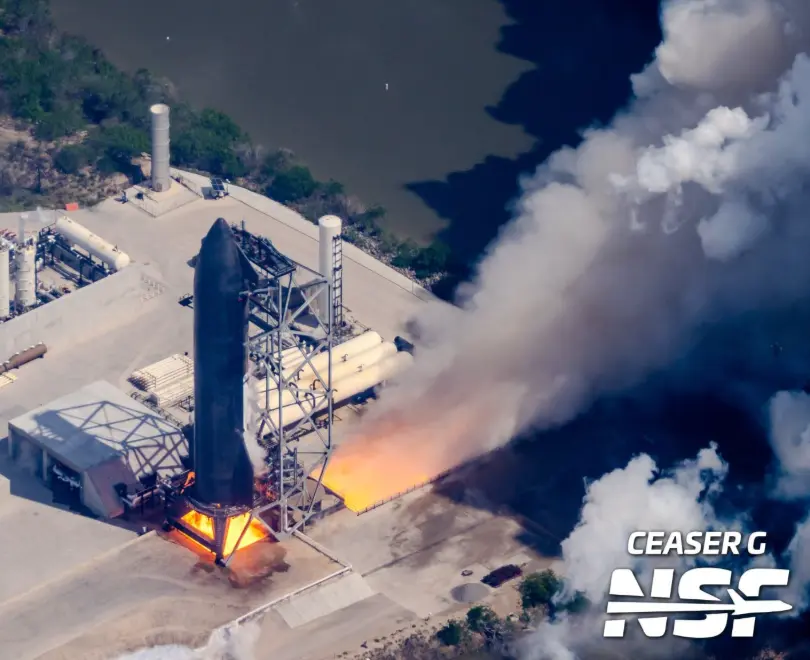
Featured Image: Ship 39 Static Fire from the air (Credit: Ceaser G for NSF)