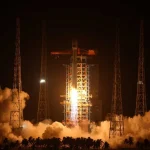
On Friday, May 22, 2026, at 5:30:21 pm CDT, Starship Flight 12 lifted off from Pad 2 at Starbase, Texas. This stack, which comprised Ship 39 and Booster 19, was the first Block 3 stack to fly for the Starship Program. As well as launching from the completely redesigned Pad 2 at Starbase. This flight was the culmination of years of work to build a much more advanced Starship vehicle and launch pad.
Flight 12
After delaying and then aborting the day before, SpaceX had a perfect chilldown and propellant load of Ship 39 and Booster 19. Then, once at the T-40-second hold point, they held for only a few seconds for final checks before going all the way to liftoff. With the new launch pad’s flame trench and water deluge systems, the liftoff looks like a Saturn V lifting off from LC-39A, with the exhaust plume and clouds split in half.
However, unlike Saturn V, this rocket didn’t lumber off the launch pad; with a thrust-to-weight ratio of nearly 1.5, this rocket shot off the pad in seconds. The entire stack then did a 270-degree roll maneuver as all 33 Raptor 3 engines were running to start the ascent burn. Then, at T+00:01:43, a single outer Raptor 3 engine shut down for an unknown reason.
The Booster would complete its ascent burn, then came hot staging and stage separation, during which the booster shut down 28 of 33 engines, and Ship 39 ignited all six engines before flying away on its own. Booster 19 then attempted to flip and complete a 33-engine boost back burn; however, several engines didn’t relight, and the rest tried to shut down.
Science Fiction & Fantasy
(adsbygoogle = window.adsbygoogle || []).push({});
The booster then lost control before all engines shut down, which sent Booster 19 into a tumble until it hit the thicker parts of the atmosphere, where the grid fins were able to regain control. The booster then completed the rest of its glide, where it attempted a landing burn before possibly exploding during the landing burn. Even though things didn’t go perfectly for Booster 19, it’s an amazing accomplishment considering it’s a clean-sheet design.
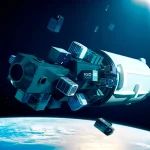
The Ship would continue its ascent burn but would lose one of its Raptor Vacuum engines at T+00:03:03 on ascent. This, however, would not spell the end of Ship 39, as using thrust vector control and a longer burn, it was able to reach nominal suborbital insertion. During the coast phase, the ship wouldn’t complete its in-space Raptor relight, but it would deploy all 22 satellites.
The last two, which were modified V2 Starlink Minis, had spotlights and cameras. The footage gathered from those shots was amazing to say the least. Ship 39 then completed its reentry and other experiments perfectly, before splashing down in the Indian Ocean on target and with an amazing-looking heat shield.
And as well, the launch pad looks to be in near-perfect shape, except for the Gateway to Mars sign, which was nearly obliterated.
Flight 12 Attempt #1
SpaceX went into a launch attempt on May 21 after having a possible abort with a Wet Dress Rehearsal (WDR) on May 20. The day started off with weather that was bad for launch, but it cleared completely as the launch window approached. After getting to about T-1 hour, SpaceX delayed the launch by 30 minutes to 6:00 pm, then by another 30 minutes to 6:30 pm.
Propellant load was nearly seamless, and the vehicles had no issues throughout the process. Then SpaceX hit the T-40-second hold, and that’s where the fun began with several holds. First hold was to check the quick disconnect vents for their final throwbacks, then the second hold at T-35 seconds was for managing pressures in the SQD, third hold was at around T-28 seconds for a water diverter issue, Fourth hold was at T-28 seconds again for sensors on the arm that manages the SQD to the ship. All this time, teams have been monitoring the propellant temperatures inside each vehicle, because the propellant can’t be held forever; eventually, the temperatures get too high for the Raptor engines.
The Fifth hold was at T-28 seconds once again and was caused by the hydraulic pin that holds the SQD arm to the tower not disengaging, as stated by SpaceX CEO Elon Musk.
Should SpaceX fix this issue by Friday, May 22, they will proceed with another launch attempt, with the road closure from 10 am to 9 pm CDT. The launch window is the same as May 21, opening at 5:30 pm CDT and ending at 7 pm CDT.
The hydraulic pin holding the tower arm in place did not retract.
If that can be fixed tonight, there will be another launch attempt tomorrow at 5:30 CT. https://t.co/DJAdvDYQpH
— Elon Musk (@elonmusk) May 21, 2026
Pad 2, Booster 19, and Ship 39, the Intro of Block 3, and Raptor 3
Flight 12 will introduce many new components to the Starship program. First off is a completely redesigned launch pad, Pad 2, which, rather than six legs and 360-degree exhaust, directs the exhaust plume through a pair of openings via a flame trench and water deflector system. The entire launch pad has been completely redesigned with a new water deluge system, tank farm, launch mount, and tower.
For a more in-depth look at the Pad, it’s covered in this standalone article here: SpaceX’s new Starship pad readies for first launch. Ship 39
Booster 19 is the booster for this flight and represents a clean-sheet design change compared to Block 2 boosters. There are many obvious changes, such as the new integrated hotstage ring and truss, only three grid fins, and a completely redesigned aft section.
SpaceX has taken lessons learned over the last several years to make changes that booster engineers have wanted for a while.

Booster 19’s Raptor 3 Engines (Credit: Max Evans for NSF)
For a more in-depth look at the booster, it’s covered in this standalone article here: Super Heavy Block 3 the Booster of the Future
Next up is Ship 39, which is also a block 3 design and a partially clean-sheet design for many of the systems aboard. A few things are the relocation of the common and aft domes to accommodate more propellant, the addition of drogue docking ports, and a complete overhaul of the Reaction Control System (RCS). This newly designed ship is set to kick off Starlink missions, orbital refueling, and eventually landing humans back on the Moon.
For a more in-depth look at the ship, it’s covered in this standalone article here: Flight 12 readies for the debut SpaceX’s next Ship evolution

Ship 39 rolling out for Flight (Credit: Max Evans for NSF)
Lastly, this flight introduces Raptor 3, which is a major upgrade over Raptor 2. Raptor 3 is another leap forward for SpaceX to make an engine reliable enough for it to act like an aircraft turbofan engine, which can be turned on at a moment’s notice and is incredibly reliable. To do this, engineers eliminated flanges around the turbopumps and simplified the overall design to make the engine easier to manufacture.
Other changes include the use of a brand-new acoustic igniter system. These igniters don’t have any moving parts or generate a spark, unlike the igniter on an internal combustion engine or the torch igniters used on Raptor 2.
Acoustic igniters rely on the interaction between a supersonic jet flow issuing from a nozzle and a resonance tube placed closely downstream, producing a dramatic increase in temperature in the resonance tube. This increase in temperature will cause the gases to ignite, thus creating an igniter. Using this type of ignition eliminates the electrical systems required for a spark ignition system and can simplify the ignition process.
Validation testing on a Raptor 3 performing a Starship V3 ascent burn. Multiple versions of this test will cover the different conditions seen by Starship’s three inner engines during its initial climb to space pic.twitter.com/Rrd4rEuGqt
— SpaceX (@SpaceX) December 3, 2025
With the igniters just using the propellant, SpaceX also switched the spin-up gases on Raptor 3; in the past, Raptor used Helium or Nitrogen. However, with Raptor 3, SpaceX has switched to using gaseous Oxygen and Methane to start their respective turbopumps.
Other improvements for Raptor 3 include higher internal chamber pressure, increased thrust, and reduced weight. The higher thrust results from increased chamber pressure. Raptor 3 sea level engines will start off at 250 tons (551,000 lbf) of thrust, with a final goal of hitting 280 tons (617,000 lbf), and Raptor 3 Vacuum engines are currently at 275 tons (606,000 lbf).
The weight was also reduced, with the engine itself going from 1,630 kg (3,593 lbs) to 1,525 kg (3,362 lbs). However, the real weight savings are on the vehicle side, with each engine having lost about 2,000 lbs (907 kg) of mass due to the deletion of most of the engine shielding on the aft of the booster.

Raptor 3 on Booster 19 (Credit: Max Evans for NSF)
This engine, with all its changes, is slated to be the program’s future until SpaceX comes up with something better. This should be the engine that lands humans back on the moon, and maybe even on Mars.
In preparation for this flight, SpaceX has done a ton of testing not only on the new launch pad but also on the vehicles themselves and on many test tanks. B18.1, which is the booster aft test article, completed 16 cryo tests. S39.1 The ship aft test article has completed 13 cryo proof tests so far. B18.3 The booster forward and landing tank attach hardware test tank has also completed 16 cryo proof tests so far as well.
Many of these tests used actuators, crush caps, and other forms of testing hardware to gather data to help make Block 3 a better vehicle overall. As for the vehicles themselves, Ship 39 has completed three cryo-proof tests, a few tanking tests with igniter tests, a spin prime, and a full-duration 52-second six-engine static fire. Some of the ship testing included chopstick sim testing and flap stress testing at Massey’s with the new truss structure.

Left to Right: B18.1, Booster Landing Test Tank, Ship 40, S39.1, B18.3 (Credit: Gage (Rough Riders Show) for NSF)
Then, Booster 19 has completed four cryo-proof tests, three tanking tests (two with igniter testing), two spin primes, one 10-engine and one 33-engine static fire, both static fires aborted due to ground-side issues, a 15-second 33-engine static fire, and, lastly, a booster Wet Dress Rehearsal (WDR) in which SpaceX fully filled the booster with Liquid Methane (LCH4) and Liquid Oxygen (LOX).
The entire stack has also aimed to complete a full WDR the day before launch on Wednesday, but appeared to halt operations mid-load. Clearly, SpaceX is taking these design changes seriously and ensuring many aspects are tested to verify them.
Timeline
With a brand-new launch pad and rocket, SpaceX also changed the entire prelaunch timeline and several elements of the launch timeline. First off, the propellant load poll now occurs at T-00:50:00, which is much later in the count than in Flight 11, which was at T-1:15:00. This is because SpaceX has significantly reduced the propellant loading times for Starship.
On Flight 11, the Ship propellant load would start around T-00:53:00, and Booster would start around T-00:41:15. On Flight 12, the Ship is set to start at T-00:38:53, with Booster set to start at T-00:35:00. This reduction in fueling time has to do with the new design of Pad 2’s tank farm. In the past, SpaceX only had one pump for both Ship propellants; now teams have four for each.

Flight 12 Prelaunch Timeline (Credit: SpaceX)
Another change is that, instead of LOX and LCH4 loads starting around the same time for the ship or booster, they now start in a staggered manner. Ship LOX load starts, then Booster LOX load, then Booster LCH4 load, and the last part to load is Ship LCH4. Then, during propellant load, Raptor 3 chilldown starts around T-00:21:30, which is a little earlier in the count than in Flight 11.