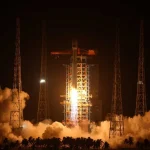
Before the emergence of the Hainan Commercial Space Launch Site, my country’s launch sites were basically “military-built and military-controlled”. Although the Hainan Commercial Space Launch Site adopted the approach of “civilian-built and civilian-controlled”, the unique “high risk” nature of aerospace limited the commercial space launch site’s early stage of development and it was impossible to completely separate from it. The existence of traditional space launch sites can also be seen from the location selection of my country’s first and currently only commercial space launch site – Hainan Commercial Space Launch Site. It is difficult to say that the existence of Wenchang Space Launch Site has no impact on the country’s decision to build my country’s first commercial space launch site in Wenchang.
However, what role traditional launch site forces play in the development of commercial space launch sites, how deeply they are involved, and how they will be separated in the future will all be inevitable issues in the future development of commercial space launch sites. This is true for the Hainan Commercial Space Launch Site, and it will also be true if our country builds other commercial space launch sites in the future. The intervention of traditional launch site forces can improve the reliability and safety of the initial missions of commercial space launch sites and better ensure the healthy and rapid development of commercial space launch sites. However, if the power of traditional launch sites is too involved, where will the advantages of commercial aerospace be reflected over traditional aerospace? In addition, there is also a very critical issue: how commercial space launch sites will “de-attach” to traditional launch sites in the future. This will also be a very important “topic” that needs to be faced in the development process of future commercial space launch sites.
In addition, the development process of commercial space launch sites will also involve a large number of military-civilian coordination issues, and military-civilian relations will extend to government-enterprise relations. The most critical of these are airspace and maritime issues. Airspace management is led by the military. Civil Aviation is responsible for air traffic management of civil aviation and implements strict airspace classification and flight plan approval systems. Before the rocket is launched, the Hainan Air Traffic Control Bureau will work with relevant departments to delineate a temporary no-fly zone and issue notices to civil aviation, general aviation and military units through the aeronautical information system to ensure that aircraft avoid the rocket flight path and debris landing area. During the launch window period, the air traffic control department monitors airspace dynamics and directs civil aviation flights to detour or wait. Sea area management adopts a comprehensive management model of “multi-department collaboration, military-civilian integration”. Before launch, the coast guard implemented a navigation ban on the landing area, and naval vessels patrolled and intercepted civilian ships to ensure that there was no risk of collision when the wreckage fell. In addition, when launching rockets in Hainan, the shooting direction is usually 90°-175° eastward, which involves military activity areas in the South China Sea. It is necessary to coordinate with the navy to avoid sensitive areas and clear relevant waters. In the early stages of the operation of the commercial space launch site, launch missions are not yet saturated, and related coordination issues are not yet obvious. However, after the completion of the second phase of the Hainan Commercial Space Launch Site, the launch site’s total annual launch capacity will jump to more than 60 times, and the launch frequency is expected to increase to “one launch per week.” With such a huge launch scale, compared with the total 8 launches of the Wenchang Space Launch Site in 2024, the problem is obvious. Moreover, the Wenchang Space Launch Site is under the control of the military and the Hainan Commercial Space Launch Site is for civilian use. The relevant coordination issues will become more prominent. This will also be another major issue that other commercial space launch sites need to face in the future construction, operation, and management.
From the military-civilian relationship, the corresponding government-enterprise relationship will be extended. Let’s put aside the air traffic control, coast guard, etc., and just talk about traffic control, clearance and control, personnel evacuation, radio detection, etc. Launch missions from traditional space launch sites are major national strategic tasks, and related activities are guaranteed by local governments. However, how should the launch missions of commercial space launch sites be defined, how should related guarantees be handled, and whether they are social behaviors or commercial behaviors. It’s still the same problem. In the early days of the launch site’s operation, the number of missions was not large. Everything was easy to say. As the frequency of launches continues to increase, how will related problems be solved? This is not just for the Hainan Commercial Space Launch Site. If other commercial space launch sites are built in the future, the same problem will also exist.