The computing power competition is “rolling” to the sky, why should the computing power center be moved to space? What are the challenges of building a “data center” in radiation-filled space? What major moves have China and the United States planned? Which technologies will become the focus of industry development in the future?
Today we will learn about: 10 new tracks for commercial aerospace in 2025 – space computing.
01
What is space computing
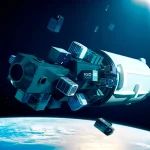
Space computing refers to the technology of deploying “computing power” into space. With the development of this technology, three different “application scenarios” have been derived: single-star intelligence (satellite-borne intelligence, AI+satellite), sky computing (computing power constellation) and earth computing (space data center).
“Single-star intelligence” is mainly to solve the pain points of autonomous satellite operation. By integrating on-board intelligent terminals on satellites, on-board tasks such as satellite independent health detection, independent mission planning, data compression, and processing analysis can be completed.
However, as high-resolution remote sensing constellations generate more and more data, space computing has been given new application prospects: counting days. Data shows that the current data utilization rate of domestic remote sensing satellites does not exceed 5%. This is mainly because the resolution of remote sensing satellites is getting higher and higher. Due to the insufficient number of ground stations, uneven global distribution and other factors, the massive original remote sensing data is covered by new data, and the effective utilization rate of the data is only 5%.
Building ground stations around the world is a very difficult matter, involving issues such as data security, international regulations, and ownership rights. “Space computing” can solve this problem very well: by adding an on-board computing module to a single satellite to process data in orbit and only transmitting “key results” back to the ground, 90% of satellite-ground link resources can be saved.
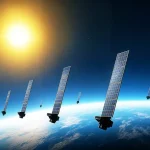
Moreover, high-resolution remote sensing constellations composed of hundreds of satellites not only intensify the demand for space computing power, but also put forward higher requirements for the utilization efficiency of computing power. If you want to improve the utilization of computing power, you need to achieve high-speed transmission of satellite data between satellites, which requires adding another module to the satellite: a laser communication terminal. It can realize point-to-point data transmission over ultra-long distances (thousands or even hundreds of thousands of kilometers), enable cloud processing of data from all satellites, and even create a “computing power constellation” to fully realize “the calculation of days and days”.
The emergence of the “calculating the earth and the sky” scenario stems from the rapid development of AI. In 2025, the world will enter the rapid construction stage of artificial intelligence data centers (AIGC). The demand for electricity and fresh water energy from terrestrial computing power is exceeding the limit that the earth can bear.
According to the “China Artificial Intelligence Computing Power Development Assessment Report” jointly released by IDC and Inspur Information, it is predicted that the IT energy consumption of artificial intelligence data centers will reach 55.1 terawatt hours in 2024, which is equivalent to the annual electricity consumption of a city with a population of 10 million. In 2027, it will exceed 146.2 terawatt hours, exceeding the total electricity consumption of Beijing in 2022.
In addition, the “water consumption per kilowatt hour” of the data center is about 1.1 liters. According to this data estimate, China’s artificial intelligence data center water consumption will reach 161 million tons in 2027, which is close to Beijing’s domestic water consumption in 2022.
If these data centers could be moved into space, the annual cost savings would be in the hundreds of billions. Therefore, space data centers are becoming a future industry comparable to satellite Internet in the global commercial aerospace field.
02
Overview of global industrial chain
At present, the development of the global space computing industry is still in its infancy. The core component computing chips are classified according to their computing capabilities: low-performance processors, such as radiation-resistant processors such as RAD6000; medium-performance processors, such as the VA7230 series of the United States Vorago, Infineon’s Cortex-M4, etc.; high-performance processors, such as NVIDIA’s Tegra X2 SoC, etc.
Among them, low-performance processors are suitable for simple control and communication tasks and are currently rarely used; medium-performance processors are the main chips of most current satellites and can handle more complex control algorithms and a small amount of data processing tasks; the development of high-performance chips for space computing is relatively slow. Most of the world’s applications of high-performance space computing chips are in the “technical verification” stage.
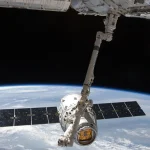
United States: As early as 2024, NASA will cooperate with HPE to deploy on-board computers equipped with NVIDIA T4 GPUs on the International Space Station. The mission can evaluate data in near real-time in low-Earth orbit. Researchers only need to transmit the evaluated and processed data or insights back to Earth. The amount of processed data is reduced by 30,000 times, greatly shortening the transmission time.
China: For space computing, the national key research and development plan “Satellite Platform Technology for Cluster/Mega Constellation Applications” project “Cluster/Mega Constellation Collaborative Computing Architecture and Network Operating System” has also made breakthroughs. In May this year, the Institute of Computing Technology of the Chinese Academy of Sciences, as the unit responsible for the project, introduced the phased application results of JigonGPT, a large aurora space-based model it developed, and the spaceborne intelligent computer payload system.
Among them, the spaceborne intelligent computer payload was developed by a team of researchers Han Yinhe, using the entire system’s domestically produced core components and a highly reliable fault-tolerant computing architecture to achieve 100 Tops-level intelligent computing capabilities; the Aurora space-based large model successfully realized the installation of JigonGPT through intermittently uploading the “Oriental Eyes High Score 01 Star”. It has been in orbit for more than 140 days. As of May 10, 2025, JigonGPT has been in orbit for more than 100 days.
Europe: The European Union is promoting the ASCEND plan as one of its strategic initiatives to address the huge computing power demands and energy challenges brought about by the rapid development of artificial intelligence.
The full name of ASCEND is “Advanced Space Cloud for European Net zero emission and Data sovereignty” (Advanced Space Cloud for European Net zero emission and Data sovereignty). It is funded by the European Commission under the Horizon Europe program to study the scientific, technical, economic and environmental feasibility of moving data centers from the ground to space, with the ultimate goal of deploying a network of space data centers in orbit with a total computing capacity of approximately 1 gigawatt (GW).
According to Research And Markets statistics, the global satellite computing hardware platform market size will be US$1.48 billion in 2024, and is expected to reach US$1.64 billion in 2025, with a growth rate of approximately 11%. This growth comes primarily from the growing demand for Earth observation data, the proliferation of satellite constellations, and more.
In the long term, space computing will maintain a high growth rate of approximately 14.3% in the next five years, driven by the demand for AI computing power, and the market size is expected to reach US$2.8 billion in 2029. This growth is mainly due to the continued expansion of the commercial space industry, the demand for satellite autonomous computing and the innovative use of AI in space applications. Emerging trends include integrating artificial intelligence into space computing platforms, software-defined space systems, onboard machine learning, and the continued miniaturization of space computing components.
By region, North America has become the world’s largest space computing market with a market share of 35%, followed by Europe with 29%, Asia-Pacific with 24%, Latin America with 8%, and the Middle East and Africa with a combined 4%. In the future, the Asia-Pacific region will become the main market for future space computing.
From the perspective of application scenarios, the communication field will account for the largest share of the space computing power market in 2024, accounting for approximately 40% of the global space computing market, followed by the remote sensing field with 29%, the navigation field with 17%, the meteorological field with 9%, and others with 5%. The remote sensing segment will witness the highest growth during the forecast period.
03
Major players in the industry
The development of the space computing market is mainly still in the stage of popularizing single-star intelligence, and businesses such as astronomical and terrestrial computing are still in the long-term planning stage.
Domestic players:
1. Nationstar Aerospace: Nationstar Aerospace was established in May 2018 and is headquartered in Chengdu, Sichuan Province. In May 2025, Group 01 space computing center of NationStar Aerospace’s “Star Computing” program was successfully launched into orbit, becoming the world’s first space computing center. Its 5POPS on-orbit cluster computing power ranks first in the world. In October 2025, Group 02 Space Computing Center was released, and a single 10P computing power satellite was unveiled simultaneously. It took the lead in launching the “Star Computing” project, which aims to build a super space computing center composed of 2,800 computing satellites to form a full-coverage, low-cost, and sustainable space computing network to cover the needs of space edge computing and ground-based artificial intelligence scenarios.
On September 23, NationStar Aerospace and Jiazhi Huixing announced that the 01 constellations of the “Star Calculation” project have successfully provided on-orbit space computing services for Jiazhi Huixing’s deep learning model. By uploading Jiazhihuixing’s traffic network analysis model to the 01 constellations of the “Star Calculation” project, the model was completed within 3 minutes using space computing power to conduct on-orbit analysis and processing of remote sensing images of Pazhou, Guangzhou City, and the road network analysis results were downloaded to the ground. This marks that NationStar Aerospace has the ability to provide normalized, constellation-level space computing power commercial paid services.
2. Stars measure the future. Founded in 2020, it focuses on satellite intelligence and is committed to the in-depth integration of “AI + aerospace”. Its new generation of high-performance smart board applied to the Micro-Nano Star Taijing 3-02 satellite is the world’s first space-based computing load that successfully uses 7nm advanced process chips in orbit, with a computing power of 275TOPS.
At present, the company has a mature series of spaceborne intelligent software and hardware products, and nearly 100 sets of spaceborne computing and ground simulation platforms in orbit and in delivery, covering optical/SAR/infrared and other remote sensing satellites. The mature product spectrum includes high-reliability domestically produced and high-performance imported solutions. In conjunction with spaceborne lightweight algorithms and satellite-ground integrated computing architecture, it has achieved closed-loop application in the four major scenarios of earth remote sensing, space science, satellite communications, and situational awareness, and has been laid out for deep space exploration and space computing scenario applications.
3. Zhongke Tiansuan. It is an innovative enterprise focusing on the research and development of space-based intelligent computing and application systems. It was established in June 2024. The goal of its “Tiancomputing Plan” is to build a space-based 10,000-ka level supercomputing and data center by 2030. According to the plan, this space supercomputing system will be composed of three core cabins: an energy cabin composed of a 1 square kilometer solar cell array, providing more than 100MW of clean energy; a computing power cabin based on domestic GPUs, achieving 10Eops intelligent computing power output; and a hundred-beam, hundred-Gbit level laser communication cabin, with a total communication capacity of 10Tbps.
Its founder led the team to send the Aurora 1000 satellite-borne smartphone equipped with domestically produced high-performance AI chips into space in 2022. It has now been operating stably in orbit for more than 1,000 days, becoming the first domestic project to complete on-orbit verification of a high-performance AI computing system. The Aurora 1000 Smart Eye, launched in 2024, has completed on-orbit inference of a large space-based model, nearly a year earlier than Starcloud-1 claimed to “support Google Gemini operation”.
4. Xingchen Future Space Technology Research Institute. On November 27, 2025, Beijing announced that it plans to build and operate a centralized large-scale data center system with a power of more than one gigawatt (GW) in a morning and evening orbit of 700-800 kilometers to achieve the goal of moving large-scale AI computing power into space. Beijing Xingchen Future Space Technology Research Institute’s main mission is to develop, construct and operate morning and evening orbital computing power constellations and build a space data center with ultra-large computing power.
5. Zhijiang Laboratory. The “Three-Body Computing Constellation” is a thousand-planet-scale space computing infrastructure built by Zhejiang Laboratory in collaboration with global partners. As a representative of scientific research institutions, Zhijiang Laboratory is the leader of the “Three-Body Computing Constellation”. The constellation plans to complete the layout of more than 50 computing satellites in 2025, and the long-term goal is to build a space computing infrastructure with a total computing power of 1000P. Its first constellation is also equipped with an 8 billion-parameter space-based model and has on-orbit data processing capabilities.
6. Changguang satellite. The self-developed Rubik’s Cube 01A satellite based on Huawei’s AI acceleration module (Atlas200-NPU) has achieved on-orbit target recognition and monitoring verification, completing a technological breakthrough from on-orbit data processing to intelligent computing.
Foreign players:
1. Planet Lab. A well-known remote sensing constellation operator in the United States has built the Pelican low-orbit remote sensing constellation and uses the NVIDIA Jetson platform for on-orbit calculations, reducing data processing time by 80%.
2. KaleidEO, India. It is a start-up company focusing on high-resolution earth observation and edge computing satellite technology. It was established in July 2022. It cooperated with the commercial remote sensing company Satellogic to deploy its self-developed AI framework on the satellite platform, reducing image processing time by 99%;
3. Palantir. It is an American big data analysis company that focuses on providing customized AI platforms for government customers. Its “Meta-Constellation” intelligence system is connected to 438 commercial satellites and integrates multiple models on its self-developed Edge AI edge platform to provide real-time on-orbit monitoring services for the US CIA, FBI, NSA and other security departments.
4. Starcloud. A start-up company in Washington, USA, focusing on the field of space computing. On November 2, 2025, the American company StarCloud successfully launched a technology test star equipped with NVIDIA H100 chip and Google Gemini large model to process remote sensing data. Jeff Bezos and Musk also believe that in the next 10-20 years, a gigawatt-scale space computing center will be established. Starcloud’s ultimate goal is to build an orbital data center with a power of 5 gigawatts and a span of about 4 kilometers, which can undertake massive AI computing tasks while reducing costs and carbon emissions.
5. Google. On November 5, 2025, Google CEO Pichai announced the launch of the “Sun Capture Project”, planning to launch two prototype satellites in 2027 in cooperation with Planet Labs, each carrying 4 TPUs to verify the large-scale computing capabilities of space orbits.
6. LEOcloud. A company focusing on space computing and cloud services, its core business is to develop and deploy space-based edge data centers to provide on-orbit data processing and storage solutions for commercial aerospace, scientific research institutions, etc. It plans to send the first generation of Space Edge equipment to the International Space Station before the end of 2025, and has received investment from Voyager.
04
Development status and trends of space computing chips
As the core component of space computing, computing chips are the foundation for the future development of space computing. With the development of AI technology, computing chips are showing the development direction of heterogeneous computing architecture that combines CPU, FPGA and dedicated function accelerators (such as digital signal processor (DSP), neural network processing unit (NPU), etc.). At present, leading domestic and foreign computing chip companies include:
domestic:
Huawei rises. Relying on Ascend AI chips to build a full-stack computing power ecosystem, with a localization rate of over 70%, it has built over 20 intelligent computing centers, and has a leading market share in government and state-owned enterprises.
Cambrian period. Its Siyuan series chips have a computing power of 256TOPS and are suitable for large model training such as Baidu Wenxinyiyan and Alibaba Tongyi Qianwen. Its enterprise value will reach 238 billion yuan in 2025, ranking first among Hurun Chinese AI companies.
Suiyuan Technology. Focusing on AI training and inference chips, Susi 2.0 training card (FP32 computing power 40TFLOPS) provides an integrated software and hardware solution, and will launch A-share IPO coaching in 2024.
Moore thread. A representative domestic GPU company, covering AI computing, graphics rendering and other fields. MTT S5000 AI training and promotion all-in-one card (FP32 computing power 32TFLOPS) has been used in multiple scenarios, and the 2025 Science and Technology Innovation Board IPO has been accepted.
Muxi integrated circuit. A high-performance GPU manufacturer, Xiyun C500 chip supports large model training, and its products are used in finance, medical and other fields. In 2025, the Science and Technology Innovation Board IPO has entered the inquiry stage.
foreign:
NVIDIA. The GPU architecture dominates the AI training and reasoning market, and the CUDA software ecosystem builds technical barriers. Q2 2025 revenue is forecast to reach US$45 billion, ranking first in the world’s semiconductors. Representative products: H100, H20 and other AI chips, which are widely used in large model training and data centers.
AMD. The MI300 series accelerator cards have grown significantly in the AI inference market. Q2 revenue in 2025 will increase by 32% year-on-year, and the performance of multi-core processors is approaching that of NVIDIA.
Broadcom. The communications semiconductor giant, its Sian3 DSP chip is based on the 3-nanometer process and provides the industry’s lowest power consumption for 800G/1.6T optical transceivers. The AI ASIC custom chip developed in cooperation with giants such as Google is used in TPU AI accelerators to support the expansion of large-scale data center computing power. The market size is expected to reach US$90 billion in 2027.
At the same time, traditional aerospace chips such as RAD5500 can no longer meet the computing power needs of modern aerospace applications, and space computing has put forward new requirements for chip design on this basis. For example, the high-energy cosmic rays that abound in space require space computing chips to have stronger radiation resistance and corresponding software and hardware fault-tolerant designs; vacuum and extreme temperature difference environments require higher heat dissipation, packaging, and mechanical reliability of chips. In addition, the inability to replace and maintain puts higher life requirements on space computing, and the limited power generation capacity of the solar wings puts lower energy consumption requirements on space chips.
Faced with this dilemma, sending consumer-grade chips to space has become the only way for the development of space computing.
05
Industry bottleneck
The industry bottleneck mainly comes from how consumer-grade chips can “harden” space conditions. These include a number of key technologies: 1. Anti-radiation technology, 2. Software and hardware combined with multi-level fault-tolerant design, 3. Hybrid active and passive heat dissipation, 4. High-performance flexible solar wings.
1. Anti-radiation process
The radiation-resistant process library significantly enhances the chip’s tolerance in high-radiation environments and meets extreme requirements for reliability and stability by optimizing materials, manufacturing processes, and circuit design.
In terms of physical hardening, the silicon-on-insulation (SOI) process reduces charge collection by introducing an insulating layer between the silicon layer and the substrate, so that the TID can withstand up to 1000-3000 krad, far exceeding the 50-100 krad tolerance of the commercial CMOS process. Wide-bandgap materials, such as silicon carbide (SiC) and gallium nitride (GaN), perform well in high-power, high-temperature radiation environments due to their high deep defect tolerance. The Dual Interlocked Memory Cell (DICE) latch design, which disperses radiation effects through redundant nodes, achieves immunity of over 500 krad TID and 37MeV cm²/mg SEU, making it suitable for high-performance aerospace applications.
2. Software and hardware combined with multi-level fault-tolerant design. include:
Hardware layer: instruction level time redundancy, multi-device redundancy;
Architecture layer: cold/hot backup of key modules, watchdog monitoring;
System layer: Use microkernel or cloud-native operating system to improve availability;
Algorithm layer: Introduce redundancy to neural network parameters or data to suppress silent errors.
3. Mixed main body is heat dissipated
Faced with the more stringent heat dissipation requirements in space, hybrid host heat dissipation has become an important way to reach the sky with large computing power:
Active loop: For high-power consumption chips such as GPU/NPU, a fluid loop is used for heat dissipation;
Passive conduction: used in low-power control units to conduct heat through heat pipes and structures;
Fault Tolerance: Even if the fluid system fails, the passive part can still maintain basic functionality.
If larger-scale computing units (such as multi-GPU clusters) are to be deployed in the future, fluid circuits will become indispensable infrastructure, but their weight, micro-vibration and reliability are still one of the main bottlenecks in the development of space computing.
4. High-performance flexible solar wings
The development of large computing power still has to face the development bottleneck of electricity. Although solar energy is inexhaustible in space, the area and power generation efficiency of satellite solar wings determine the scale of development of space computing power.
Conclusion
In the next five years, the development opportunities of the space computing power market will revolve around how to solve the above-mentioned problems such as radiation resistance, heat dissipation, and power energy. The development of technologies such as radiation-resistant technology, software and hardware fault-tolerant design, fluid circuit cooling products, and high-performance flexible solar wings will become the focus of space computing.