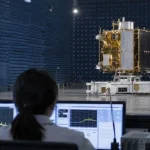
The space digital twin is not an imaginary space divorced from reality, but a “virtual space” that operates synchronously with the real aerospace system.
As China’s aerospace industry gradually moves from “completion of one mission” to “long-term, stable and large-scale operation”, a type of capability that only existed in a low-key manner in major projects in the past is being re-recognized – space digital twins.
Today we will learn about: 10 new tracks for commercial aerospace in 2025 – space digital twins.
01
What is a space digital twin?
Simply put, space digital twins use sensors to continuously collect operational data of space entities such as spacecraft and satellites, and combine physical models, engineering models and intelligent algorithms to build a digital system in virtual space that is equivalent to physical engineering and can be updated dynamically and synchronously. It is not a one-time simulation model, but a dynamic system that runs through the entire process of design, launch, on-orbit operation, and decommissioning. It can map the physical state in real time, deduce extreme working conditions in advance in virtual space, verify mission plans, and continuously calibrate itself during actual operation. In order to avoid conceptual confusion, it is necessary to clarify the boundaries between space digital twins and common related concepts: Different from digital simulation: digital simulation is mostly used for single-stage or single working condition verification, while digital twins emphasize continuous synchronization and closed-loop feedback; Different from the “Metaverse”: the core of space digital twins is not immersive experience, but engineering credibility and decision-making value. From an engineering logic point of view, the essence of space digital twins is to move key verification, risk assessment and decision-making as far as possible before launch, and continue to play a role in the on-orbit stage. This closed-loop path of “first virtual verification, then actual execution, and continuous correction during operation” is gradually replacing the traditional aerospace model that relies heavily on physical testing and on-orbit error correction, and is more in line with the realistic requirements of commercial aerospace for efficiency, cost, and reliability. From an application perspective, space digital twins have covered many key scenarios of aerospace missions: Spacecraft design verification: through high-fidelity modeling and simulation, the number of expensive and long-term physical tests is reduced and system iteration is accelerated; On-orbit operation and management: real-time mapping of spacecraft status, energy and load data for health management, fault warning and resource scheduling; Mission planning and deduction: multi-solution deduction for complex tasks such as orbit transfer, rendezvous and docking, and on-orbit services to reduce uncertainty; Fault prediction and treatment: predict the performance degradation of key components before a fault occurs, and verify the disposal strategy in virtual space; Training and situational awareness: used for personnel training, space situation construction, collision warning, and spacecraft decommissioning and reentry analysis, etc.
02
global market size
According to statistics from Grand View Research, in the aerospace field, the digital twin market size is expected to grow from approximately US$4.99 billion in 2025 to approximately US$40.01 billion in 2033, with a compound annual growth rate of approximately 28.9%. It should be noted that this statistical caliber covers the entire aerospace field, not all from space scenes. However, among various applications, aerospace missions are becoming an important testing ground for promoting the maturity of digital twin technology due to their high complexity and high failure costs. From the perspective of regional layout, major aerospace countries have formed practices in this field: United States: NASA is an early proposer of the concept of digital twins, and its related technologies have been applied to systems such as SLS rockets and manned spacecraft; China: Digital twins have been introduced into many major projects such as space stations, launch vehicles, and satellites for design verification and on-orbit monitoring; Europe: Through the “Digital Earth (DTE)” program, system-level digital twins of the earth and near-Earth space are promoted; India: ISRO introduces digital twins in rocket launches and spacecraft development for launch process simulation and risk assessment; Japan: Relying on scientific research institutions, it explores digital twin applications in fields such as astronomical simulation and earth environment prediction.
03
Major players at home and abroad
Judging from existing practice, there is no single technical route for space digital twins, but takes on multiple forms based on different application objects. The following players cover engineering simulation, on-orbit operation and maintenance, payload-level twins and constellation-level twins. There is no simple comparability between different paths. 1. Domestic player Tongyuan Soft Control: Founded in 2008, the digital space station developed based on the MWORKS software platform achieves a 1:1 digital restoration of the physical space station. It can simulate various maintenance, repair behaviors and operation scenarios in advance for simulation verification and program planning. It has been deeply involved in major national aerospace projects such as Chang’e 5, Chang’e 6, and manned moon landing. Aotian Technology: Founded in 2018, it independently developed the aoTwins digital twin platform, and launched my country’s first electric propulsion digital twin system and a constellation intelligent simulation system, covering electric propulsion on-orbit monitoring, command simulation, fault diagnosis and status deduction, as well as constellation launch deployment planning, constellation on-orbit operation and maintenance maneuvers, constellation defense monitoring and other application scenarios. At present, Aotian Technology has successfully won the bid for five projects including a certain low-orbit constellation electric propulsion digital system, a certain constellation operation control system, and a certain constellation simulation project. Star Map Measurement and Control: Established in 2016, relying on the self-constructed Space Sim simulation verification and performance evaluation application platform to create a digital twin technology system covering the entire life cycle of the spacecraft, it has been used in the construction of digital twin systems for more than ten on-orbit spacecraft. At present, its space digital twin technology has been fully integrated into AI technology, building a technical core of “simulation + intelligence”. Nationstar Aerospace: Founded in 2018, the Galaxy digital twin AI all-in-one machine launched can provide users with digital twin services ranging from underlying computing power and management platform to large model training inference and intelligent applications. With the help of NationStar Aerospace’s self-developed satellite digital twin algorithm embedded in the all-in-one machine – the Satellite Spiritual Realm Engine, low-cost, large-scale, and updateable rapid 3D modeling can be achieved. Digital Space: Established in 2019, with the SpaceIS air-space intelligent support platform and the SpaceDT satellite-ground digital intelligence twin platform as the core, it creates a series of products such as star cluster intelligent management, satellite-ground collaboration, and relying on the sky to control the sea. In addition, its independently developed “Knowing the Sky and Using the Sky Service Platform” is currently the only comprehensive service carrier in China that achieves full coverage of the global satellite service situation. Fudan University: The “Satellite Internet Digital Twin System” developed by Gao Yue’s team can achieve accurate simulation of multi-orbit satellites (such as GEO, LEO) and aerial platforms. Currently, it is cooperating with Star Network, Yuanxin Satellite, China Mobile and other companies to jointly verify the constellation layout, system capacity and interference indicators. Harbin Institute of Technology: SpaceSim, a spacecraft system design and simulation software proposed by the team of Academician Cao Xibin and Professor Wei Cheng, can support simulation analysis of the entire life cycle of spacecraft design, testing, launch, operation and mission application. It has been put into scientific research and teaching use in Aerospace Science and Technology Group, Aerospace Science and Industry Group, universities and colleges and other units. 2. Foreign players Lockheed Martin (USA): Founded in 1995, Lockheed Martin and NVIDIA collaborated to build a set of AI-driven earth and space observation digital twin prototypes that can access weather data streams in real time, use AI and machine learning for analysis and processing, comprehensively present the current status of the global environment obtained from satellite and ground observations, and simultaneously display the simulation results of weather forecast models. Empresarios Agrupados (Spain): Founded in 1971, it developed a digital twin for Europe’s large space simulator based on its self-developed EcosimPro simulation software, which can simulate various operation and failure scenarios such as valve switching and vacuum leakage, significantly shortening the operator training cycle and improving the safety and efficiency of facility operation and maintenance. Space Data (Japan): Established in 2017, it has reached a strategic cooperation with the lunar exploration company iSpace. It uses the lunar surface data obtained by the iSpace exploration mission to build a high-precision terrain model, and also develops a physical simulation system that can simulate extreme environments such as lunar communication delays and low gravity.
04
What problems are faced?
Although space digital twins have already passed the test in some major aerospace projects, if we look at it on a commercial aerospace scale, there is still a long way to go before it can be implemented on a large scale. 1. Technical level: High fidelity and strong real-time are often difficult to achieve at the same time. The coupling of multiple physics fields and the superposition of extreme environments have increased model accuracy and computational burden at the same time. Limited on-board computing power and delays in satellite-to-ground communications have also limited the depth of implementation of “real-time twins”. In the foreseeable period, it is still difficult to achieve high fidelity, strong real-time, and low cost at the same time, which determines that space digital twins must be deployed in layers and evolve in stages. 2. Industrial level: Space digital twin is a systematic project, but in reality, software, hardware, models, data and operating entities are still highly separated, interface standards have not yet been unified, and large-scale replication is difficult. 3. Commercialization level The value of digital twins is more reflected in “one less accident and more years of life” rather than directly reducing the cost of a single mission. For commercial aerospace companies with greater financial pressure, it is difficult to quantify their benefits in the short term. Therefore, the first to systematically adopt digital twins in the short term are often not startups, but entities with long-term operational tasks and extremely high failure costs. 4. Security and standards: Modeling data itself is highly sensitive, and unified modeling specifications, performance evaluation and security certification systems are still being explored, and cross-subject collaboration capabilities are limited.
05
Market prospects
In the short term, space digital twins are not a field that will explode quickly: investment is large, returns are slow, and it is difficult to scale. But it has a distinctive feature: once it is actually used, it is difficult not to use it. Its long-term certainty mainly comes from three aspects: 1. Overwhelming mission complexity: when the system is so complex that experience is insufficient to cover risks, digital twins change from bonus points to necessities; 2. Commercial aerospace operations: communications, remote sensing and on-orbit service tasks, the demand for long-term stable operation continues to amplify; 3. The capability evolution path is clear: from single satellites to constellations, from post-analysis to operational decisions, from engineering tools to basic capabilities. The real turning point may come from three types of signals: on-board computing power and intelligence capabilities mature, commercial aerospace enters the “operation is king” stage, and the industry begins to accept payment for systemic risks. From this perspective, space digital twins are not a “new application”, but a system base capability for commercial aerospace to move towards the long-term operation stage.