China commercial aerospace
1. Hainan Shangfa’s No. 1 station was successfully launched
On March 12, the first launch from launch station No. 1 of the Hainan Commercial Space Launch Site was a complete success. The Long March 8 Yao-6 carrier rocket launched the fifth batch of Qianfan constellation networking satellites into the predetermined orbit in the “eighteen stars with one arrow” method.
Hello space:
The successful launch of the No. 1 station this time plus 2024
The successful launch of Station 2 on November 30 marked that my country’s first commercial space launch site has dual-station launch capabilities.
Hainan Commercial Development
Station No. 1 has the rapid test launch capability of “7 days launch, 7 days recovery”,
Dual station operation is possible
Meet future high-density launch needs.
This mission is also the first time that a commercial constellation company and a commercial space launch site have collaborated, marking the complete closed loop of my country’s commercial space industry chain from research and development to launch.
(Picture: Long March 8 rocket takes off. Source: China Aerospace News official account)
2、
Interstellar Glory has put into production three rounds of Hyperbolic No. 3
, is expected to complete the first “orbit + sea recovery” in December
Recently, Interstellar Glory completed the first delivery of hundreds of millions of yuan in Series D financing. This round of financing was invested by Sichuan Tianfu Xinyun Digital Economic Development Fund Co., Ltd. The funds were mainly used for the research and development of the Hyperbolic 3 rocket and the construction of the Focus series engine test bench and engine production line.
At present, three engines of Hyperbola-3 have been put into production. It is expected to complete the first “orbit + sea recovery” flight test in December this year, and to complete the reuse flight test in June 2026.
Hello space:
This round of financing accelerated the development process of Hyperbola III. After completing the final assembly base in Shifang, Deyang, Interstellar Glory landed in Mianyang to build a liquid rocket engine test bed to fully support the research and development verification of the Focus II liquid oxygen methane engine. Interstellar Glory has a coordinated layout in “Deyang-Mianyang-Chengdu” in Sichuan. While developing in an all-round way, it also helps Sichuan build a complete commercial aerospace industry ecosystem.
(Picture: Star Glory Focus Series Engine Test Bench Source: Star Glory Official Account)
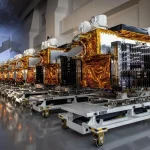
3. Approved by the National Development and Reform Commission, MicroStar is mass-manufacturing satellites. Recently, MicroStar’s commercial satellite intelligent production line project has been officially approved by the National Development and Reform Commission. It will build a commercial satellite assembly and testing hall, a commercial satellite intelligent production line and other related infrastructure in Wuxi Economic Development Zone, Jiangsu Province. After completion, it will be able to produce more than 150 200kg-500kg satellite products per year.
Hello space:
Compared with the traditional station-based satellite assembly method, the intelligent production line can shorten the satellite AIT assembly time to 1-1.5 months, saving a large number of assembly and testing personnel, and significantly saving labor costs.
After the completion of the Micro-Nano Star Intelligent Production Line, it will not only
Quick response to needs
, the marginal cost per unit satellite will also decrease, which will help it expand its market share. In a word, it means “lowering costs, increasing speed, and expanding scale.”
(Picture: Micro-Nano Starry Sky
Commercial satellite intelligent production line project
Rendering (Source: Micro-Nano Starry Sky Public Account)
4、
The State Administration of Science, Technology and Industry for National Defense issued a notice on promoting the orderly development of commercial aerospace measurement and control specifications. On March 14, the official website of the China National Space Administration issued the “Notice of the State Administration of Science, Technology and Industry for National Defense on Promoting the Orderly Development of Commercial Aerospace Measurement and Control Specifications”, which put forward requirements for commercial aerospace measurement and control in terms of station network construction, technical specifications, safety management, and support for development.
Hello space:
This notice is that our country
An important complement to the policy system in the commercial aerospace sector
. From the two mentions of commercial aerospace in the government work report, to the issuance of multiple guiding documents, to the National Space Administration, as the management department of the commercial aerospace industry, ensuring the first mission of Hainan Shangfa No. 1 station, China’s commercial aerospace is forming a safe, open, and sustainable industrial ecology.
(picture:
Notice of the State Administration of Science, Technology and Industry for National Defense on Promoting the Orderly Development of Commercial Aerospace Measurement and Control Standards (Source: Official website of the National Space Administration)
5. The first bi-monthly operational update of national 0.5m resolution satellite images
Recently, Changguang Satellite announced that it will provide bi-monthly operational update services for national 0.5m resolution satellite images starting from March 10, 2025, and released the first issue of the 2025 national bi-monthly 0.5m resolution single image (January-February).
Hello space:
Changguang Satellite
The effective coverage rate of the first released images from January to February reached 99.4%, filling the gap in high-frequency and high-precision remote sensing data in my country. The launch of national 0.5m resolution satellite images will also promote the healthy development of the downstream remote sensing application ecology towards higher resolution, higher frequency, and wider coverage.
(Picture: Bi-monthly operational update of Changguang Satellite. Source: Jilin-1)
international commercial aerospace
1、
“Sunbird” nuclear fusion-powered aircraft
Recently, the British company Pulsar Fusion released the “Sunbird”
Interstellar transfer vehicle concept video, using Duel Direct Fusion Drive (DDFD)
fusion engine
, it is expected to undergo static testing in 2025 and on-orbit demonstration in 2027. It can be used as a space tug to perform various deep space missions in the future.
Hello space:
The “Sunbird” nuclear-powered aircraft marks a major breakthrough for mankind in the field of deep space propulsion technology. If realized, it will fundamentally change the existing space exploration model and provide new possibilities for future interstellar missions.
(Picture: “Sunbird” interstellar transfer vehicle Source: Pulsar Fusion)
2、
Former Google CEO Eric Schmidt became the new CEO of Relativity Space. Recently, former Google CEO Eric Schmidt announced that he has become the new CEO of Relativity Space. He made a large investment in the company and obtained a controlling stake.
Hello space:
Schmidt’s large investment and appointment as CEO have, on the one hand, alleviated the development bottleneck of Relativity Space due to the failure of the “Terran 1” rocket test launch in 2023 and financing difficulties, and accelerated the development process of the next-generation rocket “Terran R” (planned to first fly in 2026).
On the other hand, if Schmidt can successfully replicate his ecological construction capabilities at Google, Relativity Space may become the leader of the “second echelon” of commercial aerospace, and even reshape the industry’s competitive landscape.
(Picture: Terran R Source: Relativity Space)
3、
SpaceWERX selects 8 companies
Launching $440 million in public-private partnership projects
On March 8, SpaceWERX, the commercial development arm of the U.S. Space Force, announced eight recipients of the Strategic Funding Increase (STRATFI) agreement (Albedo, Beast Code, CesiumAstro, Gravitics, LeoLabs, Rise8, Umbra and Xona). The agreement totals US$440 million, of which approximately US$101 million comes from SpaceWERX, and the rest comes from relevant military agencies and private funds.
Hello space:
The injection of official funds will help companies break through key technology bottlenecks, avoid R&D stagnation caused by insufficient funds, and improve the overall technological level of the U.S. space field.
The public-private partnership model can attract more private capital into the space field, which not only provides sufficient funds for projects, but also drives the development of related industrial chains and promotes the prosperity of the space economy. This model also provides certain reference value for the future development of my country’s commercial aerospace.
(picture:
SpaceWERX Source:
SpaceWERX
)
1879
Collection!
Commercial aerospace industry financing projects
We will carry out “
Commercial Space Project Financing Roadshow
“Activity aims to provide a platform for display and capital docking of innovation and entrepreneurial projects in the commercial aerospace field, promote the implementation of industrial innovation, and accelerate the industrialization process of innovation results.
This solicitation is fully open to enterprises in the upstream, midstream and downstream industrial chain of commercial aerospace, covering multiple fields such as new materials and new processes, parts manufacturing, complete satellites and rockets, satellite applications and services.
This roadshow will invite domestic
well-known investment institutions,
Angel investors,
Industrial Investment Group,
local government
/
Produce
industrial park
There are over 100 professional investors.
, and submit your financing BP. We will conduct a roadshow in March 2025 and look forward to your participation.