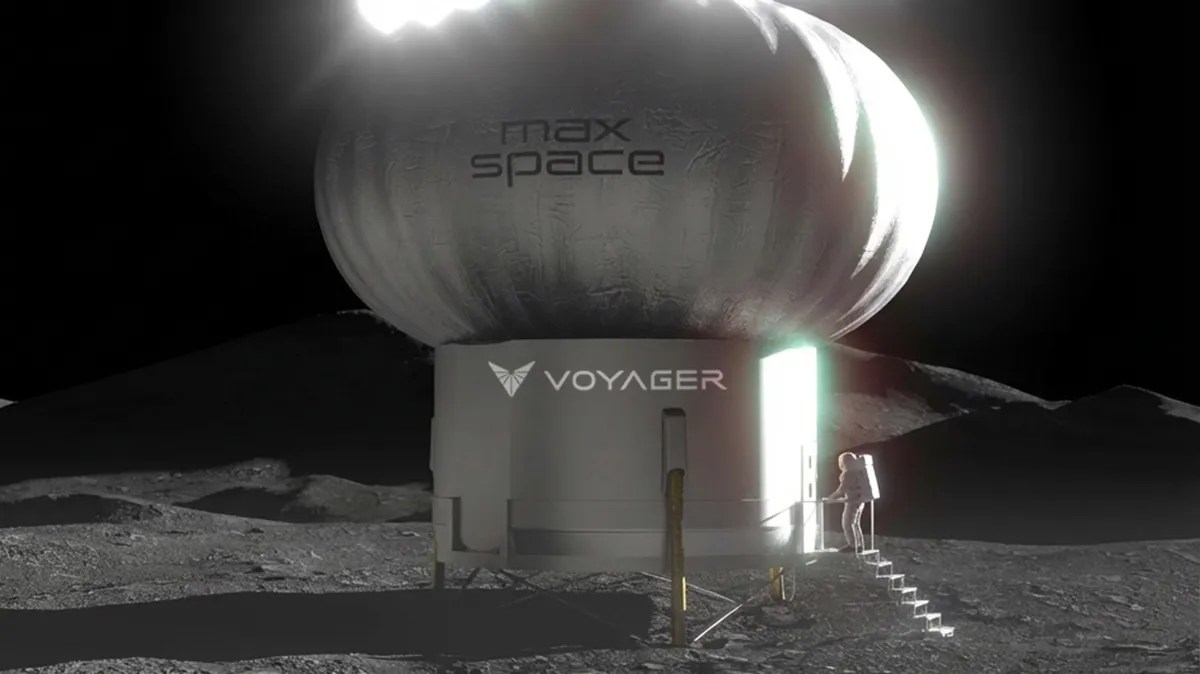
U.S. space and defense company Voyager Technologies has made a multi-million-dollar strategic investment in Max Space to advance the development of expandable lunar habitats, the companies said.
Voyager said the funding will support internal research and development focused on space habitats for long-duration lunar and deep-space missions, as well as accelerated engineering, manufacturing scale-up and mission integration activities.
The initiative is aligned with the objectives of NASA to establish a sustained human presence on the Moon by 2028, and with Voyager’s broader strategy of building infrastructure to support long-term human and robotic missions in cislunar space.
“Our investment in Max Space aligns directly with our strategy to deliver mission-ready systems that extend American strength into cislunar space,” said Dylan Taylor.
“By pairing Voyager’s integrated platform with Max Space’s expandable habitat architecture, we are accelerating the transition from demonstration missions to durable lunar capability,” Taylor added.
A spokesperson for Voyager said the investment is valued in the “low eight figures”, although the company declined to disclose the exact amount. Additional details are expected to be released alongside Voyager’s fiscal year 2025 financial results.
The investment follows a strategic partnership announced in early February, in which the companies agreed to collaborate on the development of expandable space habitats, with plans for ground validation and in-space demonstrations before 2030.
Voyager is also developing Starlab, a commercial space station designed to potentially replace the International Space Station after its planned retirement around 2030.