Chinese commercial launch startup Landspace has secured formal contracts to launch satellites for China’s two main low Earth orbit megaconstellation projects, a move expected to help ease launch capacity constraints as deployment accelerates.
Chinese media reported on Jan. 7 that Landspace had won launch service contracts for the Guowang constellation, led by state-owned China Satellite Network Group (China SatNet), and the Qianfan (Thousand Sails) project backed by the Shanghai municipal government. The reports cited Landspace’s prospectus for an initial public offering filed on Shanghai’s STAR Market, which was accepted in late December. The company is seeking to raise up to $1 billion, according to the filing.
Documents published by the Shanghai Stock Exchange show that Landspace’s Zhuque-3 methane–liquid oxygen reusable launch vehicle has been selected for China SatNet’s core supplier list. The company has also won a bid for Yuanxin Satellite’s 2025 launch services procurement, covering a single mission to deploy 18 satellites. Landspace said it plans to support Guowang and Qianfan through high-cadence launch services to meet their strategic deployment schedules.
To date, satellites for both megaconstellations have been launched exclusively by Long March rockets operated by the state-owned China Aerospace Science and Technology Corporation (CASC). While the involvement of commercial providers has been widely anticipated, Landspace’s selection marks one of the clearest indications yet that China intends to rely on newly developed commercial launch vehicles to build the constellations, which are seen as China’s response to SpaceX’s Starlink and other large commercial satellite networks.
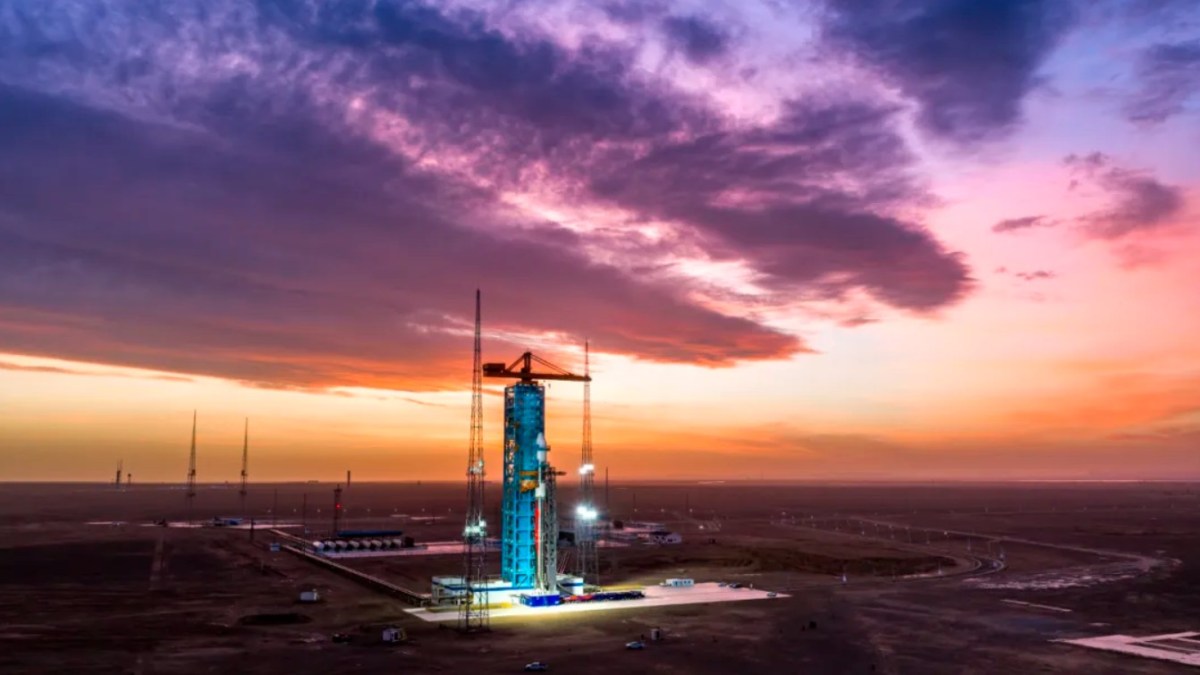
Landspace carried out the first orbital test launch of its stainless steel Zhuque-3 rocket in early December. The second stage successfully reached low Earth orbit without a payload, while the company’s attempt to recover the first stage — a first for China — failed following an anomaly shortly after the start of the landing burn. The company is targeting a second launch and landing attempt no earlier than April, according to industry sources.
Several other Chinese commercial launch firms, including Space Pioneer, Galactic Energy, CAS Space, Deep Blue Aerospace, Sepoch and Orienspace, are also developing new rockets and could debut reusable or partially reusable vehicles from 2026, adding further capacity to the market.
Guowang plans to deploy 12,992 satellites, according to filings with the International Telecommunication Union, including 6,080 satellites in orbits of 500–600 kilometers and 6,912 satellites at around 1,145 kilometers. The Qianfan project targets 15,000 satellites, with 1,296 planned to be in orbit by the end of 2027 to enable global coverage. As of December 2025, Guowang had 136 operational satellites in orbit, while Qianfan had launched 108 satellites.
China carried out a record 92 orbital launches in 2025, sharply higher than the previous record of 68 in 2024. Analysts expect the launch rate to rise again in 2026, driven by megaconstellation demand and supported by new vehicles such as CASC’s Long March 12A and Long March 10 series, alongside expanded launch infrastructure.