Voyager Technologies has secured a U.S. government patent for a process that manufactures high-performance crystals in microgravity, a technology the company says could underpin future optical communications and advanced computing systems.
The company said this week it plans to fly the patented manufacturing process to the International Space Station later this spring to demonstrate the hardware in orbit, marking an early step toward larger-scale in-space production.
Voyager’s patented method focuses on growing crystals used in optical communications and modern computing infrastructure. On Earth, gravity-induced deformation makes it difficult to produce such crystals with high precision. In microgravity, however, the materials can form with far fewer defects, significantly improving performance.
“We’re able to have higher signal fidelity, which ultimately means more bandwidth,” said Paul Tilghman, Voyager’s chief technology officer, in comments to Payload. “It also means less losses as we try and load multiple signals onto an optical fiber.”
Voyager said crystals produced in space can be five to eight million times larger than their terrestrial counterparts, enabling higher data throughput and lower error rates for applications ranging from fiber-optic networks to artificial intelligence and cloud computing systems.
Beyond communications, Tilghman said space-manufactured crystals could improve hyperspectral remote-sensing satellites, enable more compact optical computers and enhance laser-based communications links on Earth and in orbit.
The upcoming ISS demonstration aims to return an experimentally useful quantity of crystals to Earth. Voyager’s longer-term ambition, however, is to establish high-volume manufacturing in orbit, dependent on larger commercial platforms and reliable reentry services.
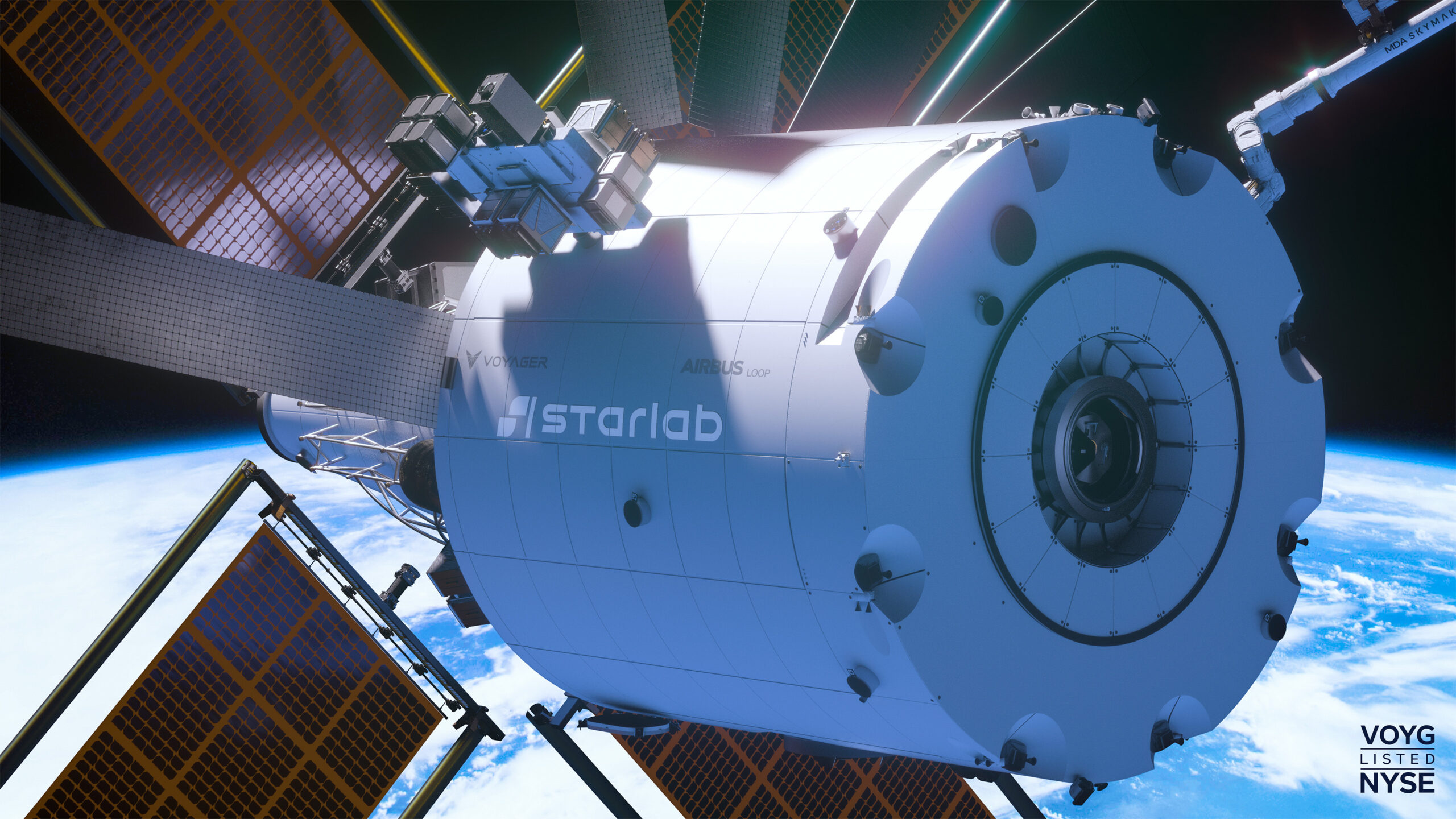
Tilghman pointed to Starlab — Voyager’s planned commercial space station — as a potential future hub for hosting crystal manufacturing hardware. He added that scaling production would require both repeatable orbital processes and dependable “downmass” capabilities to return finished products to Earth.
“There’s two dimensions of scale,” Tilghman said. “There’s how much crystal you can generate at once, and then there’s how do you actually do this as a repeatable process. Manufacturing without the ability to bring it back has fairly limited purpose.”
The patent and upcoming ISS test come as governments and private companies increasingly look to in-space manufacturing as a potential driver of the next phase of the space economy, particularly for materials that are difficult or costly to produce on Earth.