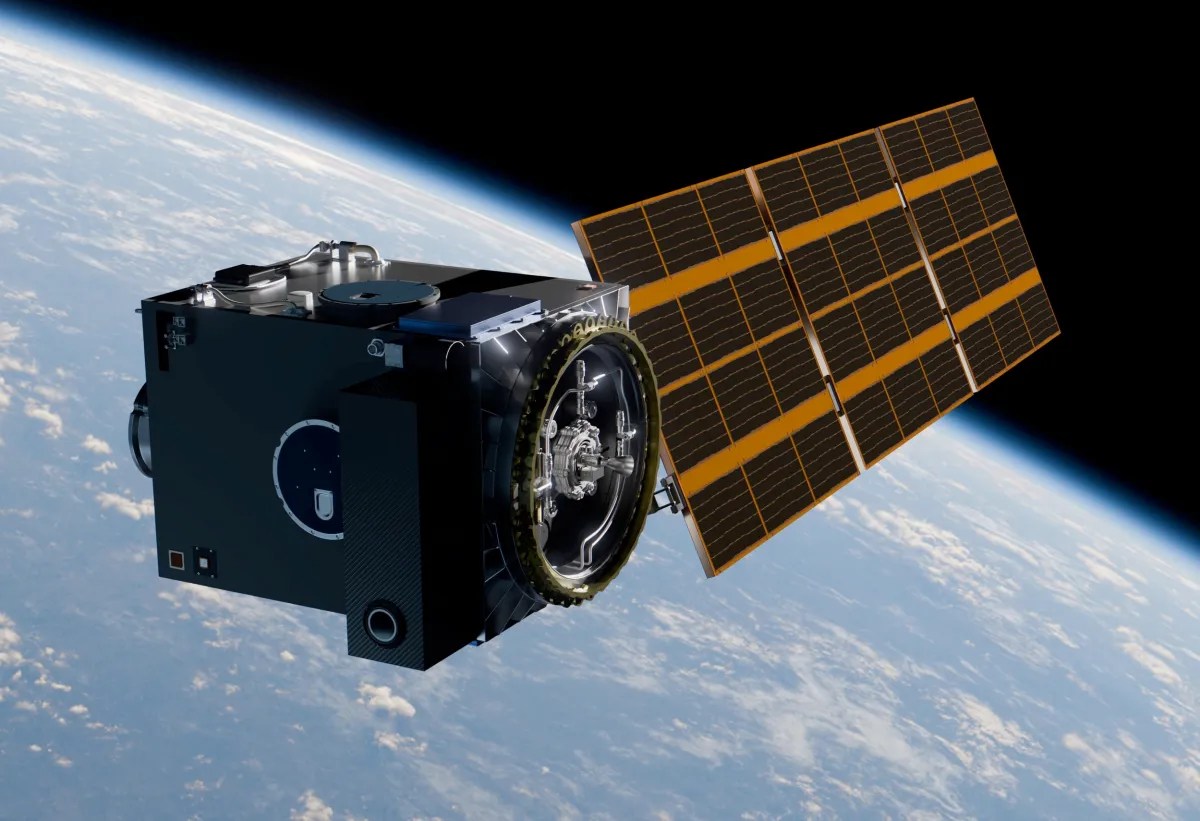
Portal Space Systems has introduced a new spacecraft, Starburst, designed to bring rapid maneuverability to small satellite constellations and national security missions. The vehicle builds on technologies from the company’s larger Supernova satellite platform.
The Starburst-1 mission is scheduled to launch in 2026 aboard SpaceX’s Transporter-18 rideshare, marking Portal’s first free-flying spacecraft carrying live payloads. The mission will demonstrate rendezvous and proximity operations, rapid orbital adjustments, and retasking capabilities for both commercial and defense applications.
“Our strategy is to deliver what customers need now and accelerate what they’ll need next,” said Jeff Thornburg, CEO of Portal Space Systems, in a statement. “Starburst gives operators a maneuverable bus that supports proliferated architectures in the orbit that matters to them. Supernova brings the trans-orbital reach. Flying Starburst-1 in 2026 lets us field capability quickly and advance the shared systems that raise confidence for Supernova’s 2027 debut.”
Starburst is designed to enhance flexibility for proliferated space architectures, which are increasingly used in large-scale constellations such as SpaceX’s Starlink and Amazon’s Project Kuiper, and are gaining attention for defense applications.
Both Starburst and Supernova share core systems and manufacturing processes, including thrusters developed for Supernova’s reaction control system. Each uses heated ammonia as a propellant, offering a compact, environmentally friendly solution that improves performance and responsiveness in orbit.
Portal plans to deploy Starburst-1 into a sun-synchronous orbit for a one-year mission. The spacecraft targets 1 kilometer per second of total delta-v, translating to an orbital velocity change of more than 2,200 miles per hour — a benchmark for small satellite agility.
The ESPA-class spacecraft will host two payloads: a stereo video monitoring system from California-based TRL11, and a superconducting magnetic actuator from New Zealand’s Zenno Astronautics. Zenno’s payload will test magnet-based technologies for precision satellite positioning and inter-satellite interactions.
Portal’s next-generation Supernova platform remains on track for launch in 2027, aimed at providing higher power and propulsion capacity for long-range and trans-orbital missions.