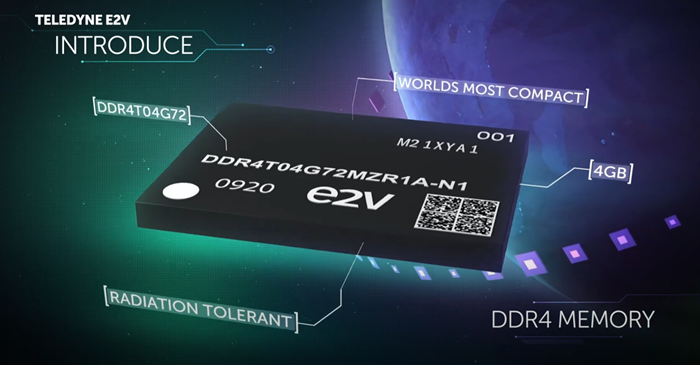
Global semiconductor innovator Teledyne e2v has unveiled its latest advancement in space-grade memory technology, the radiation-tolerant DDR4 (Double Data Rate 4) memory designed to meet the stringent demands of modern satellite, aerospace and defense applications. This new memory solution delivers a powerful combination of high bandwidth, low power consumption and radiation resilience, redefining data handling and storage performance for spaceborne systems operating in the harshest orbital environments.
As the demand for real-time processing and onboard intelligence continues to accelerate, Teledyne e2v’s DDR4 devices provide exceptional speed and endurance, ensuring mission reliability and longevity. The product embodies the company’s longstanding vision of delivering radiation-hardened, high-reliability semiconductors that enable the next generation of spacecraft and critical electronic systems to operate with maximum efficiency and data integrity.
DDR4 Technology for Space Applications
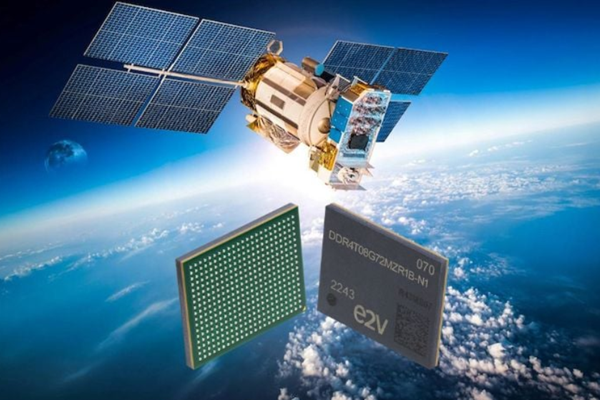
The Teledyne e2v DDR4 family is engineered specifically for spaceborne and high-reliability environments, where radiation exposure, power limitations and temperature extremes present formidable challenges. Each device integrates radiation-tolerant design techniques, offering immunity to single-event upsets (SEUs) and total ionizing dose (TID) effects that typically degrade conventional memory performance in orbit.
Operating at data rates up to 2400 MT/s, Teledyne e2v’s DDR4 provides a significant performance boost over previous DDR3 generations, enabling faster data access for onboard processing units, imaging payloads and AI-driven subsystems. The memory architecture ensures high throughput and low latency, essential for space missions involving real-time Earth observation, synthetic aperture radar (SAR) imaging, hyperspectral sensing, and autonomous navigation. Designed for full compatibility with space-qualified processors and FPGAs, the DDR4 memory is available in x8 and x16 configurations, with capacities up to 8 Gb per device. The memory has a robust packaging ensure dependable operation in both LEO (Low Earth Orbit) and deep-space missions. The device’s radiation-tolerant flip-chip BGA packaging optimizes signal integrity and thermal performance, minimizing parasitics for stable, high-speed operation. This design also facilitates easy integration into existing board layouts, reducing qualification time and system complexity.
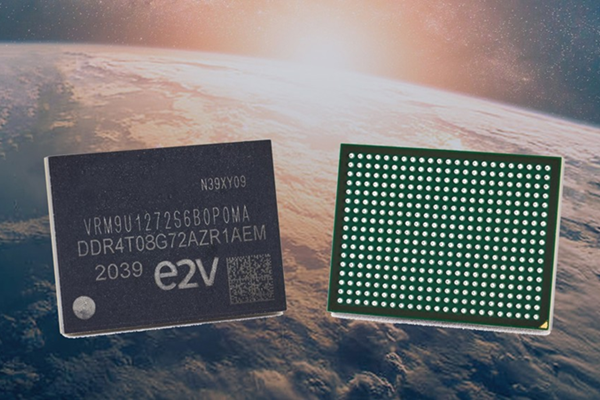
At the core of Teledyne e2v’s DDR4 innovation is its commitment to radiation performance assurance. The memory is characterized through extensive radiation testing campaigns to ensure predictable behavior under ionizing radiation, offering guaranteed functional performance in high-radiation zones such as the Van Allen belts and geostationary orbits. The DDR4’s single-event effect (SEE) mitigation and error correction capabilities safeguard against data corruption, ensuring that critical mission data remains intact throughout the satellite’s operational lifespan. With a radiation tolerance exceeding 100 krad (Si) and immunity to destructive latch-up events, the memory delivers unmatched resilience for demanding space missions. The DDR4 has a low-power architecture contributes to system-level efficiency, minimizing energy consumption while maintaining peak throughput. This balance of speed, endurance, and reliability makes the DDR4 ideal for next-generation high-performance computing (HPC) payloads, including AI-enhanced onboard processors, data routers and sensor fusion systems.
Teledyne e2v’s DDR4 memory is engineered to meet the expanding data-processing demands of modern space and defense electronics. It is ideal for Earth observation and imaging satellites that require real-time data buffering and compression, as well as telecommunication payloads that demand consistent high-throughput performance. The technology also supports scientific missions and deep-space probes operating in high-radiation environments, along with AI-enabled satellites and autonomous systems that rely on rapid data access and fault-tolerant storage.
The DDR4 memory features a drop-in solution fully compatible with leading space-qualified processors and FPGAs, allowing mission designers to upgrade existing platforms seamlessly without the need for complete subsystem redesigns. Representing Teledyne e2v’s next step toward scalable, future-ready memory architectures, the DDR4 devices are part of a roadmap that includes higher-density configurations and enhanced radiation tolerance. These advancements will support the increasing complexity of satellite payloads and the new generation of AI-driven, software-defined spacecraft. Backed by extensive in-house testing, stringent qualification processes and a strong heritage in space-proven microelectronics, Teledyne e2v continues to be a trusted technology partner for organizations seeking long-term reliability, system optimization and mission success in orbit.
About Teledyne e2v
Teledyne e2v is a global leader in the design and supply of semiconductors, imaging solutions and high-reliability components for aerospace, defense, medical and industrial applications. Headquartered in Chelmsford, United Kingdom, the company is part of the Teledyne Technologies Incorporated group, renowned for its engineering excellence and technological innovation. With a strong legacy in radiation-hardened electronics, Teledyne e2v provides components used in numerous international space missions from communication constellations to planetary exploration programs. The product portfolio spans data converters, processors, RF devices and memory technologies, all designed to perform flawlessly in radiation-intensive and high-demand environments. Through continuous innovation and collaboration with leading space agencies and OEMs, Teledyne e2v continues to shape the future of space-qualified semiconductor technology ensuring that mission-critical systems operate with the highest levels of speed, precision and resilience.