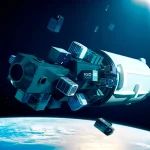
1. The improved Zhuque-2 Yao-5 carrier rocket was successfully launched
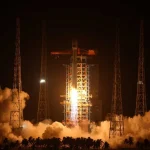
At 11:00 on May 14, 2026, the Zhuque-2 improved Y5 launch vehicle (ZQ-2E Y5) successfully launched a 2.8-ton customized test load into a predetermined orbit at an altitude of 900 kilometers at the dedicated launch station of Blue Arrow Aerospace in the Dongfeng Commercial Aerospace Innovation Test Zone. ZQ-2E Y5 is the first flight rocket of the “improved” extended version of Zhuque 2. This successful launch is of great significance, indicating that our country has entered a new stage of development in the path of liquid oxygen methane rocket technology. Compared with the previous model, the Y5 Arrow has significantly improved the rocket’s transportation capacity through a number of efficiency enhancement and weight reduction measures, and it also blends in with Yuan Xin’s requirements in the previous bidding documents. On July 23, 2025, Shanghai Yuanxin issued a bidding announcement for the 2025 launch vehicle service procurement project. Package 1 is a four-time, one-rocket, 10-satellite launch service. There are two requirements. First, the bid product must have a carrying capacity of not less than 2.8 tons in a 950-kilometer near-polar orbit. Second, the bid product must have successful flight experience before the announcement date, and a signed version of the “Flight Result Analysis and Review Conclusion” must be provided. This launch also shows that ZQ-2E has the ability to serve my country’s large-scale low-orbit satellite Internet constellation network. In the past, everyone thought that Suzaku 2 was a pity because Suzaku 2 was launched relatively early and did not meet the needs of the “GW” constellation and “G60” constellation. It not only paid a lot of silent costs, but was also a bit useless. Now it seems that this situation has slowly improved. This is definitely a good thing for our country’s current launch situation.
2. Qianfan Constellation welcomes high-density networking
Qianfan Constellation launched a total of two sets of satellites in May, sending 36 satellites into predetermined orbits. One was on May 12, using the Long March 6A rocket, and the other was on May 17, using the Long March 8 rocket. The intensive rhythm of two launches in five days shows that the Qianfan constellation has ushered in the “fast lane” of networking after a short period of silence. This also illustrates a problem from the side, that is, the “GW” constellation has almost launched a first-generation star. “GW” launched a set of test stars in May. The last networking star launch was on April 9, and there has been no networking star since. The transportation capacity has become richer, and the pace of Qianfan Constellation’s network construction has also increased. On the one hand, the launch mission of the “GW” constellation has released part of the transportation capacity. On the other hand, it also shows that our country’s current new rockets and new launch sites are beginning to mature. From the perspective of the launch site, from the beginning of the year to the end of May, Hainan Shangfa has successfully launched 5 rockets in a row, basically reaching the rhythm of one rocket per month, and it is not like 2025. There were several months in the middle when no rockets were successfully launched from Hainan Shangfa due to various reasons. Judging from the rockets, Hainan Commercial Development has successfully launched 7 times of Long Bajia, 5 times of Long 12, and 3 times of Long 8. This shows that the reliability of these rockets has also been verified, which is definitely a major benefit for our country’s future rapid networking.
3. SpaceX’s first flight of V3 configuration starship
On the morning of May 23, 2026, Beijing time, SpaceX completed the twelfth flight test of the starship, and the V3 starship made its debut. In this launch test, the V3 starship was composed of the V3 super-heavy booster B19 and the V3 starship spacecraft S39. Both used the latest version of the Raptor 3 engine and took off from the new launch station 2 for the first time. B19 is equipped with 33 sea-level Raptor 3 engines, which are divided into three layers from the inside out, with 3 in the inner ring, 10 in the middle ring, and 20 in the outer ring. By replacing the Raptor 3 engine, the take-off thrust of the Starship launcher has been increased from 7,590 tons to 8,240 tons. The S39 is equipped with three sea-level Raptor 3 engines and three vacuum version Raptor 3 engines. The sea-level version is located on the inner ring and the vacuum version is located on the outer ring. Station 2 is a new launch station built by SpaceX to support V3 starships and future starships with higher thrust. Systematic improvements have been made in terms of structural load-bearing, thermal protection, mechanical drive and propellant safety.
After watching this launch, I felt mixed emotions, admiration and anxiety. Once the starship is fully mature, it will completely rewrite the underlying logic of the global space economy. There is a very scary question. When starships mature, will our commercial satellite constellations, space stations, and lunar bases be “capacity blocked” in international competition? It’s not that you won’t be allowed to launch, but their cost advantage will make all your projects lose commercial viability. Moreover, after SpaceX completes the network of the planned 42,000 satellites, other countries will have to get through their network if they want to launch rockets. Selecting the launch window will be far more difficult than today’s work.
4. SpaceX submits IPO documents
On May 20, the SEC officially disclosed the Form S-1 prospectus submitted by SpaceX, which plans to dual-list on Nasdaq under the SPCX code to raise US$50 billion to US$75 billion, corresponding to a valuation of US$1.75 trillion to US$2 trillion. Goldman Sachs, Morgan Stanley, Bank of America, Citigroup and JPMorgan Chase served as co-lead underwriters, and 18 other banks participated in the underwriting, including almost all major investment banks in the world. The SpaceX prospectus divides the business into three major sectors: space launch, starlink and artificial intelligence. The profit and loss status and strategic positioning of the three are completely different. Starlink is SpaceX’s current core revenue source and profit pillar. For the full year of 2025, Starlink achieved revenue of US$11.387 billion, operating profit of US$4.423 billion, and adjusted EBITDA of US$7.168 billion. The launch business is the foundation of SpaceX, and it is still in a state of “strategic losses”. For the whole year of 2025, the launch business achieved revenue of US$4.086 billion and an operating loss of US$657 million. The root cause of the loss was the huge investment in research and development of the starship. The AI sector is the most shocking part of this prospectus. In February 2026, SpaceX completed the acquisition of xAI and X (formerly Twitter) in an all-stock transaction. For the whole year of 2025, the AI sector’s revenue was US$3.2 billion, but operating losses were as high as US$6.355 billion.
Objectively speaking, no matter what the outcome of SpaceX’s IPO, it will profoundly affect the valuation logic of my country’s commercial aerospace industry. If SpaceX successfully goes public at US$1.77 trillion, the valuation ceiling of all domestic commercial aerospace companies will be instantly raised. A company with a loss of nearly 50 billion yuan can be worth more than 12 trillion yuan. Then our “national team” and commercial aerospace targets on the market are likely to be able to obtain several times the valuation premium. However, if SpaceX’s stock price performs poorly after its listing, it will bring a chill to the financing environment of the entire track.
But what this incident should alert us to is, when can our commercial rocket companies truly realize normalized recycling and reuse of rockets? When will our satellite mass production level reach the level of Starlink satellites? When can our launch frequency approach 3-4 times a week? The listing of SpaceX has built a grand narrative such as the Starship Project, Starlink V3, and Orbital Data Center. However, we cannot find any domestic companies that can directly compete with each other. I hope that in a few years, we will have several such targets, so that we will no longer just copy and chase others, but also tell a narrative ourselves.
5. Blue Origin New Glenn rocket static ignition test explosion
On May 28, the Blue Origin “New Glenn” rocket exploded during a static ignition test, which is destined to be an event in the history of manned global commercial spaceflight. The rocket exploded and the only dedicated launch station (LC-36) was completely destroyed. It will take several years to rebuild one, and it is estimated that it will not be possible to restore it until around 2028. This is equivalent to a direct death sentence for Blue Origin’s launch mission for at least two years. As a result, not only is the U.S.’s spare capacity for manned lunar landings gone, but Amazon’s Kuiper/LEO constellation program is also likely to face the risk of derailment due to lack of capacity. The above is only one aspect. What is more serious is that after this incident, if Blue Origin wants to introduce external capital, its negotiating position will be completely reversed, and its valuation is likely to suffer a catastrophic cut in half. Blue Origin used to rely on Bezos’ personal blood transfusions. How long it can continue to receive blood transfusions is also a big question. After all, repairing the launch pad, rebuilding the rocket, identifying the cause, redesigning the engine… the whole process does not take three to five years, and there is no way to resume flight, and this time is not cheap. However, for friendly businessmen, this is definitely a “strategic opportunity period” for development. For my country’s rocket companies, there are advantages and disadvantages. After all, everyone is afraid of explosions. Especially in our country, this problem is more serious. When new models of rockets from these commercial rocket companies have to fly for the first time, it is estimated that the review test they will face will only increase rather than decrease.
6. The Japanese version of “Starlink” military reconnaissance network is launched
On May 14, Japan admitted that a low-orbit military reconnaissance network composed of hundreds of small satellites has been put into use. The constellation is mainly composed of synthetic aperture radar (SAR) satellites and optical imaging satellites. It can conduct high-frequency reconnaissance on the sea and the ground all-weather and all-day. What’s more serious is that this constellation has been confirmed to be used to provide real-time target data and guidance corrections for Japan’s long-range missiles. This marks that Japan has combined its “satellite constellation” with long-range missiles and opened up a space-based combat link of “space reconnaissance, precision guidance, and long-range strike.” The entire military strategy has undergone a qualitative change from “local defense” to “preemptive long-range attack.” Moreover, the constellation is designed to be deeply adapted to American standards, allowing real-time sharing of intelligence. Japan’s proactive militarization of satellite networks has turned “space warfare” from a science fiction concept into a real threat. When Japan uses its national power to quickly make up for its shortcomings in space-based capabilities, if other countries continue to sit back and wait, it will be tantamount to giving up the initiative for future development. For my country’s commercial aerospace industry, there is no longer a time window for “long-term planning”. Every delay is being transformed into a first-mover advantage for opponents.