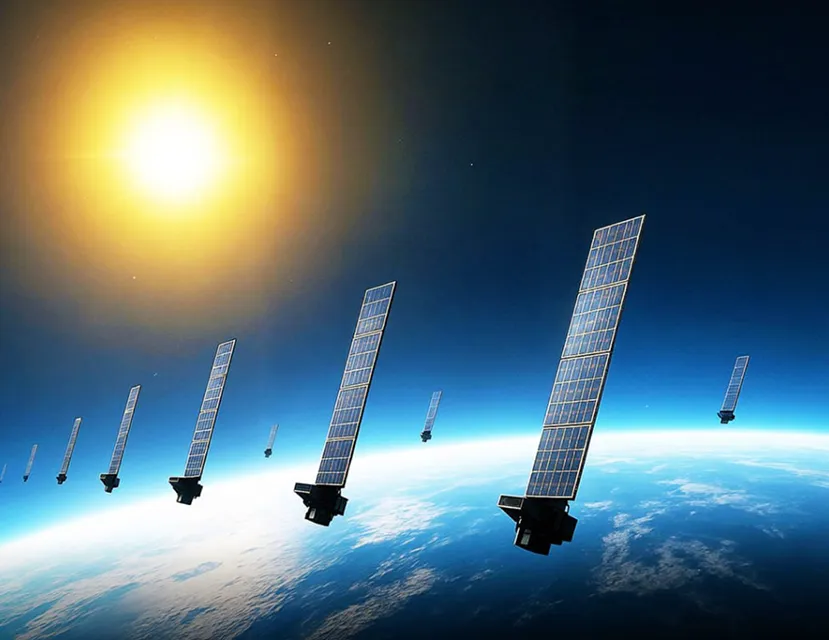
SpaceX Chief Executive Elon Musk said on September 23, 2026, that Starlink could carry the majority of global internet traffic within ten years, an ambitious forecast tied to the deployment of higher-capacity Starlink V3 satellites and proposed Starmind spacecraft combining broadband connectivity with orbital computing.
The projection would represent a fundamental change in internet infrastructure. Most international data traffic currently travels through high-capacity subsea fiber-optic cables, while satellites primarily serve remote communities, mobile users, aircraft, ships and regions where terrestrial networks are unavailable or uneconomic.
For Starlink to handle a majority of worldwide traffic, SpaceX would need to expand far beyond its current role as an access network. The constellation would have to support sustained, high-volume routing between users, gateways, satellites and terrestrial data centers while competing with the capacity, cost and reliability of fiber networks.
V3 Satellites Drive Capacity Expansion
Musk said the forecast depends on Starlink V3, the constellation’s next-generation satellite platform. SpaceX has said each V3 spacecraft is designed to provide more than 1 terabit per second of downlink capacity and over 200 gigabits per second of uplink capacity, with nearly 4 terabits per second of combined radio-frequency and optical backhaul capability.
The larger satellites incorporate more powerful phased-array antennas, expanded solar arrays and optical inter-satellite links. SpaceX claims the platform could deliver roughly 100 times more usable bandwidth than its earliest Starlink spacecraft.
Laser crosslinks allow traffic to move between satellites without immediately passing through a terrestrial gateway. This is especially valuable over oceans, polar regions and countries with limited ground infrastructure. It can also reduce the distance data travels through terrestrial networks when the orbital route is more direct.
The architecture does not eliminate the ground segment. User traffic must still enter or leave the constellation through terminals, gateways or direct connections to terrestrial networks and data centers. Spectrum availability, gateway deployment, terminal performance and local regulatory approval will therefore remain important constraints as SpaceX increases capacity.
V3 deployment also depends heavily on Starship. The satellites are substantially larger than the V2 Mini spacecraft launched aboard Falcon 9, making the greater payload volume and mass capacity of SpaceX’s next-generation launch vehicle central to deploying them at the required scale. Maintaining a high Starship launch cadence would be necessary to add capacity, replace aging satellites and expand service in high-demand markets.
Starmind Adds Computing to the Network
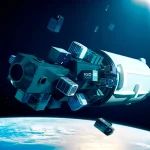
The expansion plan includes Starmind, a proposed orbital computing variant of the V3 platform. According to SpaceX’s regulatory filings, each Starmind spacecraft could have a mass of approximately 4,000 kilograms and carry high-density computing hardware alongside communications equipment.
Processing data in orbit could allow selected workloads to be handled closer to satellites, reducing the amount of raw information that must be transmitted to Earth. Potential functions include network management, traffic routing and processing data generated by other spacecraft, although the operational configuration and commercial services have not been fully detailed.
SpaceX has submitted safety and atmospheric-reentry information to the Federal Communications Commission as part of its effort to obtain authorization for the system. Regulatory review will cover issues including spectrum use, orbital debris, collision risk and spacecraft disposal.
The Starmind concept would broaden Starlink from a broadband constellation into a combined communications and computing infrastructure. However, operating high-performance computing equipment in orbit introduces additional engineering requirements, including power generation, thermal management, radiation tolerance and controlled end-of-life disposal.
Enterprise Growth Supports a Broader Market Push
Musk’s forecast comes as SpaceX expands Starlink beyond residential broadband. The company’s enterprise satellite revenue increased 108 percent year over year, according to figures cited by SpaceX, supported by corporate connectivity, aviation and maritime contracts.
These markets are well suited to low Earth orbit broadband because aircraft and ships cannot rely continuously on terrestrial fiber or cellular infrastructure. Enterprise customers can also support higher service prices than many residential users, helping finance continued satellite manufacturing, launches and ground-network expansion.
Reaching a majority share of global internet traffic would nevertheless require more than subscriber growth. SpaceX would need regulatory access across major markets, substantially greater spectrum efficiency and sufficient capacity in densely populated regions where terrestrial networks already provide inexpensive, high-throughput connections.
Musk’s ten-year projection should therefore be viewed as a long-term target rather than an established deployment forecast. The next measurable steps will be regulatory clearance for additional spacecraft, sustained production of V3 hardware and Starship’s ability to launch large batches reliably. Those milestones will determine whether Starlink remains primarily a global access network or evolves into a major backbone for internet traffic.