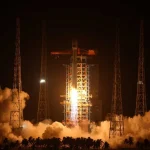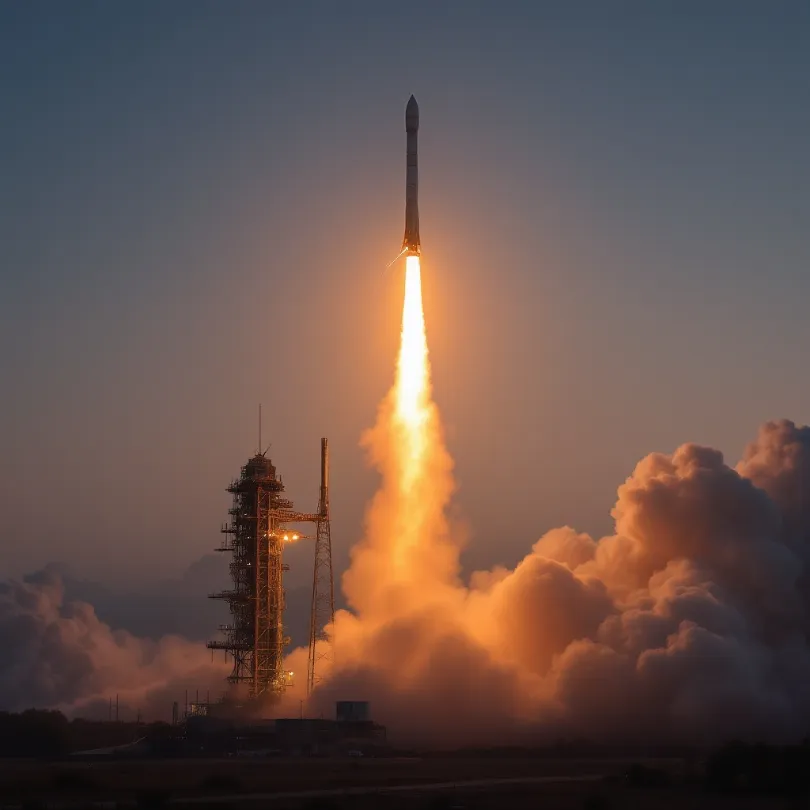
The launch, called Mission Aagaman, Sanskrit for “arrival,” lifted off at 2:35 a.m. Eastern from the Satish Dhawan Space Centre, India’s main spaceport. The liftoff was delayed by 35 minutes due to a technical issue found at the T-minus 5-minute point in the countdown. Skyroot went into the launch cautiously optimistic while acknowledging the track record of failures on first flights of new rockets.
After liftoff, the rocket closely followed its flight path, with the three solid-fuel stages performing as expected. Vikram-1 deployed a liquid-propellant kick stage, the orbit adjustment module, which fired for about six minutes to reach the target orbit. The mission carried two cubesats, one built by Skyroot and the other by another Indian startup, Grahaa Space. It also carried hosted payloads from Dcubed and Cosmoserve Space, along with miscellaneous items including postcards signed by people such as Indian Prime Minister Narendra Modi.
“We have done everything that could be done to test Vikram-1 on the ground. On July 18, we are eager to see how Vikram-1 performs in the real flight environment for the first time,” said Pawan Kumar Chandana, co-founder and chief executive of Skyroot, in a prelaunch statement. “This is our first test flight, and we will be getting valuable data from it.” After the rocket reached orbit, Chandana and co-founder Naga Bharath Daka took a call from Modi. “Absolutely no words,” Chandana said onstage.
Vikram-1 is designed to place up to 350 kilograms into low Earth orbit. An upgraded version called Vikram-1U, with strap-on boosters, will increase that payload performance to 550 kilograms. Skyroot raised $60 million in May to scale up production of the Vikram-1 rocket and develop a larger vehicle, Vikram-2.
Chandana framed the flight as a landmark for the country’s space sector. “I think this is a historic moment not just for Skyroot but also for India and the entire global space sector,” he said. “In the first attempt reaching orbit, I never thought it was possible, but the Skyroot team made it possible.” He added, “India is proud to be the fastest-growing space tech ecosystem in the world, and now we achieved one of the biggest milestones ever in India’s space sector: the first private orbital rocket reaching orbit on the very first attempt. It still feels like a dream.” Chandana praised the Indian space agency ISRO and IN-SPACe, the agency charged with promoting and authorizing commercial space activities, for their support of the launch, part of government reforms that included access to the launch site used by Vikram-1.
The company said during the launch webcast that it planned a series of test flights before beginning commercial launches but did not discuss details. Ashwin Mahavadi, senior vice president for business and strategy at Skyroot, said at the Spacetide conference earlier this month that the company planned up to two more Vikram-1 launches this year.