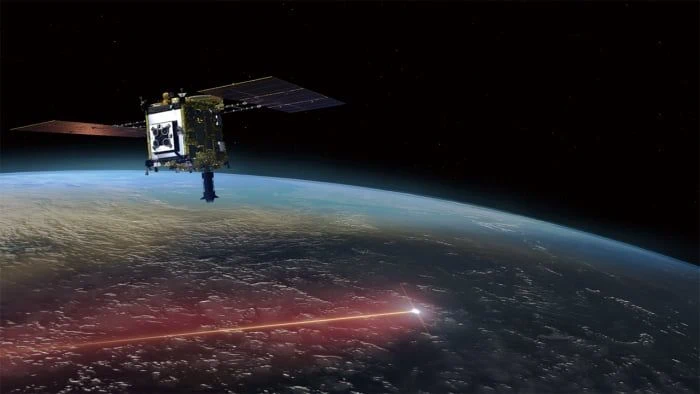
Hayabusa2’s sample return capsule has landed in Woomera, Australia, today, 5 December — or 6 December local time at Woomera. The exact landing location is now being determined, but a tweet from the mission’s official account says an estimated location of landing has been identified and teams are en route to recover it.
The craft returned not just asteroid surface material, but subsurface material (at first) as well, and will be met by Japanese scientists after completing its six-year mission to the asteroid 162173 Ryugu.
The main Hayabusa2 spacecraft meanwhile used its remaining propellant to start an extended, 11 year astronomical mission.
Spacecraft and mission profile
Hayabusa2 is a Japan Aerospace Exploration Agency (JAXA) operated mission with a dry mass of 490 kg. It launched with four small rovers, an impactor, and five target markers on 3 December 2014 on an H-IIA rocket from the Tanegashima Space Center and rendezvoused with the asteroid Ryugu on 27 June 2018.
At Ryugu, Hayabusa2 collected samples, deployed a kinetic impactor, and tried to release four small rovers onto the asteroid’s surface.
The first two rovers, HIBOU and OWL, deployed successfully on 21 September 2018. A third, Rover-2, was successful on 3 October 2018; however, the fourth failed before it was released. Nonetheless, it was still used to gather gravitational information during an intentionally destructive release from Hayabusa2 on 2 October 2019 that resulted in the rover’s crash onto Ryugu.
Space tourism guides
(adsbygoogle = window.adsbygoogle || []).push({});
Due to the low gravity on the asteroid, all three successful rovers were unable to use wheels. Instead they used a solar-powered motor to propel themselves across the surface via a series of hops, which served as a technology demonstrator for future low-gravity environments.
Sunset. It was windy today but sunny! Thanks to all your prayers, it is really sunny! We will welcome the capsule from tonight until morning!
(Collection Team M)#Hayabusa2#はやぶさ2#AsteroidExplorerHayabusa2 #HAYA2Report pic.twitter.com/HZNiyRI5fG— HAYABUSA2@JAXA (@haya2e_jaxa) December 5, 2020
The rovers were released from Hayabusa2 at altitude and allowed to free-fall to the asteroid’s surface due to the low gravity.
Likewise, the MASCOT lander featured international participation by French and German space agencies and carried an infrared spectrometer, a magnetometer, a radiometer, and a camera. It conducted 17 hours of operations (slightly longer than originally designed).
Meanwhile, the mission called for three samples to be collected: surface regolith that exhibited traits of hydrous minerals; surface regolith with either unobservable or weak evidence of aqueous alterations; and excavated sub-surface material.
Sample collection was to begin in October 2018 with surface regolith but was delayed when the deployed rovers showed large bouldered terrain and no regolith to sample. The team eventually found the regolith they needed and collected the first and only sample for the mission on 22 February 2019.
The amount of regolith collected was significant, and a subsequent collection event was deemed too risky based on the amount already aboard the craft. The team instead moved on to the kinetic impactor event for subsurface sampling.
The “Small Carry-on Impactor” was deployed on 5 April 2019 and contained a 2.5 kg copper projectile that would be shot propulsively at the surface of Ryugu to excavate material below the surface that had not been subjected to space weathering.
“We are interested in the present dynamics working on the asteroid surface, thus the sample should be recovered from the ejecta deposit in order to elucidate the dynamics. The depth of information of the recovered sample is very critical to reconstruct the sub-surface structure,” said mission scientists.
After releasing the impactor, Hayabusa2 deployed a camera to monitor the impact event, and then maneuvered itself behind the asteroid for protection.
About 40 minutes after deployment, the impactor blew its charge, sending a copper projectile towards the surface. Two weeks after the impact, to allow time for all the debris kicked up from the surface to settle back down, Hayabusa2 returned to observe the crater in detail.
After an understanding of the environment was known, mission planners directed the craft to descend to the surface and collect the now-exposed subsurface material.
See Also
- UPDATES Hayabusa2 Landing
- 60 Launch Vehicle Manuals (L2)
- Click here to Join L2
Learning from the first Hayabusa spacecraft, Hayabusa 2 carried a modified sample container seal — replacing the O-rings with an aluminum metal seal to “avoid terrestrial air contamination after the Earth return,” noted mission scientists.
Departure and capsule return
Following the sampling mission, the spacecraft departed Ryugu using its onboard ion (xenon fuel) thrusters.
The spacecraft’s three ion thrusters were used to adjust its orbit around Ryugu, perform low-energy velocity change maneuvers, and perform the burns to return the spacecraft to Earth. A fourth thruster was kept as a backup.
During the return trip to Earth, the spacecraft performed a series of Trajectory Correction Maneuvers (TCMs) leading up to TCM-3 at 3.6 million km from Earth — which placed the spacecraft on a direct intercept course with the planet.
This was further refined in TCM-4 at 1.74 million km distance to align the craft with the landing area at Woomera, Australia.
As a result of the ongoing pandemic, the team meeting the capsule arrived in Australia in November and undertook the necessary quarantine period. Once in country, the combined teams of 83 people set-up a series of ground-based antennas to locate the satellite as well as a “Quick Look Facility.”
On 5 December at 05:30 UTC (00:30 EST), the sample return capsule successfully separated from the main spacecraft.
Following the post-flight analysis of the original Hayabusa mission, the strong performance of the heatshield design for the craft has resulted in a largely unchanged design for this mission. The main improvements surround the separation sequence, onboard electronics, and a new re-entry environment measurement module to provide additional data on capsule performance.
Between 06:30 – 09:00 UTC, (01:30 – 04:00 EST), the Hayabusa2 craft itself ignited its ion engines to perform an Earth escape maneuver to continue its extended mission.
The return craft meanwhile entered the atmosphere at 17:28 UTC (12:28 EST) at an altitude of 121 km.
Parachute deployment followed at 17:32 UTC (12:32 EST).
Touchdown occurred inside a 100 km2 area closed off by the Royal Australian Air Force. Due to the inability to steer using parachutes, teams will have to locate the capsule after landing.
A beacon antenna transmitted the return capsule’s location to the team’s handheld devices. This signal was precisely determined using five deployed antennas on the ground as well as onboard a search helicopter. The team also have the ability to use radar to acquire the location, augmented by the radar reflective parachute.
Once located, a temporary cleanroom “quick look” facility will allow the scientists to perform initial, non-invasive analysis of the capsule, including checking for any gas emissions. After this is complete, the sample will be airlifted to Japan where it will undergo vacuum and nitrogen environment analysis.

As Hayabusa2 observes, the Return Capsule streaks through atmospheric entry en route to Woomera, Australia, with samples from asteroid Ryugu. (Credit: JAXA)
With the ability to collect up to 100 mg of sample material, the Hayabusa2 team plans to share some with other groups around the world. This will likely include the ongoing OSIRIS-REx team, whose own sample is due to return to Earth in 2023.
“We will exchange samples and otherwise promote scientific exchange, and expect further scientific findings through comparison and investigation of the results from both missions.”
Mission extension
The successful completion of the mission thus far has left Hayabusa2 with 66 kilograms of spare propellant.
Therefore, JAXA has planned an 11 year mission extension for the main craft. The destination is the 30 m diameter asteroid 1998 KY26 (much smaller than Ryugu). To get there, the craft will perform a series of burns and complete 6.5 orbits around the Sun.
During the period of orbit changing maneuvers to reach 1998 KY26, Hayabusa2 will have long cruise phases. JAXA will take advantage of these to perform additional science. The first will be observing zodiacal light during the change in distance from the Sun, which can be used to determine the distribution of dust in planetary space.
Secondly, the spacecraft will attempt to observe exoplanet transits across their parent stars.
In 2026, it will make a fast fly-by of asteroid 2001 CY21. As Hayabusa2 was not initially designed for such an approach, the cameras are limited — with no telephoto lens. In 2027 and 2028, two Earth flybys are planned.
Finally in 2031, 27 years after launch and 11 years after the original mission ended, the spacecraft will approach 1998 KY26. Once there, Hayabusa2 will use its imaging cameras and a remaining target marker to analyse the asteroid.