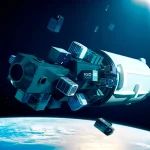
The International Space Station’s (ISS) crew grew by three members with the arrival of the Soyuz MS-29 mission on July 14. Earlier, NASA astronauts Jessica Meir and Chris Williams wrapped wrapped up critical repairs to Canadarm2 during a spacewalk. Meanwhile, the agency is accelerating plans for commercial successors to the station.
Station Arrivals and Operations
On June 30, NASA astronauts Jessica Meir and Chris Williams completed U.S. spacewalk 95. The duo spent 7 hours and 20 minutes outside the Station’s Quest airlock, with the extra vehicular activity (EVA) ending at 19:40 UTC.
Their primary objective was to repair Canadarm2, which malfunctioned during operations on May 27. Meir and Williams replaced the robotic arm’s wrist joint, which drew elevated motor current and did not move correctly. The spacewalk was Jessica Meir’s fifth and Williams’ second EVA during their respective careers, and also marked the 280th EVA in support of ISS maintenance and assembly.

NASA astronaut Chris Williams during U.S. spacewalk 95 (Credit: NASA)
The station was orbiting higher on July 1, with the Russian Progress 95 cargo vehicle firing its engines. The resupply vehicle launched from the Baikonur Cosmodrome on April 26 and is docked to the Zvezda module’s aft port. The craft fired its thrusters for nine and a half minutes to boost the station to the correct altitude for the arrival of the Russian crewed Soyuz MS-29.
The Soyuz MS-29 mission launched from Site 31/6 at the Baikonur Cosmodrome aboard a Soyuz 2.1a rocket on July 14. The vehicle carried two cosmonauts, Pyotr Dubrov and Anna Kikina, and NASA astronaut Anil Menon to the ISS. After a three-hour and five-minute journey to the station, the vehicle docked to the station’s Prichal nadir port at 17:52 UTC. At 20:30 UTC, crews opened the hatch between the Soyuz capsule and the Station, allowing the new arrivals to enter the ISS.

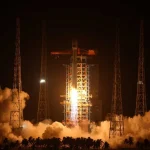
Soyuz 2.1a at the Baikonur Cosmodrome Site 36/6 (Credit: NASA)
Science and Technology Demonstrations
The International Space Station (ISS) has overseen thousands of science and technology demonstrations over its 25 years of permanent human presence. The unique conditions aboard the station allow studies not usually viable on Earth. Additionally, astronauts constantly undergo medical examinations so scientists can study the effects of spaceflight on the human body.
On June 25, NASA flight engineer Jack Hathaway worked on sequencing microbial DNA using a handheld reader in the Harmony module. The experiment aims to explore how bacteria become resistant to antibiotics in microgravity. The answers could reveal the microbe’s genomic identity and potentially reveal its adaptive mechanisms. The data from the experiment could reduce the risk of infections to astronauts during a spaceflight and could also help patients on Earth.
Meir and Hathaway worked inside the Kibo laboratory module’s Life Science Glovebox on July 6, processing cartilage cell samples to promote their growth in microgravity and observing them using a fluorescent microscope. The pair then selected samples and placed them inside a science freezer in preparation for further study on Earth. Scientists will analyze the samples to learn how to repair and regenerate injured cartilage on Earth and also develop fitness techniques for future long-duration spaceflight.

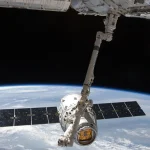
Soyuz MS-29 approaches International Space Station (Credit: NASA)
New flight engineers, Dubrov and Kikina, wore virtual reality goggles and electrodes tracking their brain signals and eye movements on July 16. The virtual experiment aims to test how a human’s sense of balance and direction adapts to microgravity.
Anil Menon also participated in a human science experiment, attaching thermo-mini-sensors to his body. During the study, the sensors track how weightlessness affects the astronaut’s body temperature and sleep patterns.
Post International Space Station Landscape
While current operations continue, NASA is planning for life after the ISS. With the decommissioning of the station expected in the coming years, the impetus is on NASA to fund one or more commercial space stations in low-Earth orbit (LEO).
After uncertainty over the future of NASA’s Commercial LEO Destinations (CLD), the agency announced a draft Request for Proposals on July 6th. NASA reaffirmed its commitment to the commercial stations strategy and is seeking feedback from American companies on the next steps.
On Monday, NASA released a draft Request for Proposals (RFP) seeking feedback from American companies on the next phase of its commercial space stations strategy, aimed at ensuring a seamless transition of activities in low Earth orbit from the International Space Station.…
— NSF – NASASpaceflight.com (@NASASpaceflight) July 6, 2026
Key CLD contenders include Axiom Space, Starlab Space, Blue Origin, and Vast, with the former expecting to launch its prototype station called Haven-1 in the first quarter of 2027.
“NASA’s review reflects what we’ve been hearing from industry throughout this process,” said NASA Administrator Jared Isaacman. “Industry believes it can meet the timelines and that a viable commercial marketplace exists where NASA is one customer among many. We are focused on supporting those efforts, enabling the capabilities that make this transition possible, and doing all we can to ensure the United States maintains a continuous human presence in low Earth orbit.”
Meanwhile, NASA and its partners will continue operating the ISS until its decommissioning, now set for 2030.
The end of July will mark the beginning of Expedition 75, with the Soyuz MS-28 crew set to leave the station on July 26. Crew-13, NASA’s upcoming commercial mission to the station, is also expected to launch in September 2026.
(Lead Image: Aurora australis over the Indian Ocean below the International Space Station at 274 miles above. Credit: NASA)
The post Soyuz MS-29 crew arrives at ISS, U.S. EVA completes Canadarm2 repairs appeared first on NASASpaceFlight.com.