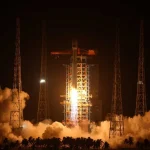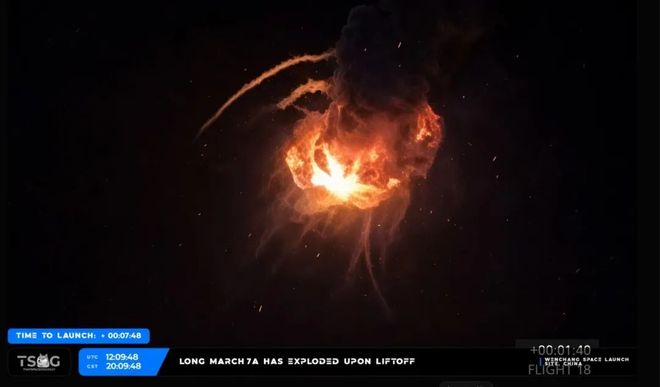
On August 10, 2026, at 20:02 Beijing Time, China launched the Zhongxing-4B communications satellite aboard a Long March 7A (Chang Zheng 7A) launch vehicle from the Wenchang Spacecraft Launch Site. However, the rocket experienced an abnormality during flight after liftoff, resulting in the failure of the launch mission.
The specific cause of the failure is currently under further investigation and analysis.
Before this mission, the Long March 7A had completed 17 launches, with 16 successes and one failure, achieving a launch success rate of 94.12%. The only previous failure occurred during the rocket’s maiden flight on March 16, 2020.
At 21:34 Beijing Time on March 16, 2020, the Long March 7A Y1 launch vehicle conducted its first flight from the Wenchang Spacecraft Launch Site. The mission failed after the rocket encountered an anomaly during flight. Subsequent investigation determined that the failure was caused by cavitation occurring at the booster oxidizer tank outlet, which may have reduced pump inlet pressure below the minimum requirement for engine operation.
The previous launch of the Long March 7A took place on July 29, 2026, at 19:50 Beijing Time, when it successfully deployed the Tianlian-3 01 satellite.
If the August 10 mission had succeeded, the Long March 7A would have reduced its shortest launch interval from 27 days to only 12 days. However, the attempt ultimately ended unsuccessfully.
Before this failure, seven Long March-series rockets had experienced launch mission failures or partial failures. They include:
- Long March 3B: five launch failures
- Long March 4C: two launch failures
- Long March 2C: two failures (including one partial success and one complete failure)
- Long March 4B: one launch failure
- Long March 5: one launch failure
- Long March 7A: one launch failure
- Long March 2D: one partial failure
The detailed failure history of these launch vehicles is as follows.
1. Long March 3B
February 15, 1996 — Long March 3B Y1
At 03:01 Beijing Time on February 15, 1996, the Long March 3B Y1 launch vehicle conducted its maiden flight from the Xichang Satellite Launch Center.
Approximately two seconds after ignition and liftoff, the rocket’s flight attitude became abnormal. About 22 seconds later, the vehicle crashed into a hillside less than two kilometers from the launch pad and exploded, destroying both the rocket and its payload.
The accident caused six fatalities and 57 injuries.
The payload was the international communications satellite Intelsat 708, and the accident temporarily affected China’s commercial launch service reputation in the international market.
After investigation, the failure was attributed to a change in the inertial reference of the rocket’s control system. The most likely failure mode was determined to be a loss of current output in the power stage of the platform servo loop stabilization circuit.
August 31, 2009 — Long March 3B Y8
At 17:28 Beijing Time on August 31, 2009, the Long March 3B Y8 launched from the Xichang Satellite Launch Center.
The first and second stages performed normally, but the third-stage engine suffered reduced thrust. As a result, the satellite was placed into an orbit lower than the planned supersynchronous transfer orbit.
The investigation concluded that the failure was caused by a malfunction in the third-stage engine subsystem. Foreign object debris blocked hydrogen injectors, resulting in localized overheating and gas leakage in the gas generator.
June 19, 2017 — Long March 3B Y28
The Long March 3B Y28 launched the Zhongxing-9A communications satellite from Xichang Satellite Launch Center.
Shortly after leaving Earth, the rocket experienced an anomaly and delivered the satellite into an incorrect orbit approximately 16,000 km above Earth, more than 20,000 km below the intended orbital altitude.
The Zhongxing-9A satellite later used its own propulsion system to gradually raise its orbit by more than 20,000 km and successfully reached its designated position at 101.4°E over the equator on the 16th day after launch.
The failure was traced to an abnormality in the roll-control thruster of the attitude-control engine during the third-stage coast phase.
April 9, 2020 — Long March 3B Y71
At 19:46 Beijing Time on April 9, 2020, the Long March 3B Y71 launched from Xichang.
The first and second stages operated normally, but the third stage malfunctioned, resulting in mission failure.
The investigation determined that the cause was the failure of an igniter on one of the third-stage engines.
January 17, 2026 — Long March 3B
At 00:55 Beijing Time on January 17, 2026, another Long March 3B mission launched from Xichang Satellite Launch Center.
The first and second stages performed normally, but an anomaly occurred during the third-stage flight phase, causing mission failure.
No final publicly released investigation results have been announced so far.
2. Long March 4C
September 1, 2016 — Long March 4C Y22
At 02:55 Beijing Time on September 1, 2016, the Long March 4C Y22 failed during launch from the Taiyuan Satellite Launch Center.
Investigation found that the failure was caused by a third-stage engine malfunction due to a welding defect. The defect caused abnormal operation during the second ignition phase, including gas ingestion and insufficient thrust.
May 23, 2019 — Long March 4C Y23
At 06:49 Beijing Time on May 23, 2019, the Long March 4C Y23 launched from Taiyuan.
The first and second stages operated normally, but the third stage malfunctioned.
The investigation identified the cause as a quality issue involving welds on the third-stage engine.
3. Long March 2C
August 18, 2011 — Long March 2C Y26
At 17:28 Beijing Time on August 18, 2011, the Long March 2C Y26 launched from the Jiuquan Satellite Launch Center.
During flight, the second stage lost attitude control, resulting in mission failure.
The investigation determined that the failure was caused by a structural failure at the connection between the second-stage auxiliary engine subsystem and the servo mechanism. The root cause was a reliability weakness in the connection design.
March 13, 2024 — Long March 2C Y67
At 20:51 Beijing Time on March 13, 2024, the Long March 2C Y67 launched the DRO-A and DRO-B spacecraft from Xichang.
The first and second stages performed normally, but the upper stage malfunctioned, preventing the spacecraft from entering the planned orbit.
The mission was considered unsuccessful.
However, through emergency orbital reconstruction operations, five orbit-control maneuvers, five trajectory corrections, and three lunar flybys, the DRO-A/B spacecraft eventually entered the planned distant retrograde orbit (DRO) after 167 days.
The two spacecraft were successfully separated.
4. Long March 4B
December 9, 2013 — Long March 4B Y10
At 11:26 Beijing Time on December 9, 2013, the Long March 4B Y10 failed during launch from Taiyuan Satellite Launch Center.
The investigation concluded that a blockage occurred in the third-stage engine, preventing it from reaching the required thrust level and causing the satellite to fail to enter orbit.
5. Long March 5
July 2, 2017 — Long March 5 Y2
At 19:23 Beijing Time on July 2, 2017, the Long March 5 Y2 launched from the Wenchang Spacecraft Launch Site.
At approximately 346 seconds after liftoff, one engine suddenly shut down while another continued operating, causing an abnormal acceleration profile and sending the rocket into a downward trajectory before it eventually fell into the ocean.
The mission failed.
Investigation determined that the cause was an abnormal structural failure in the turbine exhaust system of one of the two YF-77 liquid hydrogen/liquid oxygen engines on the first stage under complex thermal and mechanical conditions.
6. Long March 7A
March 16, 2020 — Long March 7A Y1
The Long March 7A Y1 failed during its maiden flight from Wenchang.
The investigation determined that cavitation occurred at the booster oxidizer tank outlet, possibly reducing pump inlet pressure below the engine’s minimum operating requirement.
August 10, 2026 — Long March 7A Zhongxing-4B Mission
The Long March 7A failed again during the Zhongxing-4B satellite launch mission.
The rocket experienced abnormal flight conditions shortly after liftoff.
The cause remains under investigation.
7. Long March 2D
December 28, 2016 — Long March 2D Y39
At 11:23 Beijing Time on December 28, 2016, the Long March 2D Y39 launched from Taiyuan Satellite Launch Center.
Approximately 146.7 seconds after liftoff, an auxiliary subsystem of the first-stage engine shut down prematurely.
As a result, the satellites reached an orbit with a significantly lower perigee altitude of only 210 km, with a semi-major axis deviation of 157 km.
The two Gaofen Earth observation satellites eventually reached their planned 530 km sun-synchronous orbit after multiple orbital adjustments.
However, the onboard Bayi microsatellite’s operational lifetime was reduced from the planned 180 days to approximately two months.
Note:
The Long March rocket family remains one of the world’s most frequently launched orbital rocket families. Although several variants have experienced failures throughout decades of operation, subsequent investigations have generally resulted in corrective measures and design improvements. The final cause of the latest Long March 7A failure will be determined after completion of the ongoing investigation.