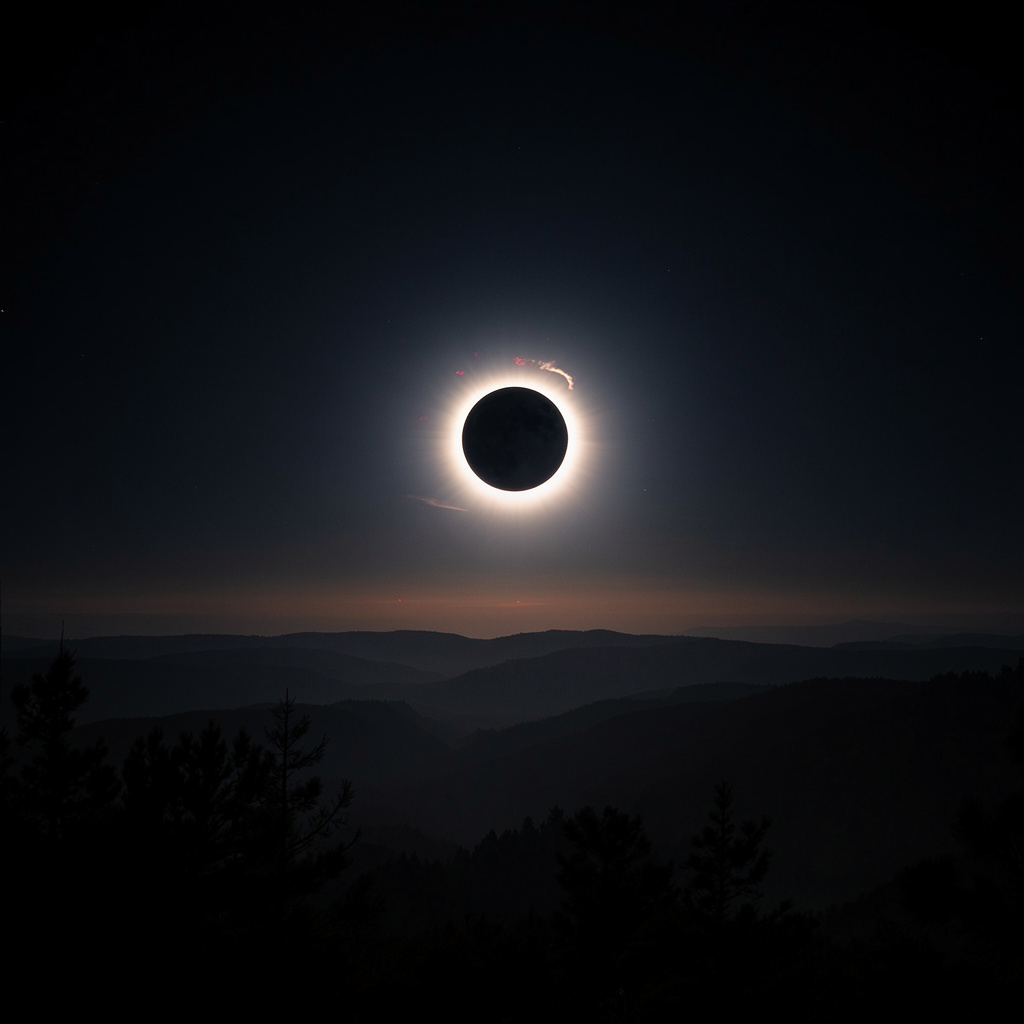
The narrow path of totality, where the Moon completely covers the Sun, will pass across Greenland, Iceland, a small part of northeastern Portugal, and then Spain. Observers elsewhere in Europe will see a partial eclipse, with the Moon appearing to take a bite out of the Sun and daylight dimming slightly. When the Sun’s surface is hidden, its faint outer atmosphere becomes visible, stars and planets can emerge, temperatures can fall, and winds may strengthen.
ESA will begin its broadcast at 19:30 CEST, hosted by space scientist and science communicator Dame Dr Maggie Aderin. Guests will include ESA Director of Science Professor Carole Mundell, ESA scientists Andy To, Miho Janvier, and Martin Hewitson, and observatory director Javier Cenarro. The coverage will explore the Sun and its corona, the famous eclipse that helped transform understanding of gravity, and ESA’s work to create artificial solar eclipses in space. The broadcast will be presented in English and is expected to finish at about 20:45 CEST.
Totality at Javalambre will occur at 20:31 CEST and last 1 minute and 21 seconds, sending the observatory into darkness. The site sits directly within the path of totality and is well suited for the event, with uncommon cloud cover, low light pollution, and a clear view toward the western horizon. That western sightline matters because the Sun will be moving toward sunset as the Moon passes in front of it. Several additional small telescopes will be brought to the observatory specifically for the eclipse to provide continuous close-up views of each stage.
ESA will not rely on Javalambre alone. Two additional live feeds will come from other locations inside the path of totality to improve the chances of capturing clear views. One feed will come from ESA’s public event in León. Another will originate in Frómista, in Palencia, where collaborator Alejandro Sánchez de Miguel will conduct observations. He is affiliated with the Institute of Astrophysics of Andalusia, the Complutense University of Madrid, and the Stars4All Foundation.
The observatory’s two main professional telescopes carry out wide-sky astronomical surveys that help scientists investigate galaxies, dark energy, and the large-scale structure of the cosmos. During the broadcast, Javier Cenarro will discuss Javalambre and explain its significance for a future ESA space science mission.
Viewers worldwide can follow the eclipse through ESA Web TV or ESA’s YouTube channel, with a dedicated telescope feed running alongside the main program. The broadcast is scheduled to run from 19:30 to 20:45 CEST on August 12, capturing the reactions of Aderin and Mundell as they witness totality.