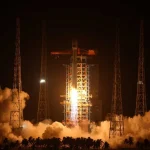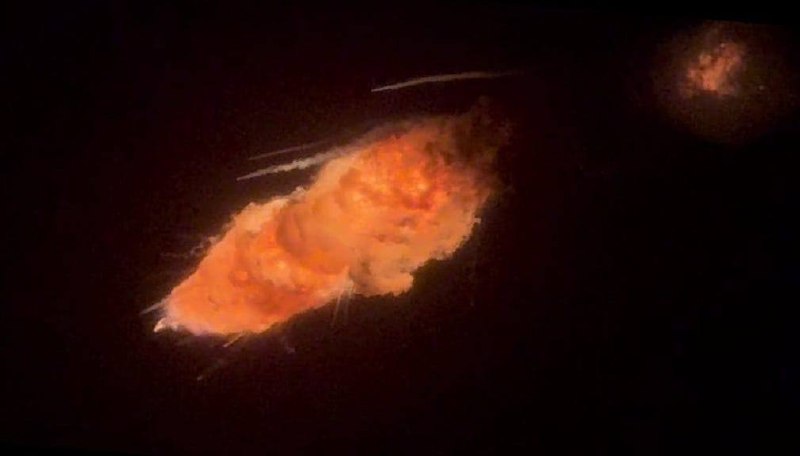
The rocket lifted off at around 8:00 a.m. Eastern (1200 UTC) from Wenchang on Hainan island, a launch window indicated in advance by airspace closure notices. It remains unknown whether the explosion resulted from an in-flight anomaly or a triggering of the flight termination system.
State broadcaster China National Radio published a brief report of the expected mission around liftoff, naming the payload as Zhongxing-4B. Low numbered Zhongxing satellites are thought to be military communications satellites. The series matches the geosynchronous orbit profile flown by the Long March 7A, which is increasingly used for such launches alongside the older, hypergolic Long March 3B.
The Long March 7A debuted in March 2020 in a mission that also ended in failure following an explosion. The launcher had since proven its reliability across a series of successful flights, most recently sending the Tianlian-3 (01) satellite toward geosynchronous orbit in late July. The rocket first stage and side boosters use YF-100 kerolox engines, which are also used on the Long March 5.
The failure was China’s 56th orbital launch attempt of 2026 and its fourth failure of the year. Previous failures involved the Long March 3B and the debut of the Ceres-2 solid rocket in January, and the loss of the debut Tianlong-3 rocket in early April.
It is not immediately clear how or if the failure will affect upcoming missions. The Long March 5, which shares the YF-100 engine, is currently scheduled to launch the Chang’e-7 robotic lunar south pole landing mission on August 24. The standard Long March 7 for low Earth orbit is used to launch cargo to the Tiangong space station roughly once every eight months, with the latest flight in May.
The second Zhuque-3 rocket is scheduled to launch later on August 10 from the commercial zone at Jiuquan, with a planned second orbital booster recovery attempt.