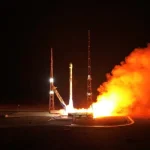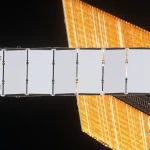
A company can manufacture satellites, launch them, and even complete the initial deployment of a constellation. But charging customers for services still requires regulatory approval. A rocket launch solves the problem of getting into space; legally providing services through a constellation involves an entirely different regulatory chain.
On August 20, 2026, China’s Ministry of Industry and Information Technology (MIIT) approved Zhejiang Geespace Technology Co., Ltd. to conduct a commercial trial of satellite Internet of Things (IoT) services for a period of two years. During the trial, Geespace may legally pilot relevant commercial services using the Geely Future Mobility Constellation (Phase I) for applications including intelligent transportation, marine fisheries, energy, and water resources management.
Many reports have summarized this development by saying that Geespace “obtained a license.” But that shorthand compresses a series of regulatory procedures into a single final permit and can create the misleading impression that every constellation faces the same licensing checklist. In reality, the required combination depends on the type of service, spectrum used, ground-station architecture, terminal equipment, and which entity is responsible for each part of the system.
The following sections examine five stages: project approval, spectrum and orbital resources, launch, operations, and equipment. Breaking down the complete business chain reveals nine identifiable categories of regulatory requirements under China’s publicly available regulatory framework. Depending on the requirement, responsibility may fall on the constellation operator, launch prime contractor, ground-network operator, or equipment manufacturer.
What Exactly Is the “Entry Ticket” Geespace Obtained?
MIIT’s announcement specifically confirms an approval for a commercial trial of satellite IoT services, valid for two years.
Under the trial rules issued in 2025, satellite IoT services provide wide-area, low-speed data connectivity for data-collection terminals, wearable devices, handheld terminals, and vehicles, ships, aircraft, and other connected objects. The primary customers are enterprises and institutions in industries such as manufacturing, transportation, energy, agriculture, and emergency response.
These services generally transmit relatively small amounts of data. Typical applications include location information, equipment status, alerts, and short-message transmission.
When vehicles leave cellular coverage, ships travel into the open ocean, or energy infrastructure is located in remote areas, satellite links can fill gaps left by terrestrial networks. The industries listed in the trial rules reflect precisely these connectivity requirements, although specific customers and products will depend on subsequent disclosures by individual companies.
Within the trial framework, companies may sign contracts with customers and activate commercial services. After approval, their regulatory assessment also covers business, operational and management support systems, as well as service quality, numbering resources, real-name registration, network and data security, and measures to prevent telecom and online fraud.
The Zhejiang Communications Administration subsequently disclosed that Geespace is the second privately owned company in China authorized to conduct this commercial trial. MIIT will evaluate the results of the trials and study the formal implementation of satellite IoT services.
Five Regulatory Layers, but Nine Types of Requirements
Investment project approval or filing, satellite network filing and coordination, radio administrative licensing, launch project licensing, telecommunications service approval, and equipment certification are legally distinct procedures.
Across a typical satellite business chain, nine categories of regulatory requirements can currently be identified:
1. Investment Project Approval or Filing
This addresses compliance for investment in and construction of the constellation. It is not a telecommunications business license.
2. Satellite Network Filing, Coordination, and Registration Maintenance
This is a filing and coordination service involving domestic review and International Telecommunication Union procedures.
3. Radio Frequency Use License
Required when relevant radio frequencies are used, subject to approved scope, duration, and technical conditions.
4. Space Radio Station License
Required for the establishment and operation of satellite space radio stations. Chinese policy allows licenses to be issued in batches under certain circumstances.
5. Civil Space Launch Project License
Managed on a launch-by-launch basis and generally applied for by the launch project’s prime contractor.
6. Commercial Trial Approval or Applicable Telecommunications Business License
The specific requirement depends on the regulatory stage of the service and the actual business being operated.
7. Ground Communications Network and Earth Station Licenses
These may apply when a company builds its own satellite communications network, gateway stations, or other earth stations, depending on station type, frequencies, and regulatory jurisdiction.
8. Telecommunications Equipment Network Access License
This may apply when terminals fall within the regulated equipment categories and connect to public telecommunications networks. The applicant may be the equipment manufacturer rather than the constellation operator.
9. Radio Transmission Equipment Type Approval
This applies when a terminal qualifies as regulated radio transmission equipment. It addresses different regulatory requirements from telecommunications network access licensing.
Of these nine categories, the first concerns project administration, while the second is a filing and coordination service. The fifth is generally handled by the launch prime contractor. Requirements seven through nine vary depending on the architecture of the ground system and terminal products.
For any individual company, the applicable requirements must therefore be determined according to which parts of the system it actually builds and operates.
Project Approval, Spectrum and Orbital Resources: Construction Compliance and Radio Resources
The commercial trial rules list project procedures among the eligibility requirements: a company’s satellite IoT constellation must comply with China’s Regulations on the Administration of Approval and Filing of Enterprise Investment Projects.
Whether a project requires formal approval or filing depends on the nature of the project and the applicable project catalogue. This stage regulates investment and construction; authorization to operate commercial services is handled separately.
Spectrum and orbital resources first enter a filing and coordination process. MIIT’s government services platform classifies satellite network filing, coordination, and registration maintenance as a filing service. Satellite operators must also be capable of fulfilling their obligations to MIIT and the International Telecommunication Union.
The process includes filing, coordination, notification, registration, and subsequent maintenance.
Once a project enters the radio administrative licensing stage, the applicable requirements must be determined according to the constellation architecture, frequencies used, and ground-station configuration.
Establishing and operating space radio stations, as well as using relevant frequencies to provide services within China, can involve both frequency-use licenses and space radio station licenses. Building a proprietary satellite communications network, gateway stations, or other earth stations may additionally require communications-network frequency or earth-station approvals. Not every project requires all of these approvals simultaneously.
A frequency-use license and a radio station license also serve different purposes. The former authorizes an applicant to use designated frequencies within specified geographic, temporal, and technical conditions. The latter authorizes the establishment and operation of a particular radio station.
MIIT guidance allows some application materials to be consolidated when applying simultaneously for satellite radio-frequency authorization and space radio station authorization, but the two approvals continue to serve separate legal functions.
For large-scale deployment of low-Earth-orbit constellations, Chinese policy allows space radio station licenses and radio-frequency use licenses to be issued in batches. Batch processing improves administrative efficiency, but filing and coordination, technical parameter verification, and interference management remain necessary.
Constellation expansion also turns radio regulation into an ongoing operational responsibility. Adding satellites, changing orbital configurations, or modifying payload parameters may require updates to network filings and amendments to licensed parameters. When frequency overlap occurs with other satellite networks, further coordination may also be required.
Operators therefore need to maintain satellite inventories and orbital and frequency parameters throughout the constellation’s operating life rather than treating spectrum regulation as a one-time procedure completed before the first launch.
Launch and Ground Systems: Different Parties Bear Different Responsibilities
Putting satellites into outer space also involves licensing for civil space launch projects.
Under China’s current publicly available rules, licenses are issued for individual launch projects and automatically expire once the project is completed. The applicant is generally the project’s prime contractor. If there is no domestic prime contractor, the final owner of the satellite or other spacecraft applies for the license.
When a constellation operator purchases launch services, launch licensing therefore generally follows the individual launch project and the allocation of responsibilities under the prime contract.
Once satellites reach orbit, the ground system is regulated according to how it is actually constructed and operated.
MIIT guidelines require relevant approvals when satellite communications networks are established or satellite earth stations are installed and operated within China, depending on station type and regulatory jurisdiction. A satellite communications network used to provide telecommunications services must also hold the corresponding telecommunications business authorization.
Gateway stations aggregate and transfer traffic between satellite links and terrestrial business systems, while telemetry, tracking and command stations handle satellite tracking, telemetry, and command links. The two serve different purposes.
If a company leases third-party facilities, station licensing and routine operation may be handled by the facility operator. The constellation operator, however, remains responsible for its own network, services, and data security.
Who builds the station, who owns the equipment, and who operates the links can therefore directly affect application documentation and subsequent regulatory responsibilities.
The licensing authority also varies according to station type. Public guidelines indicate that fixed-site radio stations are generally licensed by the relevant local radio administration authority, while major facilities such as space radio stations, satellite gateway stations, and satellite telemetry, tracking and command stations are licensed by the national radio administration authority.
The number, location, and purpose of ground stations can therefore all affect the regulatory pathway.
Operations and Equipment: Business Authorization Must Match the Actual Product
China’s Telecommunications Business Classification Catalogue classifies satellite mobile communications and satellite fixed communications as Category I satellite communications services. Category II satellite communications services separately include satellite transponder leasing and sales, as well as domestic very-small-aperture-terminal communications services.
The business license ultimately required by a company therefore depends on its actual services, customer base, and network architecture.
China’s 2025 policy guidance called for commercial trials of satellite IoT services, research into establishing new categories of satellite communications services, and further opening the sector to different types of market participants.
Geespace’s latest approval falls under the satellite IoT commercial trial framework.
For terminal equipment, two regulatory systems need to be distinguished.
Telecommunications equipment network access licensing applies to equipment covered by the network access licensing regime that needs to connect to public telecommunications networks. The satellite IoT trial rules also require companies to connect and use telecommunications equipment that has obtained the necessary network access authorization.
Radio transmission equipment type approval, meanwhile, assesses radio transmission parameters such as operating frequencies and power levels under China’s radio administration rules.
When the same terminal falls within the scope of both regulatory regimes, separate approvals may be required. The exact requirements depend on the device’s functions, network connectivity, radio transmission capabilities, and the applicable regulatory catalogue.
The applicant or certificate holder may be the terminal manufacturer, importer, or another responsible entity rather than the constellation operator. The operator is responsible for ensuring that equipment connected to and used on its network is compliant.
In an actual supply chain, terminals may be designed and manufactured by equipment companies, purchased by automakers, marine equipment suppliers, or industry systems integrators, and ultimately connected to the satellite operator’s network.
Network access licensing and radio type approval therefore follow the equipment and the party responsible for its compliance, while business authorization follows the network operation itself.
The two regulatory tracks converge when the product reaches customers: operators need to maintain lists of approved equipment connected to their networks, while manufacturers must ensure that mass-produced devices remain consistent with the models that received regulatory approval.
After the Licenses Come the Real Test: The Business Model
The approval allows Geespace to enter the stage of compliant commercial trial operations.
Under the commercial trial regime, participating companies must submit annual summaries of their trial activities. Regulators will also evaluate service quality, security management, and whether the business model and regulatory framework can be replicated more broadly.
Customer numbers, revenue, and network availability, however, will ultimately have to be demonstrated through actual operating data.
Satellite IoT also has its own measures of commercial viability. Unlike broadband satellite services, it is not primarily about peak data rates. More important metrics include connectivity in poorly covered areas, terminal power consumption, message delivery rates, and long-term cost of use.
Revenue generated by an individual terminal may be relatively small. Achieving economies of scale therefore depends on the number of connected devices, renewal rates among enterprise customers, and whether the platform can integrate with existing management systems for vehicles, ships, and industrial equipment.
Several indicators will be particularly useful to watch going forward: when commercial services actually become available, whether customers pay independently for the service, terminal models and pricing, network coverage, latency and connection success rates, and how the regulatory framework evolves after the two-year trial period.
International expansion presents another layer of complexity. Market access, spectrum authorization, ground stations, terminal certification, data rules, and security requirements must be assessed separately in each overseas market. Signing a partnership agreement or achieving signal coverage only indicates that a project has reached that particular stage; neither alone constitutes authorization to operate commercially.
For international customers, navigating these regulatory requirements is only one part of turning a satellite project into an operational service. China’s increasingly industrialized space supply chain now offers access to satellites, payloads, launch services, ground systems, and integrated solutions at highly competitive costs. If you are planning a satellite constellation or looking to source space products and services from China, contact STARPATH GLOBAL to discuss your project requirements and potential solutions.
References
[1] Ministry of Industry and Information Technology: MIIT Approves Zhejiang Geespace Technology Co., Ltd. to Conduct Commercial Trials of Satellite IoT Services, August 20, 2026.
[2] Ministry of Industry and Information Technology: Notice on Organizing Commercial Trials of Satellite Internet of Things Services, MIIT Information and Communications Letter [2025] No. 307, November 25, 2025.
[3] Zhejiang Communications Administration: Promoting the Approval of Zhejiang Geespace Technology Co., Ltd.’s Commercial Trial of Satellite IoT Services, August 24, 2026.
[4] Ministry of Industry and Information Technology: Guiding Opinions on Optimizing Market Access and Promoting the Development of the Satellite Communications Industry, MIIT Information and Communications [2025] No. 180, August 27, 2025.
[5] State Council: Regulations on the Administration of Approval and Filing of Enterprise Investment Projects, State Council Order No. 673, promulgated November 30, 2016.
[6] MIIT Government Services Platform: Satellite Network Filing, Coordination, and Registration Maintenance, accessed August 27, 2026.
[7] MIIT Radio Administration Bureau: Updated Administrative Licensing Application Guidelines for Terrestrial and Space Radio Services, January 2, 2024.
[8] Ministry of Industry and Information Technology: Guidelines for Approval of the Establishment and Use of Space Radio Stations, accessed August 27, 2026.
[9] China National Space Administration: Interim Measures for the Administration of Civil Space Launch Project Licenses, promulgated November 21, 2002; State Administration of Science, Technology and Industry for National Defense: Notice on Strengthening the Administration of Civil Space Launch Project Licenses, issued March 6, 2023.
[10] Ministry of Industry and Information Technology: Guidelines for Approval of the Establishment of Satellite Communications Networks and the Establishment and Use of Satellite Earth Stations, accessed August 27, 2026.
[11] Ministry of Industry and Information Technology: Telecommunications Business Classification Catalogue (2015 Edition).
[12] Ministry of Industry and Information Technology: Announcement on Reform Measures for the Telecommunications Equipment Network Access Licensing System, MIIT Information and Communications Letter [2023] No. 14, February 6, 2023.
[13] MIIT Government Services Platform: Guidelines for Radio Transmission Equipment Type Approval, accessed August 27, 2026.